
How did people get around Toronto during the World Cup? Here's what the data shows
How did people get around Toronto during the World Cup? Here's what the data shows
More people cycled, walked, used public transit: data
FIFA World Cup traffic fears didn't materialize. Will Toronto learn from it?
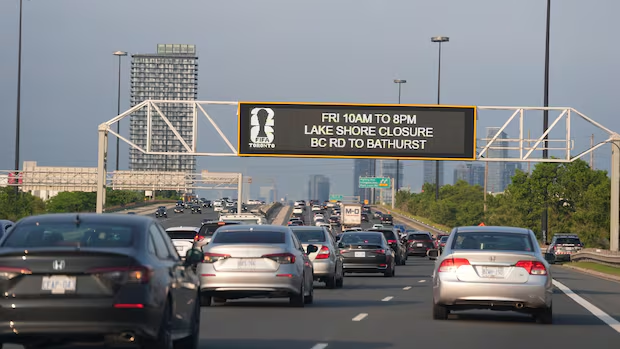
More people took up walking, cycling and transit to get around the city when it hosted the 2026 World Cup, data obtained by CBC News from the city, TTC and Bike Share shows.
Toronto’s hosting duties for the tournament kicked off on June 12 with a game between Canada and Bosnia-Herzegovina and ended on July 2 with a game between Portugal and Croatia.
On the first match day, data from the city shows that pedestrian activity around Toronto Stadium increased by 130 per cent, and cycling activity went up by 65 per cent, when compared to the previous four weeks.
The city shared data for two other match days with CBC News:
Traffic volume on expressways was also 10 to 30 per cent lower than normal on those three match days, according to city data.
It's not clear how traffic data from the World Cup compares to other major events the city has hosted, such as the 2015 Pan Am Games or the Jays' World Series playoffs last year. CBC Toronto has requested that data from the city.
Fans united by 'love of the game' as Canada, Bosnia-Herzegovina draw 1-1 in first-ever Toronto World Cup match
Still, Michael Longfield, executive director of Cycle Toronto, said the numbers point to a success.
“When the city takes a coordinated approach and really prioritizes a multi-modal approach to transportation, we can keep people moving,” he said.
The challenge will be making sure these successes become a “new normal” for the city, said Longfield.
Toronto reveals mobility strategy ahead of the FIFA World Cup
Public transit use spiked on all 6 match days: TTC data
TTC shared data with CBC News for all six match days, and it showed a similar trend to the city data.
For example, Toronto’s June 12 opening match saw just over 200,000 trips taken on routes servicing FIFA Fan Fest, such as King, Bathurst and Dufferin. That’s up from just over 137,000 trips taken that same day last year.
“We’re thrilled that on match days we saw a real spike in transit use,” said Josh Colle, chief strategy and customer experience officer with the TTC.
“The plan was always to make sure we had capacity to allow for World Cup visitors but also for people who want to just go to work that day or go to school,” he said.
“It’s a bit of proof of concept there for what really excellent transit in the city could and should look like.”
TTC to add service, express shuttles, later trains to get fans to and from World Cup games
Bike share use mostly up for total duration of World Cup
While both TTC and city data point to big increases in cycling, pedestrian and transit use on match days, Bike Share data shows that during Toronto’s stint as World Cup host, its overall usage increased between June 12 and July 2 when compared to the same timeframe last year.
That usage spiked even higher on match days, except for the Ghana-Panama patch on June 17.
Nichole Jankowski, spokesperson for the city, said that for every match day in Toronto, around 2,000 rides were handled through Bike Share’s valet locations around Toronto Stadium. At valet locations, Bike Share staff help users dock their bike or find an available bike to use.
Eric Miller, a professor specializing in transportation engineering at the University of Toronto, said the city’s overall transit plan for the World Cup “came off fairly smoothly.”
“I think it demonstrates the capability and capacity of the transportation departments and the transit to accommodate these sorts of big special events,” he said.
“Let’s try to carry forward some of the things we learned about how to move people in the city a little bit better so it happens every day, not just for special events.”
Alina Snisarenko is a Toronto-based journalist. She currently works as a digital writer for CBC Toronto and has previously worked as an associate producer with CBC Radio's Metro Morning. You can reach her with story ideas or tips at alina.snisarenko@cbc.ca.
Related Stories
 Canada
Canada 911 Ride Foundation wraps up 21st annual Ontario Ride
31 minutes ago
 Canada
Will businesses pass along the extra tariff costs to consumers? Here’s what experts say.
31 minutes ago
 Canada
U.S. trade demands aimed to reduce Canada to ’51st state,’ B.C. premier says
31 minutes ago
 Canada
U.S. politicians condemn Trump’s 'chaotic' trade war against Canada
32 minutes ago
 Canada
U.S. politicians condemn Trump’s ‘chaotic’ trade war against Canada
1 hour ago
 Canada
Trump says Canada ’wants the benefits’ of being a U.S. state ’without being one’ as trade dispute deepens
1 hour ago
 Canada
French-language, Quebec culture, non
2 hours ago
 Canada
Eastern Canada premiers renew buy Canadian calls as U.S. trade war ramps up
2 hours ago