
How extreme weather makes life more expensive for Canadians
How extreme weather makes life more expensive for Canadians
Catastrophic events 'a dominant force shaping insurance market': StatsCan
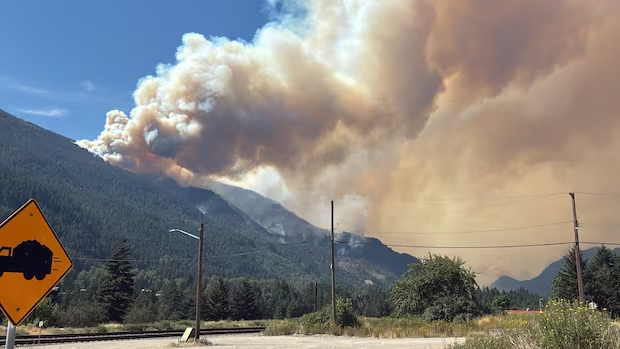
Wildfires in B.C. and the Northwest Territories. Floods in Manitoba. Heat waves in Eastern Canada. And it's only early July.
Such events are devastating for the people and communities affected. They're also increasingly hitting Canadians in the wallet, according to a recent report from Statistics Canada.
What's behind all the wild weather in Canada this summer?
Heat wave hits central Canada, as western provinces grapple with floods
Rising insurance premiums are increasingly driven by extreme weather like floods and fires, StatsCan analysts found.
"We have a new weather reality in this country where we're seeing hotter, drier summers, warmer, wetter winters, and that's bringing more extreme wildfires and more intense flooding," said Aaron Sutherland, Pacific vice-president of the Insurance Bureau of Canada.
These events are exacerbated by climate change, the report added.
While Canada's insurers used to pay out a few hundred million dollars annually in insurance claims for things like storms, wildfires and floods, "in the past few years that has ballooned to being over $2 billion … every year and just a couple years ago it nearly hit $10 billion. And so that is putting pressure on premiums from coast to coast," he said.
Homeowners pay these premiums both directly to insurance companies and also sometimes through condo fees. Renters pay indirectly when landlords are hit with increased premiums.
Between December 2019 and December 2025, premiums for home and mortgage insurance increased 45 per cent, more than twice as much as the all-items Consumer Price Index, which increased 21 per cent over the same period, the report found.
And while house insurance premiums have typically outpaced overall inflation due to increasing construction costs and housing prices, the reasons for that are changing, the report said.
"The composition of cost factors has shifted meaningfully over time, with extreme weather now one of the dominant forces reshaping Canada's home insurance market."
Alberta the 'catastrophe capital'
At no time was this more true than 2024, when catastrophic weather claims in Canada hit their highest level to date, at $8.6 billion. It was also the hottest year on record, both in Canada and globally.
Four events that year, three of which occurred within 30 days, cost insurers more than $7 billion, according to the StatsCan report:
"Eight of the top ten most costly weather events have occurred since 2013," the report said.
The second-costliest year for extreme weather claims was 2016, largely due to the Fort McMurray wildfire.
Alberta's prevalence on the list of costliest extreme weather events is one reason home and mortgage insurance have increased there more than any other province. Some insurers in the province were not profitable in 2024, the report notes.
"Alberta has been sort of the catastrophe capital of this country for several years going now," Sutherland said.
Over the past five years, increasingly frequent and severe flooding has been a primary driver of insured losses, the StatsCan report said.
"Flooding is the most frequent and costly natural disaster in the country, and recent events have contributed to sustained upward pressure on home insurance premiums," the report said.
These include floods associated with the 2021 atmospheric river in B.C. and heavy flooding in Central and Eastern Canada in 2024. Insurers paid out $9 billion for flood damages over the last 10 years, nearly half of which was in 2024 alone.
The costs outlined in the StatsCan report are those paid out by insurers. Uninsured losses, which include damage to municipal infrastructure, are typically higher and covered by various levels of government – largely through the federal Disaster Financial Assistance Arrangements Program. This means the costs are ultimately borne by taxpayers.
Provincial and territorial governments apply to the program to access funds following natural disasters, and it has paid out more than $14 billion since its inception in 1970, according to the Parliamentary Budget Officer.
That office predicts the cost of the program will climb from a yearly average of $881 million between 2010 and 2024 to $1.8 billion per year from 2025-2034.
The good news for consumers is that 2025 provided some relief in the form of less extreme weather across the country.
Home insurance is also more affordable relative to previous years due to what Sutherland called "a really healthy competitive marketplace" with many options.
But he predicts more years like 2024 going forward due to changing weather patterns, and says adaptation is key to keeping costs in line.
"For things like flood … it's not super exciting. Not a lot of people want to do a ribbon-cutting over a new storm sewer, but the unfortunate reality is that our municipal infrastructure is getting woefully out of date and isn't equipped to deal with the amount of rainfall we're having."
Starting in April 2025, federal disaster assistance funding increased to 90 per cent of disaster mitigation costs in high-risk areas of provinces and 100 per cent in the territories, according to Public Safety Canada.
Sutherland said he hopes this incentivizes provinces and regions to build for the future.
"That is critical because ... when it comes to flood, wildfire, simply rebuilding with the same materials and the same design that just got overwhelmed doesn't make any sense."
Tara Carman is a senior reporter with CBC British Columbia. She has been a journalist in Vancouver since 2007 and previously worked in Victoria, Geneva and Ottawa. You can reach her at tara.carman@cbc.ca
Related Stories
 Canada
Hundreds of firefighters battle California wildfires
16 minutes ago
 Canada
Fort Chipewyan leaders criticize Elections Alberta over advance voting delays for referendum
16 minutes ago
 Canada
Why the Katie Zacharia debacle is a huge embarrassment for Trump and his White House
1 hour ago
 Canada
Overnight major road closure for resurfacing work
1 hour ago
 Canada
U.S. tax breaks decimate Canada’s horseracing industry
1 hour ago
 Canada
Record fall warmth sends the mercury climbing in B.C.
2 hours ago
 Canada
Pro
2 hours ago
 Canada
Alberta referendum expected to bring finality, but also more questions on separation
2 hours ago