
How Mounties in Alberta and B.C. are using AI to write reports
How Mounties in Alberta and B.C. are using AI to write reports
Legal experts warn of accuracy risks and court delays
Mounties are testing a program that could eventually see criminal defendants battle a new opponent in court — artificial intelligence.
RCMP say AI is being used to write police reports on everything from traffic tickets to serious offences — except major crimes including murder — in Alberta and British Columbia detachments in a pilot project.
Developer Axon calls its program Draft One.
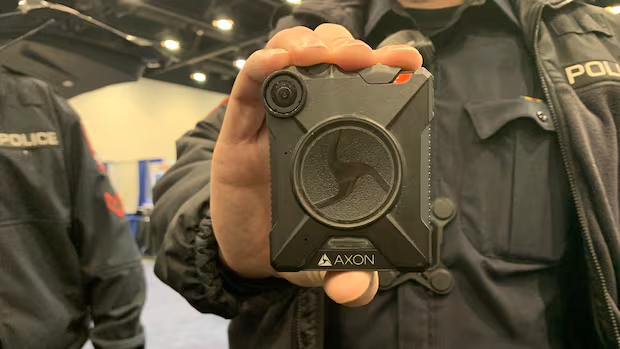
It works this way: officers are equipped with body-worn cameras, which record their interactions in the field.
AI then converts audio from the footage into written reports that officers check over for errors. The program requires police to change at least 10 per cent of what's produced.
Obvious errors are sprinkled throughout the report, Axon says on its website, to ensure edits are made. The user is prompted to sign off on the final copy.
The report can be used in court.
The program is powered by the same model used by OpenAI's ChatGPT. But RCMP say Draft One turns down the dial on creativity to reduce factual errors known as hallucinations.
The pilot ends in August, and Mounties say the results will be reviewed to determine if it's worth keeping.
"Using Draft One is not intended to free police officers from administrative burden or remove the need to write reports entirely," RCMP spokeswoman Marie-Eve Breton said in an email.
"We are piloting this software to determine if using it can decrease the time and resources needed to create reports."
Draft One is also being used by some U.S. police departments. The Calgary Police Service also recently announced it's testing a real-time translation service developed by Axon.
The company says on its website that officers typically spend 40 per cent of their time putting together reports, and Draft One has been helpful.
"This just saved me hours," says a Draft One user in a video on the website.
"Dang, this thing is nuts!" says another.
No incident report written by Draft One in Western Canada has made it into a courtroom yet, Breton said.
But when it does, it'll include a disclosure at the top saying that it was produced by AI and the officer behind it can testify to its accuracy.
Breton added the reports don't replace officers' notes used to aid their memories in court.
AI risks missing nuance, slowing justice system: experts
Two experts say Draft One may make policing more efficient but could complicate every other legal step that follows.
"This is herculean," said Calgary-based criminal defence lawyer Jillian Williamson.
"I have several concerns. And to be clear, I don't think we can stop this. The legal system has to adapt to the reality of AI being utilized."
Williamson said lawyers, judges, suspects and victims rely on police reports to bring justice. They're used in bail hearings, trials, civil lawsuits and insurance claims.
"Bail is a critical, critical part of the criminal-justice process.... (Police reports are) the main thing (Crown prosecutors) read in determining if they have a position on bail," she said.
Once the AI reports make it to court, they'll likely transform proceedings and cross-examinations.
"It's going to slow the system down," Williamson said. "Defence lawyers are going to want to know what parts were created by the officer and what parts were created by the AI system."
A competent lawyer would also go through body-camera footage to ensure it aligns with the AI-generated report, she said.
Angela Lee, a professor in the University of Alberta's faculty of law, said there are also concerns about accuracy.
Studies have shown even advanced AI transcription can't accurately pick up what's said in an audio recording, said Lee.
"We're talking about things like people with accents, or people using slang, people talking over each other. There's a risk that there's going to be a lot of nuance that's lost or not accurately captured."
There are also concerns about memory contamination.
"If AI is the one that has control over the narrative at the outset, the officer's own recollection or memory of the event can be subtly altered to match what the AI has already provided instead of actually reflecting the officer's true account."
Lee said the program also doesn't guarantee efficiency.
"We are finding ourselves in this productivity paradox where, yes, it can shave maybe 30 minutes off of the time that an officer would spend drafting this report," she said. "But then they need to spend 20 minutes parsing through the draft."
Officers already find it difficult to juggle their duties and write police reports, and now they're being asked to be editors, said Lee.
"Reviewing or editing something is different than just drafting it from scratch, especially when we're talking about something that is based in memory, which is already quite fallible and not necessarily entirely neutral or objective," she said.
Williamson said the requirement that officers change at least 10 per cent of a report is bizarre. "Where did they come up with that number?"
Draft One can have severe consequences, added Lee.
"When there are errors in police reports, that can be extremely serious and can really fundamentally alter the outcome of criminal prosecutions," she said.
"There is this trust deficit when it comes to policing in Canada right now, and layering AI on top of that is only going to make matters not necessarily better."
Related Stories
 AI News
Seattle startup hub puts its AI founders up for hire
39 minutes ago
 AI News
In the presence of Khaled bin Mohamed bin Zayed, Tahnoon bin Zayed chairs meeting of Artificial Intelligence and Advanced Technology Council
40 minutes ago
 AI News
How you can prepare for AI in the workforce
40 minutes ago
 AI News
Google’s bug bounty pause highlights growing AI vulnerability triage challenge
40 minutes ago
 AI News
Abu Dhabi's Artificial Intelligence and Advanced Technology Council meets to review AI progress
40 minutes ago
 AI News
Can Rising AI Demand Drive Growth for ASML's Advanced Technologies?
1 hour ago
 AI News
ServiceNow takes aim at enterprise AI’s workflow bottleneck with AI Workflow Factory
1 hour ago
 AI News
Is regulation enough to stop AI systems killing us all? | Letters
1 hour ago