
How startup tash is building infrastructure to invest in trading cards
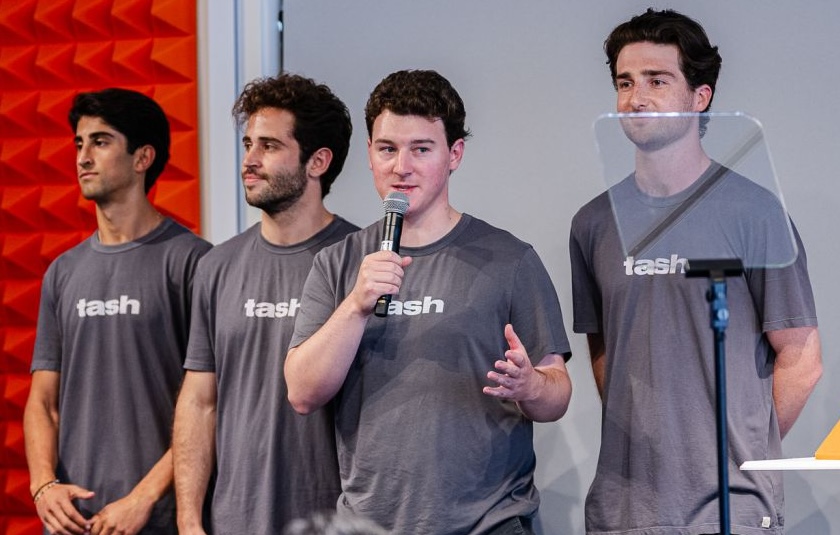
Tash is building portfolios of investment-grade trading cards—indexes that people can invest in.
Long before Victor Shammas, BS 26, and Nico Sharma, BS/BA 26, started thinking about trading cards as an asset class, they were collecting for the joy of it. It wasn’t until years later, as Haas undergraduates, that they saw a business opportunity.
By then, trading cards had matured into a $15 to $50 billion market—depending on whether you include retail card sales and games only or the wider secondary market of services and grading. The students discovered that the infrastructure for investing in trading cards wasn’t included in those estimates.
To bridge that gap, Shammas and Sharma, along with UC Berkeley co-founders John Ohanessian and Nathan Borshell started tash, an investment platform for trading cards. The startup’s name is a nod to taash—meaning “cards” in Hindi/Urdu—says Sharma, who was partial to collecting soccer cards.
Cards are one of the few collectible categories where scarcity can be measured, the founders said. Grading companies’ population reports show how many copies of a particular card have been graded, while transaction histories provide the data on what those cards have sold for.
But investing in cards remains largely inaccessible to people without the capital, expertise, or time to build a collection themselves. Investors must research and price cards, authenticate purchases, arrange storage and insurance, track their value, and eventually find buyers when they want to sell. Tash is building the infrastructure to simplify this process.
“We’re building portfolios of investment-grade trading cards—indexes people can invest in,” Sharma explained. “Instead of buying one card yourself, you can invest in a diversified portfolio of high-end cards.”
For now, tash is targeting accredited investors who may not have the time or expertise to build their own portfolios. The company is also working toward becoming SEC-regulated, which the founders hope will allow them to reach retail investors who want exposure to the market without having to invest large amounts in individual cards.
“Our main vision is to make investing in trading cards as intuitive as investing in an ETF would be,” Shammas said.
Tash is graining traction. The startup was accepted into the prestigious Summer 2026 Y Combinator accelerator program and also raised a pre-seed round, which Shammas said gave the team the resources to commit to building the company full time.
Shammas and Sharma also credit their Haas experience with helping them reach that milestone. They pointed to professional faculty members Jonathan Heyne and Bill Fanning, whose respective startup and growth marketing courses connected them with venture capitalists and experienced marketing executives.
Further down the line, they see an opportunity to bring trading cards into institutional portfolios, making the asset class more accessible to wealth managers and other professional investors.
“Our way of thinking about this is, ‘Let’s not flip cards anymore, we’ve done enough of that,’” Shammas said. “Let’s actually treat this as an asset class and prove that our thesis is right.”
Related Stories
 Stocks & Markets
Marvell Technology, Semtech, Lattice Semiconductor, and Micron Stocks Trade Down, What You Need To Know
1 hour ago
 Stocks & Markets
Warren Buffett's Top Advice for Investors Bracing for a Market Crash
18 hours ago
 Stocks & Markets
Tokyo startup to broker trades of unlisted Japan stocks in US, UK
1 day ago
 Stocks & Markets
ETMarkets NRI Talk| Want to invest in US IPOs? Ankita Pathak on what Indian investors need to know
1 day ago
 Stocks & Markets
AMD, Dell, HPE lead tech stocks with top momentum scores
4 days ago
 Stocks & Markets
Taiwan Stocks Hit Record High as Tech Stocks Rally
5 days ago
 Stocks & Markets
STI Stock Pops As Insiders Buy And Board Tightens Governance
5 days ago
 Stocks & Markets
A Chinese company offering data services starts trading in the U.S. Ruihe Data enters a regulated market.
6 days ago