
How the Tenth Schedule is reshaping India's coalition politics ahead of monsoon session
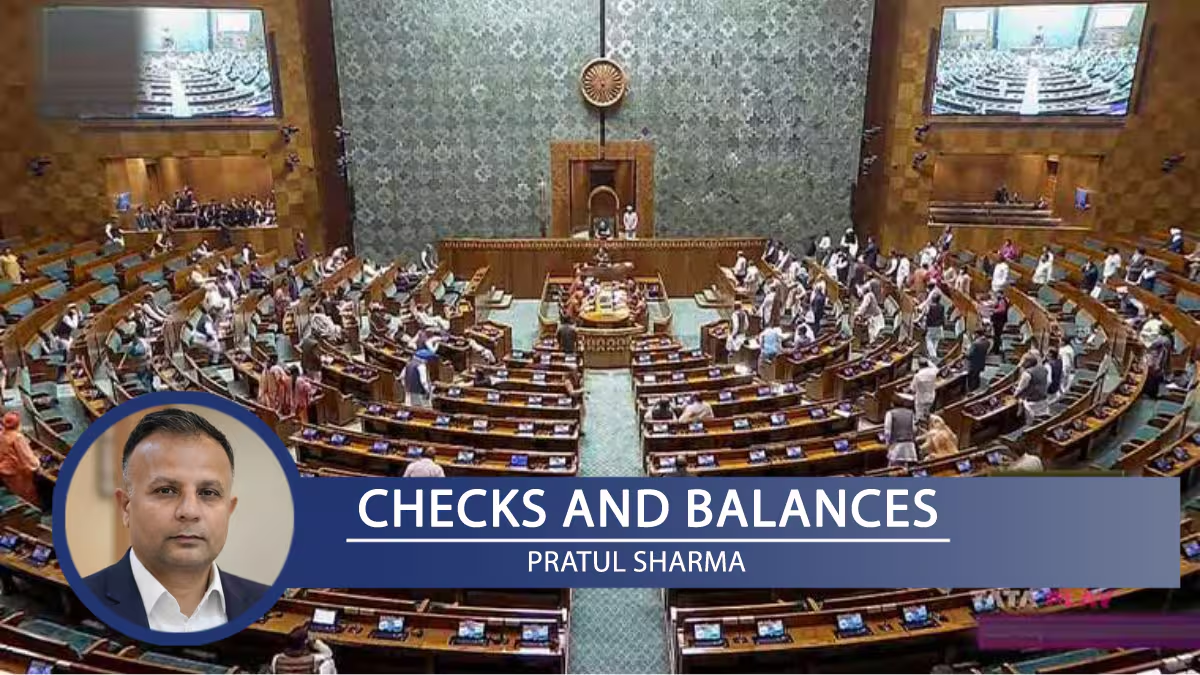
When Parliament's monsoon session begins in July, the seating arrangement would reflect how quickly politics can change. MPs who sat together a few weeks ago may now find themselves on opposite sides of the aisle. Others could discover they are in the same camp for reasons that have little to do with ideology.
Three developments have driven this churn. Seven of AAP's 10 Rajya Sabha MPs, led by Raghav Chadha, have merged with the BJP, invoking the two-thirds provision to avoid disqualification under the anti-defection law. Twenty of the TMC's 28 Lok Sabha MPs have broken away and merged with the Nationalist Citizens Party of India (NCPI), a previously unknown entity. In Maharashtra, six of Shiv Sena (UBT)'s nine Lok Sabha MPs are moving towards Eknath Shinde's faction, though that process is still being contested.
The numbers have altered the balance within the NDA. The NCPI has suddenly become one of the larger constituents of the alliance, ahead of both the TDP and the JD(U). If the Shiv Sena (UBT) MPs formally join Shinde's camp, that group too will move up the rankings among NDA partners. The TDP and JD(U), both of which played a key role in helping Narendra Modi run a comfortable third term, now find their relative strength reduced, not because of an election result, but because of shifts within other parties. That said, Chandrababu Naidu and Nitish Kumar continue to carry political weight that goes well beyond the current parliamentary numbers of their parties in the NDA.
It is worth examining what has actually changed. The NCPI's new importance comes entirely from the MPs who have joined it. It has not acquired a new vote base or organisational network overnight. The TMC rebels have indicated that they intend to challenge the Trinamool's claim to represent the party in Parliament. It would be for the Speaker to decide the matter.
The common thread in all three cases is the merger provision in the Tenth Schedule. The law protects legislators from disqualification if at least two-thirds of a legislature party move together. Though, designed as an exception to the anti-defection law, it has increasingly become a route for large-scale political realignment, unmatched in scale in recent times.
The swelling NDA numbers may help the government in getting its biggest legislations like delimitation, and even One Nation, One Election pass the test.
While NDA numbers points to BJP’s dominance, at the same time, there is speculation that some opposition parties, such as NCP (SP) and the TMC, could move closer to the Congress, or even consider mergers, as electoral contests become increasingly polarised. If that gathers pace, Indian politics may move further towards two broad blocs: the BJP-led NDA and a Congress-centred opposition.
The larger question is what such a shift would mean. Since the 1990s, regional parties have played an important role in representing local interests, caste groups and regional aspirations. Their weakening could produce a more straightforward contest between two national formations. But, as many regional leaders argue, it could also reduce the diversity of voices that have shaped coalition-era politics.
During the 2024 polls, the BJP's push for securing more than 400 seats fell short, as it centred on single-party dominance. Now, with breakaway factions joining the alliance, a similar challenge may arise. The difference is that if these parties continue to contest elections as part of an alliance and seat-sharing arrangements remain in place, some diversity of political representation may still be preserved.
The monsoon session may settle some immediate questions about recognition and parliamentary strength, but the broader issue of political loyalties will remain.
Given the fluid nature of political alliances, however, more changes can be expected in the run-up to the 2029 polls. Each one also sending a confusing signal to the electorate.
Related Stories
 AI News
Kate reflects on Italy tour in essay, as new pictures released
16 minutes ago
 AI News
9 people remain in critical condition after fatal train collision in U.K.
16 minutes ago
 AI News
Italy PM Meloni ‘stunned’ by Trump’s claims she begged him for a photo
16 minutes ago
 AI News
Chapel opens for first of new memorial day events
17 minutes ago
 AI News
Decommissioned signal box becomes railway museum
17 minutes ago
 AI News
Nine people in critical condition after train crash
17 minutes ago
 AI News
Should everyone be on GLP
17 minutes ago
 AI News
6th person dead in hospital after fatal collision in Mapleton, Ont.: OPP
17 minutes ago