
Huawei outlines new partner support system and enterprise AI deployment framework
Huawei outlines new partner support system and enterprise AI deployment framework
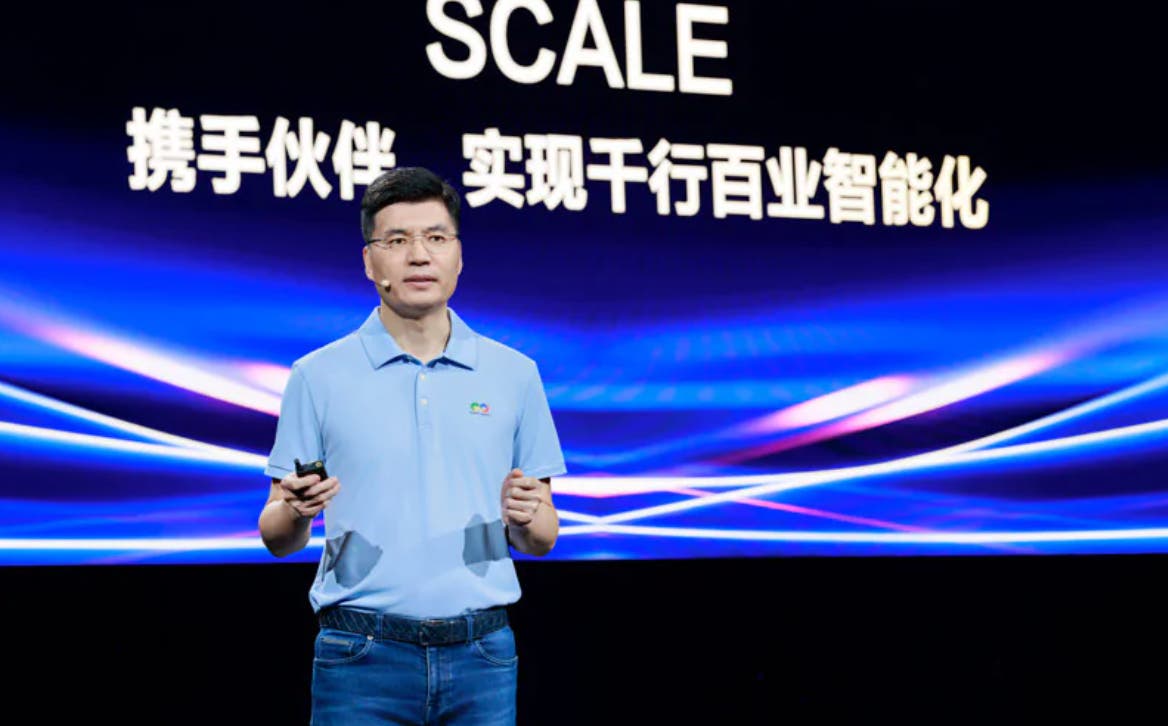
Huawei’s new SCALE partner support system will equip partners with the capabilities they need to help customers move intelligent transformation from individual pilots to large-scale adoption.
Huawei has introduced its SCALE partner support system as part of what it calls the "Huawei + Partners" collaboration model at HUAWEI CONNECT 2026 in Shanghai.
Leo Chen, Huawei's senior vice president and president of Enterprise Sales, said the program is designed to support partners involved in developing, validating, delivering, and operating AI projects.
SCALE has five support areas: scenario-based solutions, co-innovation, aligned marketing, local service and consistent quality, and efficient collaboration. Huawei said these are intended to address partner requirements across solution development, integration verification, delivery, operations, and system collaboration.
Under the scenario-based solutions component, Huawei provides infrastructure products that partners can use to develop industry-specific AI applications. Huawei said its partners have developed more than 100 scenario-based solutions across eight industries using the company's products and tools.
Huawei has also made reference architectures available for 48 business scenarios. Partners can use them alongside the company's cloud-based OpenLab environments for solution design, application development, testing, debugging, and integration verification.
The company said it has worked with partners to build more than 130 online and physical showcases with customers. Huawei also said its training and certification programs have supported more than 50,000 AI professionals over the past three years.
Huawei has also introduced a seven-step framework for deploying AI in enterprise production systems, alongside its DIMAK engineering system.
The framework sets out the deployment process, while DIMAK provides engineering components for enterprise AI applications.
The first stages of the framework cover understanding an industry's business logic, selecting core scenarios, and addressing technical and engineering requirements. Later stages cover production deployment, extending applications along the value stream, working with industry ecosystems, and continuing to develop industry-specific AI capabilities.
Huawei Deputy Chairman of the Supervisory Board Tao Jingwen said enterprises will need to redesign processes around collaboration between employees and AI rather than adding AI to existing workflows without changing how work is organized.
"Future enterprise processes will be designed around collaboration between people and AI. This is not about mounting an engine onto an old carriage, but about designing a whole new car," Tao said.
Huawei's framework begins with identifying business scenarios for AI deployment. The company said business specialists and AI teams should assess scenarios together, using a 12-question process developed by Huawei to evaluate potential use cases.
Development then moves from a minimum viable product to a pilot in a specific scenario. If the pilot meets its intended requirements, the framework calls for integrating the application into a production system and deploying it on the enterprise's IT infrastructure for routine operations.
After deployment, the framework calls for extending the application to related parts of the value stream and working with developers and other industry participants.
Huawei has also expanded its industry-specific organizational structure to support these deployments. The company said it now has 66 sub-business units and account departments covering specific verticals across 10 industries, supported by computing platform teams and smaller industry-focused engineering groups.
Huawei also introduced DIMAK, an engineering system covering Data, Infrastructure, Model, Agent, and Knowledge. The system is designed to provide technical components for building and operating AI applications around specific business scenarios.
At the infrastructure and model layers, Huawei said DIMAK is compatible with major AI models. Its data and knowledge components are designed to prepare internal information, including policies, processes, technical standards, and employee expertise, for use by AI systems.
Agent engineering is another part of the system. Huawei said enterprises can use it to define agents' responsibilities and permissions, as well as how agents interact with employees and other agents across business processes.
Tao said agent deployments also require defined responsibilities and coordination to avoid overlapping authority or conflicting actions. Huawei linked this part of the system to openJiuwen, its open-source AI agent platform, which the company said supports multi-agent collaboration, agent development, and governance.
Huawei said elements of DIMAK have been used across several industries. At the event, representatives from Shenzhen Loop Area Institute, Nanjing Iron & Steel, and Guangzhou Pharmaceutical Holdings discussed projects involving model adaptation, data and knowledge governance, logistics, steel production, and AI-assisted drug research.
Related Stories
 AI News
ETSA 2026: Emergent shifting focus from AI software to business automation, says CEO Mukund Jha
31 minutes ago
 AI News
Sam Altman will address the UN Security Council on the risks of artificial intelligence
1 hour ago
 AI News
Rising use of AI in Canadian courtrooms creates divide
2 hours ago
 AI News
Doctors tripled their AI use
2 hours ago
 AI News
Matt Walsh questions Trump’s push to rename “Artificial Intelligence” after POTUS unveils the final two name suggestions
4 hours ago
 AI News
‘Your Job Could Be Next…’: Obama’s Brutal Warning On Artificial Intelligence; Trump Still Silent
4 hours ago
 AI News
From Psychology to Artificial Intelligence: Yijing (Tabitha) Han’s Path in Product Design
4 hours ago
 AI News
Trump Announces Plans to Create ‘AI Force’ and Name AI Czar
5 hours ago