
Hundreds march in Vancouver to oppose planned AI data centres
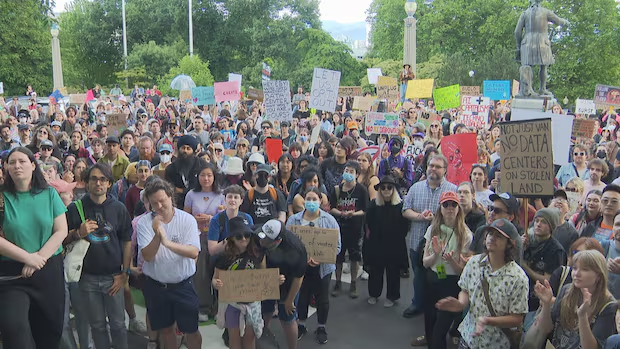
Hundreds march in Vancouver to oppose planned AI data centres
Demonstrators cite water and power usage, lack of consultaiton
Hundreds of people took to the streets in Vancouver on Saturday to oppose the construction of two new AI data centres in the city.
Demonstrators marched from the Vancouver Art Gallery to City Hall where they called for the projects — a partnership between Telus and the federal government — to be halted.
Protester Greenlee Welsh told CBC News she doesn't believe the trade off between what AI firms are promising and the cost is worth it.
"I would say the environmental impacts, so much water being wasted, so much power being used," she said.
"It seems to make life easier, but I think in the end if we use our own human abilities I think we will be a lot happier and a lot better off."
One of the two data centres, planned for the former Hootsuite headquarters in Mount Pleasant, is slated to come online by the end of this year, while the second facility is planned for 150 West Georgia St. in 2029.
Hundreds march in Vancouver against 2 planned AI data centres
A recent study by the International Energy Agency estimated data centres used 140 billion litres of water globally in 2023.
With Metro Vancouver already under Stage 3 water restrictions, demonstrators say the move doesn't make sense.
"Even if it's a small drain on the water supply it's going to make things worse, population growth is already straining our water supply," organizer Guerric Haché told CBC.
"We were not consulted, we don't benefit from this, this doesn't do us any good and we're sick of essentially not being in charge of our own communities."
More stories from Vancouver-South Coast
Haché said he'd like to see data centres operated under public or community ownership, and under strict and scientific regulations around water use efficiency and power use efficiency.
The data centres have the support of the B.C. government, which rolled out its own AI data centre power policy in January that requires companies to go through a competitive process to get B.C. Hydro power.
Premier David Eby said environmental impacts are a part of the equation.
"That's a concern of mine as well, which is why ensuring these data centres are not mass consumers of water is a key interest," he said.
"I just want to reassure people that we have those regulations in place and that is key for British Columbia in terms of any centres going forward.
Ottawa announces funding for AI, new data centres in B.C.
Telus maintains that the projects will be on the leading edge of environmental responsibility.
The company says the facilities will run on 98 per cent clean hydro power, and use 90 per cent less water than a traditional data centre. It also says they will recycle enough waste energy to heat 150,000 homes.
For those who turned out in Vancouver, that's not a convincing message.
This was the second major anti-AI data centre protest in the city this year, and demonstrators vowed they will be back for more.
With files from Shaurya Kshatri
Related Stories
 Canada
‘We know we got this wrong’: Target apologizes for children’s clown Halloween costume
53 minutes ago
 Canada
U.S. Secret Service aware of Iranian state media video threatening life of Barron Trump
53 minutes ago
 Canada
CBC News Network's Aarti Pole speaks to former Conservative cabinet minister Jason Kenney about new counter tariffs from Canada
54 minutes ago
 Canada
Nine McMaster faculty members inducted into Canadian Academy of Health Sciences
54 minutes ago
 Canada
Ontario Premier Doug Ford admits ‘it got a little heated’ with President Donald Trump
54 minutes ago
 Canada
Canada announces 'dollar-for
54 minutes ago
 Canada
Trump threatens to rename Lake Ontario. Checkmate, Canada. | Opinion
1 hour ago
 Canada
Air Canada still carrying U.S. alcohol as Ottawa pushes ‘Buy Canadian’
1 hour ago