
Hundreds of undocumented Alberta students at risk of losing free access to school
Hundreds of undocumented Alberta students at risk of losing free access to school
Temporary residents in immigration limbo risk children losing funded education
Hundreds of children and teens already attending Alberta schools could be ineligible to enrol for free in September as their families’ immigration status hangs in limbo.
Of the nearly 46,000 students in Alberta schools who are temporarily in Canada, data provided to CBC News by some school boards shows that potentially thousands of children and youths’ study permits will expire by Sept. 30, 2026 — the day after Alberta Education takes a headcount to determine each school’s funding.
The challenge comes as Albertans prepare to vote on several referendum questions concerning whether public funds should pay for temporary residents’ social supports, including K-12 education.
In Alberta’s largest school division, the Calgary Board of Education, 680 current K-11 students have not yet been able to provide immigration papers to ensure their schooling continues, a division spokesperson said in a statement.
Another 1,681 students’ study permits will expire before Sept. 29, and their continued eligibility for enrolment is at risk, according to the school division.
Edmonton Public Schools has tallied about 500 students whose permits are expiring or expired, while the Edmonton Catholic School Division has 1,493 students with expired documentation, and 169 more students with permits expiring before Sept. 29.
School division spokespeople say they have teams of staff working with families to obtain the necessary records, and that the number of students with expired permits varies throughout the year.
It's a scenario that deeply troubles education advocates.
“I'm just horrified that children are going to be negatively impacted by an adult-made policy that's not recognizing their value,” said Lorraine Kinsman, a former teacher and school principal who is the director of programs at the Calgary Bridge Foundation for Youth. The foundation helps newcomers get children enrolled in school and connects them with resources like language programs.
School is vitally important for newcomers to integrate into a community and build social connections, she said.
Klinsman said messages going home to parents urgently requesting copies of new permits and saying their child's enrolment is at risk, have taken a shift in tone from previous years.
Denying undocumented children access to school will cost society more in the long term if their development languishes and disenfranchisement later leads to poverty and crime, she said.
“This isn't children falling through the cracks,” Klinsman said. “This is children falling into a chasm we're creating.”
Provincial and federal government representatives, meanwhile, are referring questions to the other level of government.
“Education is a provincial and territorial responsibility in Canada, as is the funding model of school,” Jeffrey MacDonald, a spokesperson for Immigration, Refugees and Citizenship Canada (IRCC), said in an email. "IRCC cannot comment on the finances of educational institutions."
In an interview on Monday, Alberta Education Minister Demetrios Nicolaides said it is individuals’ responsibility to renew their paperwork, and the federal government’s job to process it in a timely fashion.
“I strongly encourage the federal government to take any and all measures that they can to ensure that those renewals are completed quickly,” he said.
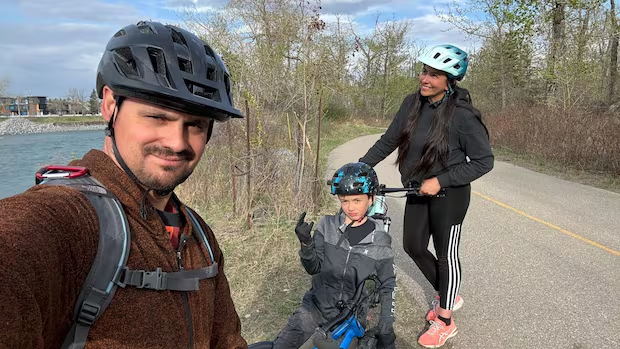
Among the children currently barred from returning to school is seven-year-old Silvestre Bórquez, who has just finished Grade 1 at a Calgary public school. His father, Fernando Bórquez, moved to Calgary with his wife and then-three-year-old from Chile, hoping for a safer environment and new experiences.
Silvestre has now spent more than half of his life in Canada and enjoys correcting his parents’ English, his father said.
“Everything that he knows has been here,” Fernando said.
However, the parents' previous employers weren’t able to renew their work permits, which expired September 2025. The family has applied to stay in Canada on humanitarian grounds, and also applied for temporary residency. Unable to work while they wait for the federal government to consider their applications, they’re relying on the generosity of friends in their community.
Fernando said he has provided the CBE with documents showing the federal government is working on their applications, but he can’t get a commitment that Silvestre will begin Grade 2 in September. He said he’s been meeting with school division officials and they seem puzzled about what to do.
Fernando said he cannot afford to pay international student fees, which can be more than $13,000 a year, depending on the school division.
The family purchased private health insurance, he said. But he is astounded that his son’s education is at risk.
“In my country it’s a [crime],” Fernando said. “If your child’s not in the school, it doesn't matter your status or whatever, you are a criminal.”
With no clarity on how long it could take the federal government to decide the family’s fate, Fernando said he’s preparing to home-school Silvestre. But he doesn’t want to tell his son he’s not allowed to go to school and potentially hurt his sense of belonging.
Fernando said he suspects a lack of education funding is driving the push to limit enrolment of undocumented students.
“There should be another way to raise that money,” he said. “And not just denying education, which is completely wrong."
Nicolaides said the province isn't changing any school funding related to a student's immigration status.
Lisa Jane de Gara, a settlement worker with Action for Health Communities, an IRCC-funded organization, said she believes a ballooning number of children and youth in Alberta becoming ineligible for school is a trickle-down effect of changes to federal immigration policy, including stricter controls over the temporary foreign worker program and admission of international students.
Trudeau announces reduction in temporary foreign workers, suggests more immigration changes to come
It's become far more challenging for people temporarily in Canada to get a renewed residency permit from the federal government, de Gara said.
As of June 24, the IRCC website estimated that the processing time for temporary residency applications was about 144 days.
As working parents’ permits expired, their children’s study permits also became invalid. With renewal no longer a guarantee, de Gara said families who imagined themselves staying in Canada for the long term are now in limbo.
Garrett Koehler, press secretary for Nicolaides, said in a statement that families who apply to extend their residency and study permits before they expire remain eligible to enrol children in school until the federal government makes a decision on their applications, if they can show proof their application is in process.
Narrower eligibility for renewed permits has created a bottleneck, creating longer waits for renewal decisions, de Gara said.
If a school division can’t submit valid immigration paperwork to the province, it won’t receive funding for that student from the provincial government, she said.
The Edmonton Catholic School Division, for example, said the province audits a selection of student records annually, and could claw back funding if any students are found to be ineligible.
“The increased scrutiny, I think, has come in large part because of a very much larger population of students have become ineligible by virtue of their immigration status, versus in the past, when that was very much less common,” de Gara said.
Koehler — and five school divisions contacted by CBC News — said the rules, policy and their practices haven’t changed.
However, the number of temporary students enrolled in Alberta schools has nearly quadrupled in four years, to 45,961 this year from 12,943 in 2021-22.
Edmonton public school trustees last year asked Nicolaides to amend Alberta’s Education Act to change the legal definition of a resident student to allow undocumented students to attend classes.
Edmonton public school board wants Alberta to guarantee undocumented children a right to attend school
Law in Ontario and B.C. is more permissive, granting more children the right to a funded education in provincial schools.
The Alberta School Boards Association members passed a resolution this spring advocating that “all school-age individuals who are ordinarily resident in Alberta be eligible to receive fully funded K-12 education in Alberta's public, separate and francophone school boards, recognizing children's right to education as described in the [United Nations] Convention on the Rights of the Child."
Referendum questions target temporary residents
Rhiannon Rutherford, a volunteer with the Alberta Workers’ Association for Research and Education (AWARE), who advocates for immigrant families, said another change is that the provincial government is asking citizens to question whether temporary residents should have free access to publicly funded services, such as health and education.
“There has been a concerted effort to stigmatize and scapegoat migrants for, you know, failing public services or gaps in funding for public services,” she said in an interview on Monday.
Albertans will vote on 10 referendum questions on Oct. 19, including multiple immigration-related questions.
Alberta premier, cabinet formalize wording of Oct. 19 separation question
One question asks if voters would support a law making only citizens, permanent residents and “Alberta-approved immigrants” eligible for provincially funded programs, including education.
Another question asks if voters support a law requiring all non-permanent residents to reside in the province for a year before qualifying for provincial social programs, such as schooling.
A third question asks if the government of Alberta should charge a “reasonable fee or premium” to non-permanent residents using the province’s health and education systems.
Temporary foreign workers pay taxes in Canada, some of which go to provincial governments to fund public services like health and education.
"What we're talking about is making sure the services are prioritized to the people who have registered a permanent stake in our country and our province," Smith said in response to a reporter's question in February.
"That's Canadian citizens and permanent residents. Temporary individuals should be treated as that."
Earlier this year, Koehler provided data showing the province spent nearly $545 million on K-12 education for temporary resident children in the school year that just ended.
Rutherford said, with no policy changes in writing, it’s likely the provincial government is putting pressure on schools to follow student residency requirements more strictly.
“That has really put a chill on educators working in the system who might otherwise be, you know, very supportive of all children being able to attend school, worried about consequences for looking the other way, or not even really having the ability to look the other way,” she said.
Alberta Teachers’ Association president Jason Schilling said he’s also hearing anecdotes about families being told students may not be eligible to return to school without new immigration papers.
Schilling said many teachers fear if the referendum proposals pass, educators will become de facto immigration officials, required to police and enforce students’ access to school.
“At the end of the day, this is going to impact kids and their learning, who are at no fault for their immigration status,” he said.
Students forced to stay home until their parents or guardians can get renewed permits will struggle to catch up, and put more pressure on overtaxed teachers to help fill gaps in their learning, Schilling said.
When CBC News shared some of the school divisions’ numbers of undocumented students facing removal from school with Nicolaides, the minister said he hadn't seen numbers like those before.
He said although he is obliged to follow the definition of a resident student in the law, he would look at what flexibility he is afforded.
School divisions can accept undocumented students if they have the space and the resources, Nicolaides said.
“It would be something that I would want to take a closer look at to get a better understanding of how many individuals may be affected," he said.
Janet French covers the Alberta Legislature for CBC Edmonton. She previously spent 15 years working at newspapers, including the Edmonton Journal and Saskatoon StarPhoenix. You can reach her at janet.french@cbc.ca.
Related Stories
 Canada
Alberta drivers face another jump at the pump after Illinois refinery outage
51 minutes ago
 Canada
Will Carney accept EU chief's 'associate member' offer to Canada?
51 minutes ago
 Canada
Bishnoi gang threatened to 'take over Canada' in 2025 letter to police
51 minutes ago
 Canada
Ford, Joly call on Stellantis to make new model at Brampton plant after automaker signals potential sale
1 hour ago
 Canada
David Eby taps campaign manager as election speculation grows
1 hour ago
 Canada
Trump says Canada becoming an EU associate member could be considered ‘hostile act.’ Live updates here.
1 hour ago
 Canada
Fact File: White House claim of beer victory doused by Sapporo brewer
2 hours ago
 Canada
Trump says Canada
2 hours ago