
I ran up a massive carbon debt as a teacher. Now I'm planting to make amends
I ran up a massive carbon debt as a teacher. Now I'm planting to make amends
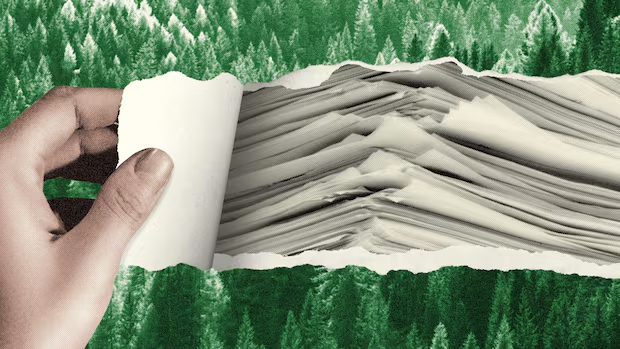
Over 3 decades, I likely handed out more than 1.6 million sheets of paper
This First Person column is written by Michèle Shannon, who lives in Powell River, B.C. For more information about CBC's First Person stories, please see the FAQ.
My wake-up call should have happened when a student playfully — and perhaps pointedly — referred to me as the Packet Queen.
Back then, I joked there was an award for the teacher who racked up the most photocopies and carried on with my lesson. I believed my students valued the goldmine of papers designed to help them explore concepts, practise procedures and prepare for exams. The packets, plus all the tests and quizzes churned out by the photocopier under my command, had an environmental impact I had yet to digest.
I began teaching high school math in 1994 in Squamish, B.C., armed with a curriculum, textbooks and piles of photocopied handouts. The paper trail seemed infinite as I went about generating learning materials. Those stacks of paper were for me the architecture of education — the physical scaffolding, along with books, pencils and erasers.
In retrospect, the numbers tell a story: that of my career measured in reams.
When I sat down and did a back-of-the-envelope calculation on my career, the result was a staggering monument to the pulp and paper industry. Assuming an average of 10 sheets per student per week, for 150 students over the six to seven classes I taught per year, the calculation is simple. Over three decades, I likely handed out more than 1.6 million sheets of paper.
If you were to stack those sheets today, they would tower more than 150 metres high — a skyscraper taller than many of the buildings in downtown Vancouver.
Those numbers feel like heavyweights now. An environmental debt accrued while I was busy teaching everything from accounting to calculus.
I study climate change. This summer, it got too hot for me to do my field work
The digital era and the use of technology in the classroom lessened the photocopying I did, and the shift to paperless teaching and virtual learning during the COVID-19 pandemic helped turn the page. When in-person classes resumed after the pandemic, I made a more conscious effort to minimize my paper use.
And yet, I retired in 2022 wishing I had changed my relationship with the school photocopier much sooner. I left teaching with an unexpected burden: the "pulp debt" of my profession.
In recent years, my spouse and I have pondered how to offset our carbon footprint. We've bought a hybrid vehicle, installed solar panels on our house, limited air travel to visits with family and planted some trees on our property.
Those few trees, however, don't even begin to replace the ones taken for my paper trail. Sometimes I wish I had worked as a tree planter somewhere along the way.
Fortunately, retirement has introduced some new variables. Now living in Powell River on B.C.'s Sunshine Coast, it's here, on this land, that the math changes. We've planted a vegetable garden as well as a flower garden consisting largely of pollinating plants.
We have a large lawn that we’re naturalizing to mimic the Pacific Northwest ecosystem we live in. By conscientiously choosing trees, shrubs and plants, and prioritizing indigenous ones, I hold some hope that I can eventually repay my debt to Mother Earth.
On a recent ferry trip to Vancouver Island, just across the Salish Sea, we discovered a nursery that specializes exclusively in propagating and growing plants native to coastal B.C. for restoration and gardening. There, we decided on a variety of trees and shrubs to further our naturalization project by planting Rocky Mountain juniper, blue elderberry, Sitka alder, Nootka rose, mock orange, red-flowering currant, Oregon grape, Pacific wax myrtle and snowberry.
I’ve realized that I am beginning to balance the scales not with a pencil and a calculator, but with a shovel. The same hands that filed stacks of paper to the rhythmic chunk-chunk of the photocopier are now pressing sword ferns, salal and kinnikinnick into the soil to the melodic chirp-chirp of birds.
I like to imagine that each shrub I plant will silently offset a month’s bundle of photocopies. I also like to imagine many of the students I taught are using their critical thinking skills to solve complex problems related to climate change and to understand their impact more immediately, addressing environmental issues created by previous generations.
Canadian tries to set world record for most trees planted in 24 hours — again
As I reflect on environmental accountability, it is not lost on me that the place I now call home was widely recognized as the largest producer of newsprint in the world. The Powell River Mill was an industrial titan that, for much of the 20th century, fed a global hunger for paper.
However, the landscape is shifting.The mill site permanently shut down operations in 2023 and the site, now known as tiskʷat, is being repatriated to the Tla’amin Nation — a reclamation of land and a movement toward a different kind of stewardship. As the community works to reconcile its complicated history, I strive to do the same on my own small property.
Do you have a compelling personal story that can bring understanding or help others? We want to hear from you. Here's more info on how to pitch to us.
Michèle Shannon taught high school mathematics in Squamish, B.C. Now retired, she enjoys gardening, volunteering and recreating in Powell River, B.C.
Related Stories
 World
World
Sault triathlete takes on two world championships in one month
38 minutes ago
 World
World
Canadian survivor of 9/11 looks back 25 years later
39 minutes ago
 World
World
Thousands turn out in Serbia for funeral of 'Butcher of Bosnia' Ratko Mladić
1 hour ago
 World
World
Canadian survivor of 9/11 terror attacks tells his story
1 hour ago
 World
World
France sets 3
2 hours ago
 World
World
The steel 'embodies his soul': 9/11 family takes World Trade Center beam across US
2 hours ago
 World
World
France put on a record
2 hours ago
 World
World
Africa, Mercator and the politics of how we see the world
3 hours ago