
In Canada's largest honey
In Canada's largest honey-producing region, beekeepers brace for U.S. tariffs
Proposed new tariff could hurt exports, domestic prices and agriculture
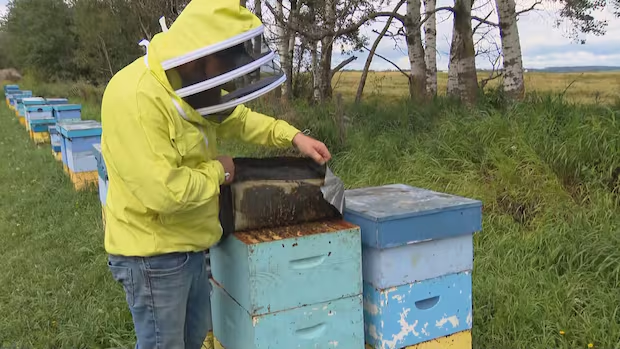
Harvest is in full swing at a family-run honey farm in central Alberta — but there's a cloud hanging over this year's sweet crop as producers watch the clock tick down on a trade agreement with the United States.
“It's just one more frustration,” said Lorne Prins, who owns Gull Lake Honey, located about 130 kilometres south of Edmonton. The operation has nearly 3,000 hives spread across roughly 90 locations in the heart of Canada’s largest honey-producing province.
The looming Aug. 19 deadline has thousands of local producers like Prins bracing for a major sting. A proposed 50 per cent U.S. tariff on honey could effectively close off their biggest export market, he said.
The U.S. administration threatened the levy in July on hundreds of Canadian goods, citing what it describes as unfair trade practices. The threat caught industry stakeholders off-guard, given that Canadian honey was previously exempt from tariffs under the Canada-U.S.-Mexico Agreement (CUSMA) on trade.
The wet summer had already created stress about honey production levels this year, Prin said. "Now to even consider the possibility of our honey prices being squashed by U.S. tariffs.”
Rod Scarlett, executive director of the Canadian Honey Council, expressed “surprise and shock” over the inclusion of honey among new goods potentially facing tariffs.
Nationally, the industry generated more than $241 million in revenues in 2025
“Alberta is Canada’s biggest producer,” Scarlett said. “The Prairies are about 60 per cent of the honey production. Alberta represents 40 per cent of that.”
Though Prins solely sells locally, he will still be hit by new tariffs, saying he expects domestic prices will plummet if Canadian exporters lose their top international buyer.
“It will strand an enormous amount of honey on the Prairies and it could be really, really damaging to our price this year,” Prins said.
Canadian beekeepers typically send about 70 per cent of their honey exports to the United States. Scarlett said that volume likely surged over the last fortnight as producers raced to move their shipments south before the tariffs take effect.
‘“[The] U.S. packers were quite worried that they wouldn't be able to get Canadian honey. They moved up their contract delivery dates and prices,” Scarlett said.
Jeremy Olthof, owner and operator of Tees Bees, about 150 kilometres south of Edmonton, said the tariff threat is an added stress in a year where wet weather has already disrupted timelines and delayed extraction schedules.
“I know of a lot of beekeepers that are scrambling,” he said. “And because this year … everything is so much later, there just isn't enough honey in barrels right now to get moved in time.”
While his own operation doesn't export a lot to the U.S, Olthof echoed Prins concerns that his business would be hit hard by a potential drop in prices.
Barbara McKenzie, executive director of the Alberta Beekeepers Commission, said losing access to the U.S. market would be “catastrophic” for Canadian producers.
A survey of local producers conducted by the organization last week found many expect exports will immediately collapse, she said.
“Many of our producers would not be able to have the funds to be able to purchase what they need to overwinter their bees. Nor would they be able to restock their bees after winter hive losses.”
And those ripple effects wouldn't stop at honey, McKenzie added.
“We have effects on pollination. We have effects on other food crops,” she said, noting the industry's crucial role in pollinating canola, fruit and vegetable crops.
“This isn't just a few hundred million [dollars] in honey that's being affected. It's billions of dollars across the agriculture industry that would be affected by these tariffs,” she said.
In an email statement to CBC News, Agriculture and Agri-Food Canada(AAFC) said it has met with the Canadian Honey Council and industry groups about the potential impacts.
If a deal isn't reached, AAFC said there are existing federal programs like AgriInvest and AgriStability to help cushion losses.
AgriInvest covers smaller income dips, while AgriStability handles larger losses. The deadline for the latter has already passed for this year but it would still be allowed if requested by a province or territory and approved by the AAFC, it wrote.
Producers that apply after the enrolment deadline would be subject to a penalty of 20 per cent of their total payment, AAFC said.
A spokesperson for Trade Minister Dominic LeBlanc said in a statement to CBC News that Canada is "engaging intensively with the United States to address outstanding trade issues," but declined further comment while negotiations continue.
Back on the farm, Olthof said all that's left for local producers to do now is wait and hope a deal is reached before time runs out.
“The mood is just hoping and praying that they get this figured out, and hoping this doesn't go through,” he said.
Nadeer Hashmi is a reporter for CBC News in Red Deer, Alta. He was formerly a reporter in Yellowknife.
Related Stories
 Canada
Teen shooter kills 4 at Oregon elementary school before being shot by a witness
38 minutes ago
 Canada
Quebec sovereigntists see fundamental rift with Alberta separatists
39 minutes ago
 Canada
CREA revises down 2026 home sales forecast again as September transactions fall 7.7% over same month last year
39 minutes ago
 Canada
Canadian steelmakers offset some U.S. tariff pain with domestic demand
39 minutes ago
 Canada
The most Canadian saying might not be from Canada, eh?
39 minutes ago
 Canada
Stellantis workers set to vote on potential strike action this weekend
1 hour ago
 Canada
Convicted killer attending McGill law school divides students over safety, 2nd chances
1 hour ago
 Canada
A super typhoon may determine Canada’s late
1 hour ago