
In Las Vegas, Autodesk Goes All In on Artificial Intelligence
In Las Vegas, Autodesk Goes All In on Artificial Intelligence
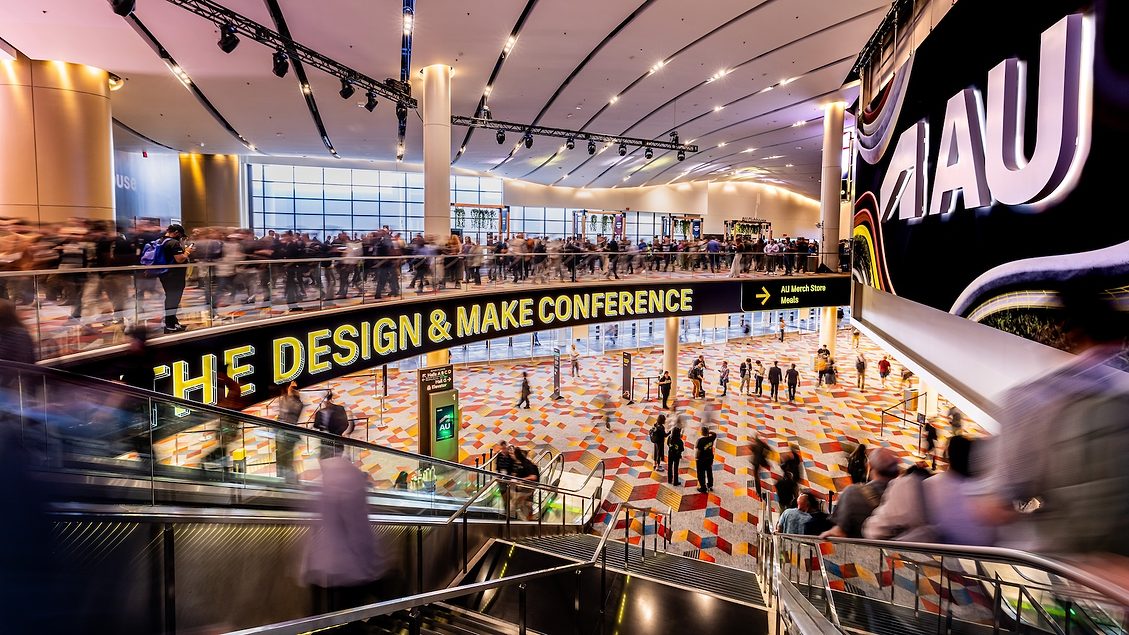
The scene at the Venetian Expo in Las Vegas for the 2026 edition of Autodesk University.
On September 15, some 12,000 people gathered at the Venetian Expo convention center in Las Vegas to learn about the latest innovations in “design and make” software. The annual Autodesk University conference, attended largely by architects and engineers, is perhaps the closest thing the AEC sector has to a Silicon Valley–like product launch, complete with a choreographed dance performance, robots roaming around stage, and live demos by nervous developers who would clearly be more comfortable coding. The event goes by the acronym AU, but this year it was all AI.
The gathering featured choreograped dance performances. Photo courtesy Autodesk
Autodesk announced a suite of new and improved AI features that seemed to touch on every aspect of project delivery. Cloud-based BIM platform Autodesk Forma, which is billed as “the future of AEC products like Revit,” is now integrated with “project intelligence” that can summarize client requests, flag submittal issues, or keep track of costs, scheduling, and construction sequencing. Forma and Revit will now include AI tools such as Building Layout Explorer, which can configure apartments for an entire building, or one that adjusts annotation with the click of a button. The biggest announcement was that Autodesk Assistant, a standalone agent—meaning it’s capable of completing complex tasks autonomously—will begin rolling out in 2027. There is even an Orchestrator, an AI system that helps select from the various AI models which one is appropriate to a given task—an AI to help manage all the AI.
The timing of this AI-focused AU couldn’t have been worse. “Look, this week has been very doomy in AI world,” admitted Autodesk CEO and president Andrew Anagnost, referring to the roiling conversation sparked just a few days earlier. A researcher named Jacob Coxon had publicly resigned from tech company Anthropic and OpenAI, and the report of his departure in the Washington Post was no less than an apocalyptic warning that the technology is on the cusp of achieving self-improving superintelligence with insufficient safeguards. “There’s a little 10 percent chance that we’re all dead,” Anagnost joked.
Autodesk CEO and president Andrew Anagnost addresses the crowd. Photo courtesy Autodesk
Polling conducted in September by Politico found that roughly 70 percent of Americans feared that artificial intelligence could destroy humanity. The anxieties that architects might have about Autodesk’s AI tools, however, aren’t for their lives but rather their livelihoods. Although aware of these concerns, the message from Autodesk about the impact of this technological disruption was mixed.
The oft-repeated promises at AU were that these new features would “unlock capacity” and “eliminate grunt work.” Gone will be the days of tedious clicking in a model, replaced with typing in prompts. “Intelligence alone doesn’t build the world around us; you do,” Anagnost reminded the thousands in attendance at his keynote address. He argued that rather than replacing architects, AI would lead to more productive jobs in which everyone would be liberated to contribute to higher-value decision-making. But Anagnost also illustrated how implementation might actually work, saying: “If you’re hiring 10 people now, maybe you should hire five or seven and create a budget for technology.” It doesn’t take Revit’s new AI tools to find the conflict between these two models.
In one of the live demos, a developer playing the role of an architect fed a sketch of a slatted facade to Autodesk Assistant, which, in just a matter of seconds, not only modeled a wood rainscreen but also specified a metal bracket that would achieve a slight bend in the louvers shown in the drawing. The “architect” made a few tweaks and sent the project along to his colleague, playing the role of an engineer, to develop the custom metal piece. In the quick and seamless handoff, however, it was easy to miss that the original sketch made no reference to any such connector. The decision that the slats would be made of dimensional lumber joined by a metal bracket was made entirely by the AI in seconds and went without question, bypassing an opportunity for design—for the high-level decision-making that was repeatedly promised throughout AU.
Demos of Autodesk Assistant. Images courtesy Autodesk; click to enlarge
When asked about this example of AI making design decisions, Anagnost maintained that “the user has to stay in control” and pointed out that “the user gets to override that decision.” But this suggests that rather than eliminating grunt work, as these tools are adopted, AI will create a new kind of drudgery of second-guessing and pushing back on the generic and probabilistic assumptions it makes. Rather than a future of architects liberated to be auteurs, it suggests that the role of the architect will increasingly be as an auditor.
Looking for quick answers on architecture and design topics? Try Ask RECORD, our new smart AI search tool. Ask RECORD →
The AI at AU was not contained to Autodesk’s new features but also extended to some genuinely intriguing tools on display from vendors on the convention floor. For example, a plug-in by Swedish startup Arkyv scans for and highlights potential code-compliance issues, and Maestro has developed a vibe-coding platform that allows architects to create custom toolbars in Revit for frequent tasks without needing to know how to code.
Despite shifting public sentiment and calls for regulation, the adoption and integration of AI isn’t coming to an end anytime soon; too much of it is just too useful. Autodesk’s vision of the future is a model of practice in which, as Anagnost put it, “we’re all going to become managers of agents.” But, before we click accept and handoff AI designs to the next step in the process, it’s worth asking—Is that the type of work architects want to do?
Looking for a reprint of this article? From high-res PDFs to custom plaques, order your copy today!
Related Stories
 AI News
Anthropic offers startups a free year of Claude Team and US$1,000 in credits
23 minutes ago
 AI News
VEON and Amdocs Enter 10
23 minutes ago
 AI News
Globee® Awards for Impact, Now in Its 19th Year, Invite Artificial Intelligence Achievement Nominations Worldwide
1 hour ago
 AI News
Premier seeks to trademark her voice to combat AI deepfakes
2 hours ago
 AI News
Dalio Says We’re Nearing Point Where AI Bubble May Burst
2 hours ago
 AI News
First Nation says Bell Canada has duty to consult on AI data centre near Regina
3 hours ago
 AI News
OpenAI says its artificial intelligence just solved some of maths’ hardest problems
3 hours ago
 AI News
Pornhub returns to Australia but only for adults with Apple devices
4 hours ago