
India news: Police used 'excessive force' on CJP protesters
This blog has now closed. Read below for some main headlines from India on Monday, August 24:
Tired of missing our real-time updates? Click here to add us as a Preferred Source on Google. Then tap the "Star" or "Preferred" to keep DW News at the top of your feed.
That's it from us in Delhi today.
Be sure to catch us tomorrow for more news on all things India.
Foreign Minister Jaishankar meets Russian President Putin, says economic cooperation has grown
Indian Minister of External Affairs S Jaishankar met Russia's President Vladimir Putin in Moscow on Monday.
Jaishankar told Putin that the economic cooperation between the two countries has grown "very significantly."
"We have a very strong picture of cooperation to present," Jaishankar told the Russian leader after he co-chaired a meeting of the India-Russia Inter-Governmental Commission on Trade, Economic, Scientific, Technological and Cultural Cooperation on Monday.
The foreign minister conveyed that Indian Prime Minister Narendra Modi looked forward to welcoming Putin at the BRICS Summit in New Delhi which kicks off on September 12.
India National Security Advisor Ajit Doval in China for border talks
India's National Security Advisor Ajit Doval has arrived in China ahead of talks scheduled for Tuesday on the disputed India-China border in the Himalayas.
Doval — who is India's Special Representative on the India-China Boundary Question — reached Beijing on Monday afternoon on a two-day visit, India's Foreign Ministry said in a press statement.
The Indian top security official's visit comes at the invitation of Chinese Foreign Minister Wang Yi, the statement added.
Doval is set to meet Yi on Tuesday for border talks.
"At this meeting, the two sides will, in accordance with the spirit of the consensus reached by the leaders of the two countries, continue to engage in in-depth communication on the boundary question and jointly safeguard peace and tranquility in the border areas," news agency AFP quoted Chinese Foreign Ministry Spokesperson Lin Jian as telling the media.
Doval will also meet China's Vice President Han Zheng during his visit, the foreign ministry in New Delhi said.
Tensions flared in India's longstanding border contention with China in 2020 when troops from both sides clashed in the Galwan valley, leaving 20 Indian and four Chinese soldiers dead.
The skirmish — which was India and China's first deadly military confrontation since 1975 — put relations between the two nuclear-armed Asian giants under strain.
Indian and Chinese officials have regularly held border talks since the clashes.
The talks come weeks before India hosts the 18th BRICS Summit in September. New Delhi is hoping that Chinese President Xi Jinping will attend the summit but there is yet to be any statement from Beijing.
If Xi does come to New Delhi for the summit, it would be his first trip to India since the 2020 standoff.
Tracking the tense relationship between India and China
To view this video please enable JavaScript, and consider upgrading to a web browser that supports HTML5 video
WATCH — Can India's Gen Z turn climate awareness into action?
India's young climate activists want to help those hardest hit by environmental degradation but how can they mobilize the masses?
Beyond likes: Can Gen Z turn climate awareness into action?
Indian Foreign Minister S Jaishankar in Russia
India's Foreign Minister S Jaishankar is visiting the Russian capital of Moscow for the 27th Session of the India-Russia Inter-Governmental Commission on Trade, Economic, Scientific, Technological and Cultural Cooperation, which he is co-chairing.
Jaishankar's two-day trip, which began Sunday, comes at the invitation of Russia's First Deputy Prime Minister Denis Manturov, India's Ministry of External Affairs said in a statement last week.
Jaishankar is slated to meet his Russian counterpart Sergey Lavrov during the visit and exchange views on regional and global issues, the ministry said.
Jaishankar visit comes as New Delhi and Moscow continue to bolster their long-standing relationship, which spans decades and is deeply rooted in history, trade and defense.
Since the beginning of Russia's full-scale war in Ukraine, New Delhi has been under pressure from Kyiv's western partners over its cooperation with Moscow.
Observers say India has adopted a neutral stance on the Ukraine war.
Indian Prime Minister Narendra Modi said during talks last year with Russian President Vladimir Putin that India was "not neutral" and had a side, which he elaborated was the "side of peace".
On Monday, Jaishakar sent greetings on X to Ukrainian Foreign Minister Andrii Sybiha on Ukraine's Independence Day as Kyiv celebrates its separation from the Soviet Union 35 years ago on August 24, 1991,
"Look forward to further deepening our bilateral partnership," Jaishankar said in the post.
India's double bind: Trying to mollify Russia, US
Fire at Maharashtra government hospital leaves three newborns dead
Three newborn babies died in an early morning fire at a Neonatal Intensive Care Unit of a government hospital in Amravati in India's western Maharashtra on Monday.
The fire broke out around 3.30 a.m. local time at the District Women's Hospital after a ventilator suddenly exploded, Indian media reports said.
The unit where the fire started is meant for premature and critically-ill babies.
Maharashtra Revenue Minister and Amravati District's Guardian Minister Chandrashekhar Bawankule said in a statement that the hospital staff safely evacuated the other babies in the unit as soon as the fire erupted.
According to news agencies ANI and PTI, 39 infants were admitted to the unit when the blaze started.
Six babies have been moved to another hospital for treatment, reports cited officials as saying.
The exact cause of the fire is not yet known.
Bawankule said he has ordered a probe into the incident.
Amnesty probe singles out use of AK-type assault rifle on Bihar protesters
Amnesty International said that it had verified two videos filmed during the Cockroach movement protests in the eastern state of Bihar's Siwan on July 24, where a police officer is using an AK-type assault rifle against protesters.
"Firearms of this kind are designed to kill and, in the context of assemblies, may lawfully be used only to meet an imminent threat of death or serious injury to a specific individual, and only as an absolute last resort," the organization said, adding that it had found "no evidence any such threat existed."
The Bihar Police told the Supreme Court last Monday that one of their police constables "got trapped in the crowd during the protests and fired four rounds in the air, adding that no one was injured.
The Bihar Police agreed in its account to the court that AK-47 rifle was a "platoon-level weapon" used in special operations and not in crowd control situations.
The Bihar Police. however. maintained that it had not used excessive force.
What Delhi Police said about the use of force
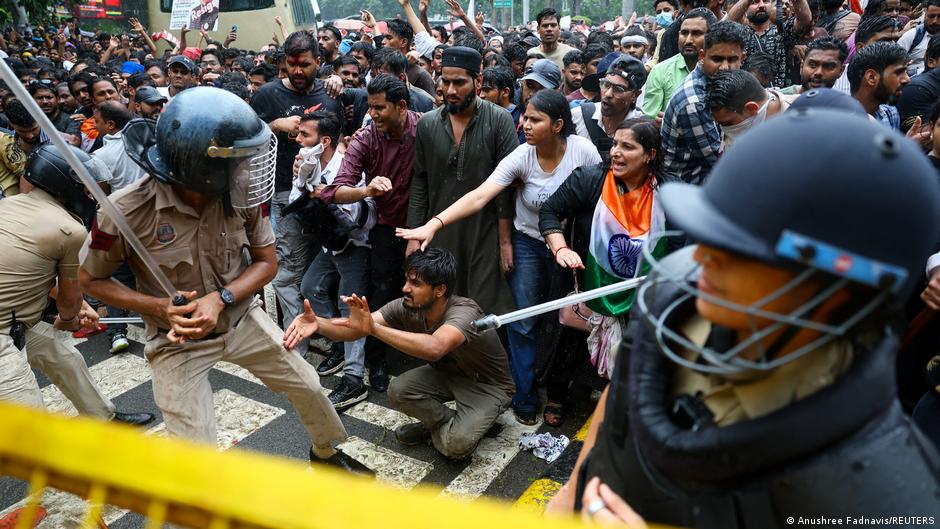
The Delhi Police has denied the use of excessive force during the July 20 protest march to the Indian parliament that was met with violent police action, triggering allegations of police brutality.
Amnesty's report comes just days after the Supreme Court formed a high-powered enquiry committee to probe the allegations of violence by both police and demonstrators.
Police officials told the Indian top court last week that they used force only after the protests stopped being peaceful.
The Delhi police claimed that anti-social elements "masquerading as aggrieved students" got mixed with the thousands of protesters and caused "grievous injuries" to security forces.
The capital's police told the court that 240 personnel were injured in the clash with protesters.
The Delhi police asserted in the Supreme Court that it used "maximum restraint" while using only the "minimum required force" to control the protest.
Amnesty said that there were "isolated incidents of protesters throwing stones."
'State-sanctioned violence masked as crowd control,' Amnesty alleges
Aakar Patel, Chair of Board, Amnesty International India said in a statement that Indian authorities first "suppressed" the demonstrators right to protest with a communication blackout, barricading and transport disruptions.
"They then attempted to crush it with unnecessary or excessive use of force against peaceful protesters, including children. This heavy-handed response was state-sanctioned violence masked as crowd control. The continued impunity after a month is a testament to that," Patel said.
The protests, which were led by the viral satirical Cockroach Janta Party (CJP), were sparked by the leak of question papers for a highly-competitive national medical college entrance exam. The protests made India's then-education minister Dharmendra Pradhan step down.
The movement is seen as one the biggest challenges for Prime Minister Narendra Modi in his three terms in power.
The CJP movement has expanded to focus on unemployment and opportunities for young people.
India's 'Cockroach' protesters claim online censorship
Amnesty says police deployed 'unlawful and deadly force' against CJP protesters
Indian police used excessive force — including pellet-firing shotguns, tear gas launchers, grenades, batons and electric shock devices — in their clampdown of July's youth-driven Cockroach protests, a new digital investigation published by human rights group Amnesty International on Monday alleged.
Amnesty said that its Evidence Lab had verified video and photographic evidence — along with witness testimony — to confirm the use of the weapons in Delhi and eastern India's Bihar state.
"The weapons were deployed in a manner that breached international law and standards and domestic policing guidelines," Amnesty said in a report that contradicts police claims.
Amnesty also published an account of an anonymous protester who claimed to have sustained pellet injuries.
"I saw an officer standing roughly 300-400 metres away aiming the (pellet-firing) shotgun towards where I was standing. I started running in the opposite direction and that's when I got hit on my back, otherwise I would have been hit on my face and chest," Amnesty quoted the protester as saying.
The protester told the international human rights organization that doctors had confirmed that they were pellet injuries.
The Delhi police had earlier posted a statement on X deeming reports claiming the use of pellet guns against peaceful protesters as "completely false and misleading".
On Friday, opposition leader Rahul Gandhi reached a Delhi Police station with a 19-year-old protester who said he was wounded by pellets during the July 20 march.
Gandhi staged a sit-in with the protester outside the police station, demanding a police investigation into the shooting. The protester's case was subsequently registered by the police.
This is Dharvi from DW's studio in New Delhi. We are back with our daily digest of all the biggest headlines that are stirring up attention in the world's most populous nation.
The Indian government continues to face criticism in the aftermath of the Cockroach protests, the massive youth-led agitation that rattled Prime Minister Narendra Modi's administration as it demanded an overhaul of the country's education system. A new report by Amnesty International says that Indian police used excessive force against protesters in crackdowns on last month's demonstrations.
In a horrifying tragedy, three newborns have died in a fire at a government hospital in the western Indian state of Maharashtra.
And in international relations, India's Foreign Minister S Jaishankar is in Russia, co-chairing the 27th Session of the India-Russia Inter-Governmental Commission on Trade, Economic, Scientific, Technological and Cultural Cooperation.
Follow along for all this and more.
Related Stories
 India
India
Starlink, Ambani’s venture should get equal treatment, let consumers decide: Shashi Tharoor
1 week ago
 India
India
Lawrence Bishnoi’s rise: Student politics, first murder and a sprawling crime network | India News
1 week ago
 India
India
India’s finance minister says market liquidity makes it easier for investors to exit
1 week ago
 India
India
India news: CJP alleges 'deliberate' delay in leaders' release
1 week ago
 India
India
Indian Diaspora Holds Pro-Modi Counter
1 week ago
 India
India
Clashes Erupt in London as Diaspora Divided Over India's Election Chief and Electoral Roll Controversy
1 week ago
 India
India
London: Indian diaspora rallies in support of PM Modi, criticises CJP protesters
1 week ago
 India
India
Cabinet Approves Go
1 week ago