
Indian engineers spent years chasing Silicon Valley. Now some say ‘I would not come to the U.S.’
For a 22-year-old Indian in tech like Jignesh Ammineni, this was the place to be.
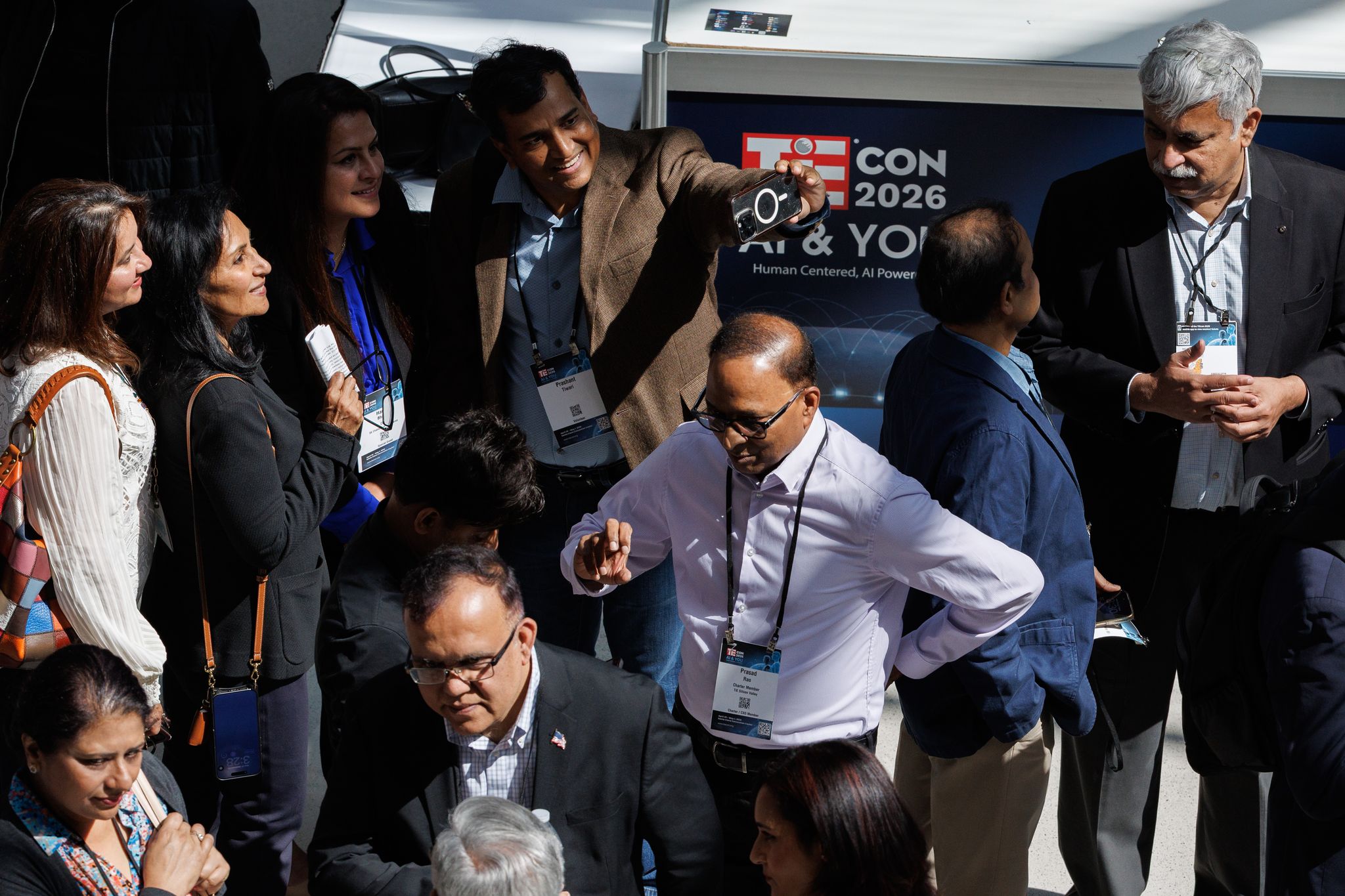
In the heart of Silicon Valley, for a sunny week in April, Indian tech workers, founders and executives from some of the hottest Bay Area startups gathered around pitch decks and crowded into lecture halls for keynote speeches on AI and data centers.
Ammineni had arrived in the Bay Area a few weeks before, carrying with him the same aspirations as many of the C-suite types who were onstage at the Indus Entrepreneurs conference, or TiEcon, an annual gathering that serves as a reminder of how deeply embedded Indian Americans are in Silicon Valley’s power structure.
Once a small group of engineers arriving on student visas and work permits, Indians now occupy key roles across the startup ecosystem, from founders to funders, and are among the most visible and influential groups in the tech industry, rising to top leadership at the likes of Google, Microsoft, IBM and Adobe. A Chronicle analysis also shows that they comprise nearly a tenth of all executives in the Bay Area, 15% of executives at the largest companies and fully a third of all founders in the prestigious startup accelerator Y Combinator.
Article continues below this ad
“The tech industry here is the best, innovation is greater here than anywhere else in the world, so I want to be here,” Ammineni, a recent computer science graduate from the University of Massachusetts, said as he moved between conference halls at TiEcon, occasionally running into people he met earlier in the day.
Yet, like a growing number of Indian expatriates in the cradle of America’s tech culture, Ammineni isn’t certain he’ll stay.
“The plan is to learn as much as I can,” he said. “And after that, probably head back to India.”
That sentiment is why some Indian tech trailblazers fear that, after decades of prominence, the best days of the diaspora in Silicon Valley are over. The opportunity gap between the U.S. and other countries like India is now smaller. President Donald Trump has added a $100,000 fee to H1-B visas for overseas applicants, and last week his administration announced green card applicants would have to go abroad to apply, a policy that’s roiled immigrant communities. Although how the new policy will be implemented remains unclear, his broader immigration crackdown has left many fearful and disillusioned with the U.S., pushing some visa-holding tech workers to Canada or elsewhere.
India’s rise as a domestic tech powerhouse also makes it an emerging alternative to Silicon Valley, with companies like OpenAI and Nvidia investing billions in the country.
Vinita Gupta, the first Indian American woman to take a company public, came to California in 1974. At the time, she said, returning to India was not an option.
“India has become prosperous enough where good engineers, technical skills, can fetch you a good job. That was not true when I came,” said Vinita Gupta, who arrived in California in 1974 and later became the first Indian American woman to take a U.S. company public. “We couldn’t go back.”
In contrast, there are early signs that Trump’s policies and changing economic dynamics are pushing Indians to move back today. Networking website LinkedIn cited a 40% increase in tech professionals changing their location to India in the third quarter of 2025.
The dreams of U.S. careers for people like Srini Madala, who immigrated in 1986 and went on to found three startups, are changing: “If I was 25 again and had the same opportunities,” he said, “I would not come to the U.S.”
Those of Madala’s generation can remember a time when Indian people were rare in Silicon Valley. In the early 1980s, when M.R. Rangaswami moved to the Bay Area to work for tech companies, he was often the only Indian on staff.
“Now, I can walk into a Google or an Oracle, and it looks like half the staff is Indian, right?” said Rangaswami, who went on to found the early angel investment firm Sand Hill Group. “Very different experience from what I had.”
Silicon Valley’s reliance on skilled Indian immigrants is often traced back to India’s first Prime Minister, Jawaharlal Nehru, who took power in 1947 and asserted a vision that his nation’s global standing would rest on science.
When M.R. Rangaswami, an Indian American tech executive and philanthropist, arrived in the Bay Area he was often the only Indian-American in meetings.
The timing was serendipitous. A generation of Indians was ready when the U.S. passed the 1965 Immigration Act, which removed national-origin quotas and gave preference to skilled workers who spoke English, a boon especially for upper-class Indians, who grew up in a culture where English remained an elite language. And the Indian Institutes of Technology, a network that now counts 23 prestigious technical universities, generated a deep talent pool.
“You could say that Indian politics is more responsible for the growth of Silicon Valley than almost anything else in the world,” said Muzaffar Chishti, senior fellow at the Migration Policy Institute, a nonpartisan think tank in Washington, D.C. By contrast, Asia’s other giant, China, restricted emigration from the country till the early 1980s.
The demand for skills wasn’t just in engineering. Many Indians who immigrated early were doctors staffing up hospitals in rural America. And if they came to work in the “semi-conductor” industry, as Silicon Valley was known back then, they had specialized skills.
But it was the emergence of the H-1B visa program in 1990, which required only a “specialty occupation,” that created a parallel pipeline of Indian workers from more diverse backgrounds, Chishti said.
Y2K fears also helped. As 1999 gave way to the new millennium, there were serious concerns that older computers would mistakenly interpret the last two “00” digits in “2000” as “1900,” potentially disrupting everything from traffic lights and planes to banking and nuclear plants.
The concerns were so strong that Congress temporarily raised the H-1B cap to 115,000, opening entry for more Indians to arrive in the U.S. tasked with patching legacy systems.
“Y2K was a great big boost, an inflection point, I would say, for the IT sector from India because there’s so much that needed to get done here in the U.S.,” Madala said. “Our business increased — I would say doubled overnight.”
The crisis was averted and many Indians stayed and sought citizenship. The Indian population in the Bay Area nearly tripled from 49,000 in 1990 to 144,000 in 2000, and then rose further to 222,000 by 2010. They filled the ranks of a group that has redefined the cultural makeup of Silicon Valley and the Bay Area. Nowadays, a quarter of all employed Indians are software developers and 31% of all software developers are of Indian ancestry.
But that now decades-old journey is at risk.
Part of what’s being contested under Trump now is who gets to be American and who gets to enjoy its success.
“It’s an existential moment for America on multiple dimensions, including its future direction,” said Karthick Ramakrishnan, founder and executive director of AAPI Data, a research and policy organization at UC Berkeley.
The rise of the country’s nativist movement has brought a willingness to sacrifice future American prosperity, Ramakrishnan said. This pushback against immigration makes recent arrivals reluctant to stay and potential immigrants from India reluctant to move here.
“It’s not unprecedented for immigrants to pick up and leave even after a couple of generations,” Ramakrishnan said. “That changes the trajectory of the future Indian American population, and American society and business in general.”
A recent poll of 1,000 Indian Americans conducted by YouGov and the Carnegie Endowment found 40% of respondents thought about leaving the U.S. either frequently or occasionally, citing frustration over U.S. policies and concerns over cost of living and personal safety. A quarter of respondents also cited better career opportunities in other countries.
Rangaswami, the angel investor, isn’t worried about higher barriers to immigration in the U.S. affecting the presence of Indians in Silicon Valley, and would still immigrate to the U.S. today.
“I would absolutely do it. I went from being a customer support analyst to the director of marketing in three years,” he said. “ Even now, if you are good, you will be successful.”
Like Rangaswami, entrepreneur Talat Hasan believes Silicon Valley still offers cutting-edge paths to success. But she also remembers when it wasn’t easy for Indians like her to break barriers in Silicon Valley.
She came to the Bay Area in 1968 with a master’s degree in solid state physics and earned a job at Philips Research Labs in Sunnyvale. In 1983, with Philips’ blessing, she co-founded a startup based on her work in automated semiconductor manufacturing tech.
Talat Hasan, a Bay Area tech entrepreneur, believes the region provides a rare path toward success for Indian Americans.
Talat Hasan, at her home in Saratoga, said she was first Indian woman to start a tech company in Silicon Valley.
“I have the dubious distinction of being the first Indian woman to start a tech company in Silicon Valley,” said Hasan, who had a five-month-old baby at the time. “We had no money. We took loans on our credit cards with 21% interest in those days, and this was the height of that awful recession.”
Hasan faced discrimination as an Indian American and a woman, and, on her way to founding another startup and working as a venture capitalist, discovered that Indian Americans had more difficulties raising money compared to white founders. Despite the hardships, she praises the country that provided for her success.
“Why this country was so amazing is that, at the end of the day, people only look at what you can do and what you can offer,” she said.
Others are also bullish. Gupta, the first Indian woman to take a U.S. company public with Digital Link Corp. in 1994, still encourages Indians to make their way to Silicon Valley.
“They should still come here because this valley is based on individual talents and not based on where you were born, where you were educated,” she said. “It’s embracing to all people from all over the world. More egalitarian than you could be anywhere else.”
At TiEcon, Jacob Helberg, the under secretary of state for economic affairs, said that with the advent of artificial intelligence, the U.S. and India have an opportunity to be the anchors of a new technological axis.
TiE Silicon Valley president Anita Manwani, center, at The Indus Entrepreneurs (TiE) conference at the Santa Clara Convention Center in April.
“India has a very rich ecosystem,” he said onstage. “In Silicon Valley, Indian Americans have made incredible contributions to the American technology ecosystem, and so we believe that kind of connective tissue runs deep in the fabric of our country and provides a great opportunity to deepen that relationship.”
He did not discuss the backlash to H-1Bs or the Trump administration’s crackdown on immigration.
Such issues remain top of mind for Indian entrepreneurs. Given the current political climate and rapid technological changes afoot with artificial intelligence, Hasan said she’s discouraged some of her Indian relatives from moving to the U.S., unless they have a great career prospect.
“This country has changed too much,” she said, “and I’m not sure you’ll have as much of an opportunity as you would have had even 15 years ago.”
Related Stories
 Technology
Zelenskyy says holding elections during war would 'destroy' Ukraine
46 minutes ago
 Technology
Execs say work needed to keep tech startups in Colorado
50 minutes ago
 Technology
Mining technology tested in Yukon uses particles from space to see underground
2 hours ago
 Technology
White Bear First Nation launches new technology hub for students to train close to home
2 hours ago
 Technology
Two startups receive EDF equity investment
2 hours ago
 Technology
‘It’s now or never’: why investors are still betting big on Israeli tech
5 hours ago
 Technology
Zelenskyy details rift with dismissed defense minister, saying some of his actions were misguided
6 hours ago
 Technology
Texas Tech football news: Top Red Raiders recruit transfers high schools
9 hours ago