
India's Civil Service Was Designed To Be Unaccountable
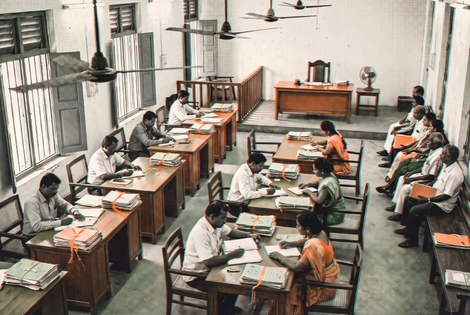
In the administrative offices of the Delhi government, service technicians responding to hardware complaints recently uncovered a perplexing defect. Inside the sealed plastic casings of several biometric attendance machines, engineers found water.
Given the absence of roof leaks or nearby plumbing, officials suspect that water was deliberately poured or sprinkled into the scanners in order to disable them. This alleged sabotage cannot be seen as an isolated technical malfunction, since it emerged directly against the backdrop of a new administrative crackdown.
A few months earlier, Chief Minister Rekha Gupta conducted a surprise inspection of the State Goods and Services Tax (GST) office, discovering that several senior officials and bureaucrats were absent during official working hours.
In response, the government instituted mandatory biometric attendance across all departments, extending the requirement to Additional Chief Secretaries, Principal Secretaries, and heads of departments. Under the new directive, officials were required to record their presence at 9.30 am and log out at 6 pm.
While an official investigation into the suspected tampering remains under way, the episode illustrates a deeper resistance within the state apparatus to basic institutional oversight.
This resistance is far from an isolated anomaly; it fits a broader pattern of bureaucratic entitlement across the country.
Take Delhi's Thyagraj Stadium, where national-level athletes were made to return early from training so that a senior bureaucrat could take his pet dog on a walk. In many jurisdictions, administrators expect state protocol officers to manage their personal logistics at airports and transit hubs, or even demand unauthorised VIP lighting, private luxury modifications, and custom accommodation on state resources before assuming official duties.
When the Right to Information Act was introduced to bring transparency to official decision-making, sections of the bureaucracy spent years creating procedural hurdles to restrict public access to basic file notations. Even in the judiciary, chief secretaries and top-level bureaucrats are routinely punished for contempt of court for refusing to follow binding court orders.
This pattern raises fundamental questions about power, accountability, and the implicit social contract between public servants and the state.
In his seminal 1995 work, The Revolt of the Elites and the Betrayal of Democracy, Christopher Lasch highlighted how modern managerial classes quietly withdrew from shared public life in America, and how this is bound to happen in any democratic society. While earlier thinkers like José Ortega y Gasset feared that populist masses would undermine democratic standards, Lasch argued that the primary threat to modern democracy comes from above, not below.
This secession is now visible in daily life when elites bypass public infrastructure altogether. Their children attend elite private or international schools, their families use private hospitals, and their lives unfold within insulated enclaves. They remain shielded from the ground realities of the public they are meant to serve.
When an elite class never has to experience the consequences of dysfunctional public systems, its members stop viewing themselves as public servants bound by common rules. In the administrative sphere, this mindset translates into an expectation of immunity. A senior bureaucrat who is insulated from common civic duties views a daily biometric clock-in not as a standard measure of public accountability, but as an indignity that fails to respect their status.
This dynamic has severe consequences for the broader socio-political culture. The civil service is often described as the steel frame of governance, but its role extends far beyond administrative processing and policy implementation.
Senior bureaucrats establish the organisational culture, ethical baseline, and operational norms for millions of public employees, as the general public looks up to them. When senior officials are suspected of evading basic attendance checks, it sends a damaging signal throughout the administrative hierarchy.
Consequently, lower-tier employees start perceiving rules as instruments of control for the weak rather than binding standards for all. This creates a pervasive culture of cynicism, eroding morale within government departments and deepening public distrust in state institutions.
Following the discovery of water in the attendance scanners, the Social Welfare Department announced plans to place biometric machines under continuous CCTV monitoring. Additionally, IT branches began exploring mobile tracking systems that combine facial recognition with real-time geolocation for field officers.
Despite these measures, relying on heavier surveillance to enforce compliance addresses only the surface symptoms of institutional resistance. It does not create professional commitment or public service ethics.
Addressing this challenge requires moving past piecemeal technological fixes and tackling the structural incentives that govern the civil services.
First, the framework for performance evaluation demands comprehensive reform. For decades, civil service appraisals have relied heavily on subjective Annual Confidential Reports, which often prioritise institutional conformity and seniority over concrete achievements.
To restore accountability, evaluations must transition toward objective Key Performance Indicators. Officers should be assessed on verifiable metrics, such as project completion timelines, budget efficiency, and measurable service delivery outcomes. Linking career progression to demonstrated public results shifts the administrative mindset from mere tenure accumulation to genuine performance.
Second, the guarantee of lifelong job security needs to be balanced with periodic performance reviews. Under current conditions, removing a tenured civil servant for persistent underperformance or dereliction of duty is extraordinarily difficult. Implementing mandatory, systematic evaluations at key career milestones would allow the state to offer early retirement to officers who fail to meet basic performance standards.
Third, the administration should expand lateral entry at senior levels. Introducing domain experts from private industry, scientific institutions, and academia into senior decision-making roles breaks up the insular culture of the traditional civil service. Lateral entrants bring specialised technical knowledge and a results-driven workplace orientation, challenging the generalist model that has long dominated public administration.
Finally, the framework governing administrative discipline must be overhauled. Under current regulations, departmental inquiries into misconduct or negligence can drag on for years, during which officers often remain in service or draw full pay while under suspension. This slow process undermines deterrence and reinforces the perception that senior officials enjoy near-total immunity.
Establishing fast-tracked, independent administrative tribunals dedicated specifically to hearing misconduct cases would ensure that inquiries are resolved within fixed timelines. When allegations of sabotage or dereliction are handled with speed and procedural fairness, it restores faith in the state's willingness to enforce its own rules.
A modern state cannot function effectively when its administrative elite seeks exemption from the basic standards of civic accountability. The alleged sabotage of biometric machines in Delhi offices offers a clear window into an administrative culture that prioritises status over public duty.
Rebuilding this steel frame will not be achieved through cameras or facial recognition software alone. It requires deep, structural reforms that realign civil service incentives with public performance, breaking down the insular culture that Lasch so presciently warned against.
Only when administrative authority is tied directly to accountability can the state deliver on its promise to serve the public interest.
Related Stories
 India
India
Expert: India should focus on job creation
51 minutes ago
 India
India
Mysterious New Outfit Hosting Mohan Bhagwat in New York Has Old RSS Links
52 minutes ago
 India
India
Nepal warns of more possible floods as communities grapple with devastation
2 hours ago
 India
India
‘In America, behave true to America’: Mohan Bhagwat tells Indian diaspora to fulfil duty to ‘karma bhumi’ | India News
4 hours ago
 India
India
At least 90 Americans missing in Nepal flood among 2,000 unaccounted for
7 hours ago
 India
India
Toxic Day 3 Box Office Collection: Yashs Film Mints Rs 26.60 Cr On Raksha Bandhan, Earnings Drop By 29.3%
8 hours ago
 India
India
"Our diaspora is living bridge": Euphoria in Tashkent as Indian community welcomes PM Modi
10 hours ago
 India
India
‘Their whole village has disappeared’: frantic hunt for survivors in Kathmandu hospital
11 hours ago