
India’s politics in the last 12 years | Hindustan Times
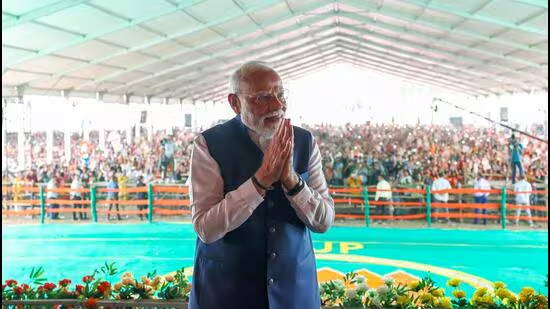
India’s politics in the last 12 years
Opposition parties have found it difficult to match Modi’s appeal, BJP’s relentless groundwork and identity politics
If the political landscape of India in 2026 is vastly different from that of 2014, a large chunk of the credit for this must go to Narendra Modi. Through the course of his three tenures — the third is ongoing and he has just become India’s longest serving elected Prime Minister — Modi has rewritten the grammar of electoral politics, expanded the Bharatiya Janata Party’s reach to communities and regions once thought impossible, and used a combination of welfarism, Hindutva, and personal popularity to corner the Opposition. But there’s a bigger picture: India’s political topography today isn’t just dominated by the BJP but also markedly different from the past in three significant ways.
Before 2014, there was a kernel of truth when the Opposition termed the BJP as a Hindi belt party of upper-castes. Despite a smattering of leaders from marginalised castes, the party repeatedly stumbled in culturally heterogenous regions and among castes and communities who were not culturally wedded to caste. Leveraging Modi’s own credentials as a backward class leader, the BJP has pushed to marry Hindu nationalism with caste politics, using iconography, mythology, welfare outreach and identity politics to appeal to lower castes, especially in provinces such as Uttar Pradesh and Bihar. It has turned Hindutva into an ideologically nimble vehicle to make inroads into states that were lukewarm to the initial 90s push, such as Bengal or Odisha. The result is that today, the BJP rules a far more culturally heterogenous chunk of India than the Congress or any other Opposition party.
Two, a mix of shrewd strategy, smart tactics, and sheer political popularity has almost sounded the death knell of regional parties that dominated India for almost three decades. From Mamata Banerjee in Bengal and Nitish Kumar in Bihar to Naveen Patnaik in Odisha and Uddhav Thackeray in Maharashtra, regional satraps have fallen by the wayside, finding it difficult to match not just Modi’s appeal, but also that of the BJP’s central largesse, relentless groundwork, and identity politics, amid allegations of favouritism towards BJP-ruled states, misuse of central agencies, and a fraying federal compact.
And three, the last 12 years have seen increasing marginalisation of Muslims in politics, both in terms of the number of lawmakers — the BJP usually doesn’t nominate Muslims as candidates — and electoral heft in states such as Bihar and West Bengal. Unfortunately, this has coincided with many Opposition parties taking the community for granted, evidenced by the fact that even in Muslim-majority districts, parties such as the Trinamool Congress in Bengal or Congress in Bihar have seen a splintering of support in favour of newer entrants or more rooted opponents.
Related Stories
 India
India
Leaders of India’s Cockroach party jailed for violating ban on protest site
6 minutes ago
 India
India
Indian diaspora in London stages counter
3 hours ago
 India
India
‘Power comes from people’s mandate, not chaos’: CM Yogi Adityanath warns against ‘Bangladesh
4 hours ago
 India
India
Delhi traders urge PM Modi, Rahul Gandhi, Kejriwal to postpone protests till January 31
6 hours ago
 India
India
Jagan Mohan Reddy recalibrates stance, demands CEC's resignation, signals opening to INDIA Bloc
6 hours ago
 India
India
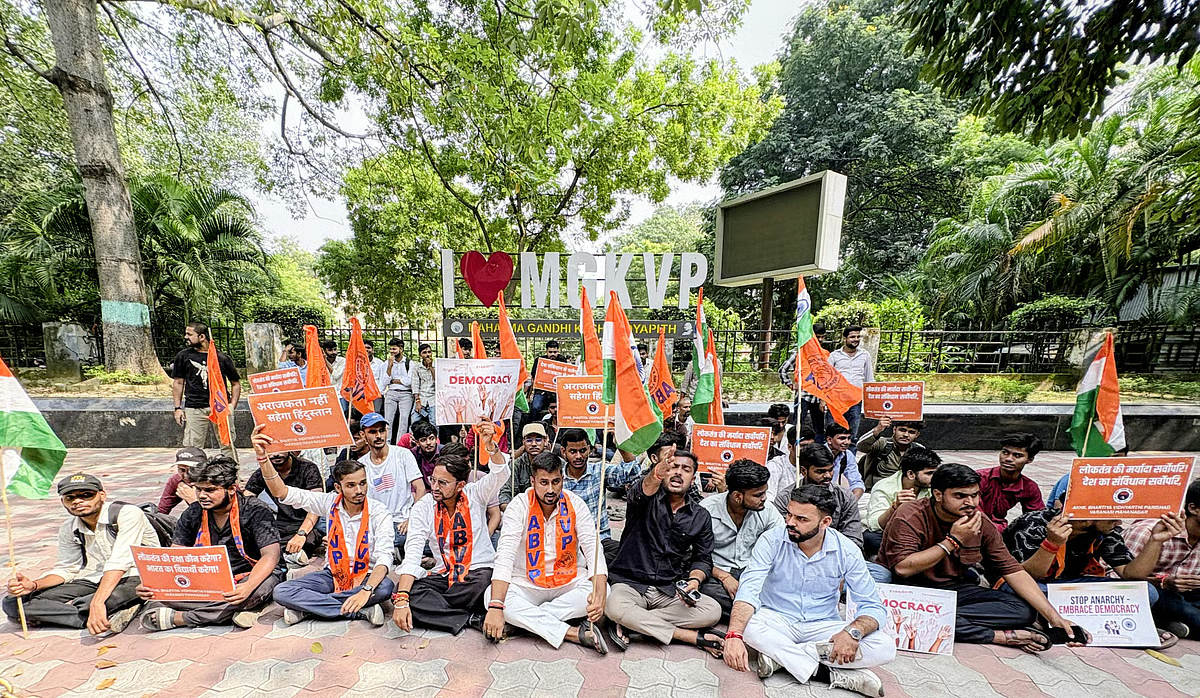
ABVP stages nationwide protests against ‘politics of anarchy’, backs constitutional institutions
6 hours ago
 India
India
The 'Cockroach' Context: Lessons From Nepal, Spain, Kejriwal On Protest
7 hours ago
 India
India
UPI politics, SIR protests and India’s inflation squeeze | Delhi Police | CEC | Macro Matters Ep 10
10 hours ago