
Inside the Biggest Feud in Artificial Intelligence
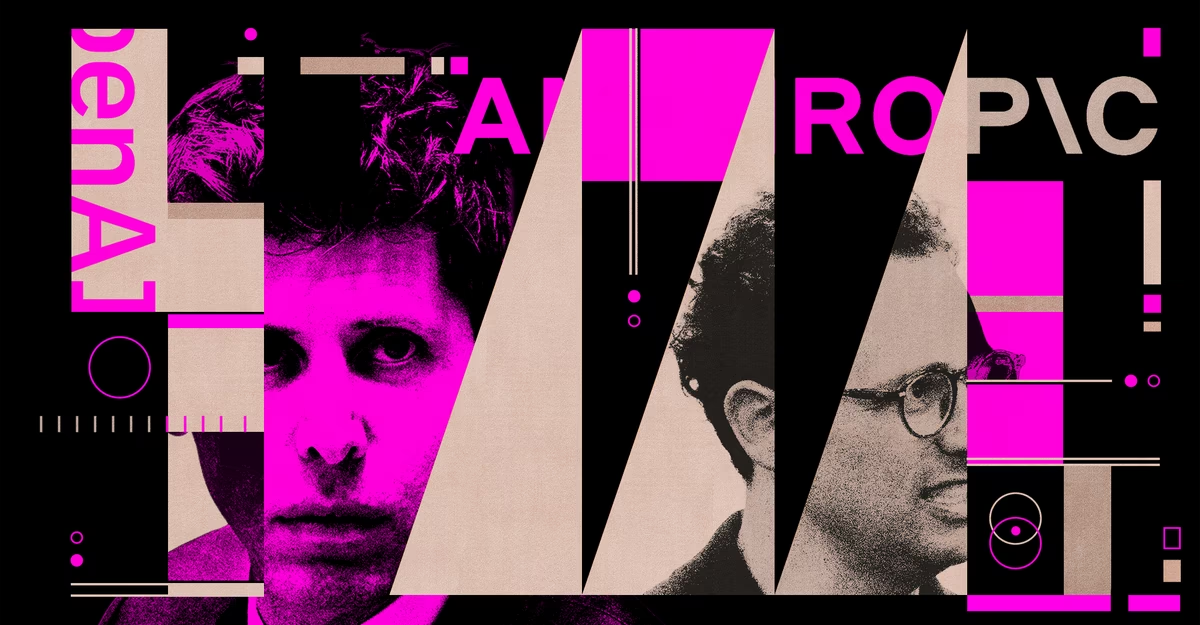
Being in San Francisco in the mid-2020s sometimes feels like what I imagine living in Los Alamos was like in 1943, when the Manhattan Project rolled into town. The air is heavy with excitement and dread. Engineers toil, day and night, on systems of profound consequence. Wild-eyed prophets sell visions of a transformed world, and politicians drop in to check on the progress of the project. Everyone knows that the fates of nations, and trillions of dollars of capital, rely on what happens here, yet no one can fully appreciate what it would mean if the project succeeds.
One person consumed by this question is Dario Amodei, a Princeton-educated physicist who in 2016 left Google to join OpenAI, then a fledgling non-profit AI research lab. He looked the part of a mad scientist, with round glasses and short brown ringlets that he twisted in his fingers whenever he was feeling nervous or thinking hard about something. He was known among his colleagues as a brilliant, bullheaded researcher with deep convictions about AI, which he often expressed by writing long essays that he circulated inside the company.
The most famous of these essays among OpenAI workers was a 26-page document titled “Big Blob of Compute.” Amodei wrote it in 2017, shortly after arriving at OpenAI, and it spelled out his grand theory of intelligence—how it emerged in nature, how it could be built into AI systems, and how it could be developed safely. Amodei’s hypothesis that machine intelligence was primarily a function of scale—that AI systems got smarter as they got bigger—steered OpenAI’s research agenda toward large language models, which Amodei saw as a promising path to artificial general intelligence, or AGI, a human-level intelligence capable of doing anything the brain can.
By the middle of 2020, three teams were racing toward AGI: OpenAI, DeepMind, and Google Brain. But a fourth team was quietly assembling under Amodei, then OpenAI’s vice president of research. Amodei and his team had led the development of GPT-2, then GPT-3, and he was feeling ever more certain that he wasn’t going to stick around for GPT-4.
Career-wise, things were going great for Amodei. GPT-3 was a hit among programmers, and his research on large language models was starting to bear fruit. A year earlier, two researchers on Amodei’s team, Jared Kaplan and Sam McCandlish, came up with what they called the “scaling laws”—equations that described predictable increases in LLM performance as you poured more data, compute, and parameters into them. Another researcher on his team, Paul Christiano, pioneered a technique called “reinforcement learning from human feedback,” or RLHF, which allowed OpenAI to steer its models away from harmful outputs. A third team under Amodei was already making plans for GPT-4, which would be orders of magnitude bigger than GPT-3.
But along the way, Amodei lost faith in the company’s leadership. He had come to believe that Sam Altman was a two-faced manipulator and that OpenAI’s co-founder and president, Greg Brockman, was power-hungry and reckless. Amodei had qualms about their decision to turn OpenAI into a commercial enterprise, and thought that they were straying from the nonprofit’s original mission to “benefit humanity as a whole, unconstrained by a need to generate financial return.”
Most of all, he was sick of the tribal warfare that had turned the whole place into a viper’s nest and forced him to fight for ideas he thought should be obvious. One person who spoke to Amodei during this time said that Amodei considered OpenAI “a shit show” that was “run by low-integrity people.” If he hadn’t reached his breaking point yet, it seemed possible that he soon would. “Every day there was a new crisis, a new crazy thing that Sam was about to do in 24 hours if Dario didn’t throw an absolute temper tantrum,” the person said.
That year, Amodei started pulling members of his team aside to tell them about all the objectionable things he’d seen. The worst, in his opinion, was a fundraising scheme that Greg Brockman and Ilya Sutskever, two of OpenAI’s co-founders, had cooked up back in 2017, when Elon Musk was pulling away from OpenAI and the company needed a new source of funding. Their idea, which became known as the “countries plan,” was to set up an auction between governments, including the United States, China, and Russia, for the rights to OpenAI’s future AGI technology, according to five people familiar with the plan.
The plan had started months earlier, as a more benign proposal to explore the idea of creating an international coalition to promote the benefits and manage the risks of AGI. But by the time Brockman and Sutskever pitched the plan to OpenAI employees at an internal presentation that winter, it had turned into a fundraising strategy. Brockman and Sutskever rationalized the plan by claiming that AGI—if and when it arrived—would have such powerful national-security implications that governments would seize it from the private companies that developed it, according to two people familiar with their thinking. And if OpenAI might be forced to hand over AGI to Xi Jinping of China and Vladimir Putin of Russia eventually, why not sell it to them now, when the company needed the money?
“It sounded like tech people pitching an insane start-up, where they have this wacky plan and then at the end of the plan, it’s like, We’ll make the government pay for it,” one person who heard the presentation told me. (An OpenAI spokesperson insisted to me that although the company “briefly considered whether to turn OpenAI into an international cooperative endeavor,” it “did not consider selling AGI to China or Russia.”)
Amodei was horrified when he heard about the countries plan. Were they insane? Selling AGI to dictators, he believed, was the exact opposite of OpenAI’s mission, and it was a slap in the face to people including the members of his safety team, who joined OpenAI because they believed it was a noble cause.
In December 2017, he wrote an email to Brockman and Sutskever, along with some other top OpenAI executives, spelling out his objections to the countries plan. He wrote that the original idea of an international AGI coalition “seems to have morphed over the course of a couple weeks into something I strongly believe is a bad idea: a plan to sell AGI to governments, e.g. Russia, China, and the US; or raise money from those countries with a promise to do so; or perhaps even play countries off against each other in an attempt to get funding.”
He continued: “In my opinion this plan would exacerbate rather than reduce arms races, would potentially enable human rights atrocities (giving someone like the Russian government ‘an AGI that implements their values’ would allow them to do unspeakably awful things to their people), and would undermine OpenAI’s moral legitimacy.” Instead, Amodei said, OpenAI should be optimizing for what is “good for humanity.”
His protests turned out to be moot. After Musk pulled out, the company found new funding from Microsoft and abandoned the countries plan. But Amodei never forgot how seriously Brockman and Sutskever had considered an idea he found morally obscene.
In 2018 and 2019, Amodei objected to a number of other business decisions OpenAI made, such as selling access to GPT-3 through an API. But his biggest concern was about Altman’s character. He recorded examples of times he felt Altman had misled him. During private beta-testing for GPT-3, for instance, he’d asked Altman for a list of the customers who had been approved to use GPT-3. Altman sent him one. But Amodei claimed that he had discovered another, longer list of approved customers, which Altman hadn’t told him about.
Amodei also thought he’d caught Altman misrepresenting his negotiations with Microsoft for a new, $1 billion investment; Altman told Amodei that Microsoft had rejected certain safety-related provisions of the deal that Amodei had wanted to include. One of these provisions was about OpenAI’s so-called merge-and-assist clause—a line in OpenAI’s charter, which Amodei had written, that committed OpenAI to stop competing with, and start assisting with, any “value-aligned, safety-conscious” project that “comes close to building AGI before we do.” During the Microsoft negotiations, Amodei had insisted that Microsoft shouldn’t be able to veto an acquisition of OpenAI—the most likely way that a merge-and-assist would be enacted—but Altman had told him that Microsoft wouldn’t agree to the term. Amodei believed that Altman had been so eager to get the deal done that he conceded the provision (or never asked for it in the first place), then lied to him about it.
Some of their disputes were related to business and strategy decisions, but others seemed more like ethical lapses to Amodei. Altman, for example, had met Kanye West and offered to let him into the GPT-3 private beta in 2020, according to two people familiar with the offer. Jack Clark, OpenAI’s policy director, quashed the idea, pointing out that West had recently posted a video that seemed to show himself urinating on a Grammy award and appeared to be mentally unstable. (This was before the period in which West began to publicly express admiration for Hitler.)
There were many more examples on Amodei’s list—times he thought Altman had acted recklessly, or seemed to get caught in a lie. Few of them were worth quitting over, on their own. But they added up to a picture of a person who, in Amodei’s mind, couldn’t be trusted with a technology as powerful as AGI. His sister, Daniela Amodei, was also getting fed up with OpenAI. She and Brockman had once been close. (Brockman even gave a toast at her 2017 wedding to Holden Karnofsky, who joined OpenAI's nonprofit board that year.) But years of working together had strained their relationship. She had also started to clash with Mira Murati, then OpenAI’s vice president of applied AI and partnerships, over who was in charge of making decisions related to safety.
Inside OpenAI, some employees viewed Daniela as her brother’s high-EQ counterpart. She was a skilled manager who had majored in English literature in college and worked in politics before her career in tech. But as her role expanded to include managing more of OpenAI’s technical teams, she collided with Brockman and other leaders, who came to see her as the third member of an inflexible triumvirate that included Dario and Karnofsky.
Daniela had an unusual process for working through conflicts. She and Karnofsky had a large collection of stuffed animals, which they treated as their personal advisory council for managerial role-playing. Each animal had an assigned character profile. Jinji was a lazy cat who encouraged Daniela to cancel meetings and avoid taking on too much work. Maura, a pink bear, was a detail-oriented, type-A manager. A panda named Beary Bonds was the “patron bear of generosity and empathy.” She treated these exercises as something between an inside joke and an earnest management technique. (In 2023, she told me the animals were “very useful in analyzing different personality types.”) And although not many people at OpenAI knew about the animals, the ones who did weren’t sure how seriously she took their advice.
That year, the Amodeis began building their own nucleus inside Open AI. “Dario’s clique,” as some people called it—though it was really both his and Daniela’s—set up private Slack channels and held their own meetings. They talked constantly about safety, using jargon that was unfamiliar to the more technical engineers. And to the people who weren’t invited, it felt standoffish—a safety splinter cell that was refusing to work with anyone else.
“Dario had a habit at the time of just saying, We must do X; it is the morally correct thing to do. It was like a shortcut to win any argument—‘because safety.’ And that really pissed the non-safety teams off,” one former colleague told me. Amodei had considered quitting before, but he’d always talked himself out of it. Staying and fighting for OpenAI’s mission, he reasoned, was better than letting other, less safety-minded people do the job. He knew that OpenAI had the most talented researchers in the industry, and the best chance of getting to AGI, and he thought that he could change the company from the inside. But one day in 2019, he emailed his housemates, and a few close colleagues on the safety team, and told them that he had given up on making OpenAI work. Any progress that the safety team made was bound to be temporary, he said, and would always be overridden by Altman and Brockman’s commercial priorities.
He thought about going to work for DeepMind, whose safety work he respected. But Jared Kaplan, the physics professor who led scaling-laws research at OpenAI, suggested a different idea: What if Amodei gathered all the people at the company who shared his views on safety, and they started their own company together?
Amodei was initially skeptical. Did the world need one more company racing toward AGI? Wouldn’t a mass exodus of safety-minded OpenAI employees make the company even more dangerous? But the more he thought about Kaplan’s idea, the more he liked it. In 2020, the year GPT-3 came out, Amodei approached a few members of his clique and pitched them on the idea of leaving OpenAI together to start a new company. Like OpenAI, the new company would do cutting-edge AI research focused on scaling up large language models. But they would be surrounded by other people who cared deeply about safety, and they would be free of OpenAI’s constant drama and infighting.
Within a few weeks, Amodei had collected seven co-founders: himself, Daniela, Jack Clark, Sam McCandlish, Tom Brown, Chris Olah, and Jared Kaplan. (An eighth co-founder, Ben Mann, was added later.) That was enough to get started. And once they told the rest of OpenAI that they were leaving, more would certainly follow.
Amodei didn’t want to leave right away. First, he decided to tell Altman about his plans and offer him a list of conditions under which he’d agree to stay. He suspected those conditions—which would include giving the safety team veto power over new product releases—probably wouldn’t fly. But Amodei hoped that the threat of leaving, and bringing some of OpenAI’s brightest minds with him, would force Altman to take them seriously.
While Amodei negotiated with Altman, the group of seven formed a private Slack channel and called it BATNA, which stood for “best alternative to a negotiated agreement,” a wonky business-school term that referred to their option of walking away. And they started to plan their escape. Once it became clear that Altman wasn’t going to give Amodei what he wanted, the BATNA group hired a lawyer and began negotiating the terms of what they started calling “the divorce.”
Altman agreed that the BATNA group could poach any other OpenAI employees it wanted for a period of several weeks, in exchange for agreeing not to poach any more for a year afterward. Daniela Amodei, who was leading the negotiations on the BATNA group’s side, asked to take some of their internal research documents with them to the new company. They agreed to sign a mutual non-disparagement agreement, each group pledging that it wouldn’t bad-mouth the other in public.
Then, in December 2020, OpenAI employees got an invitation to an all-staff virtual meeting. Altman began the meeting as if it were a normal weekly update. He ran through updates on OpenAI’s research and announced a few new hires. Then he turned the floor over to Amodei, who announced that he and six other OpenAI leaders were quitting to start their own, safety-focused AI organization.
Emoji, exclamation points, and shocked messages flooded the meeting’s chat window as Amodei put a positive spin on the news. He said that OpenAI would continue to pursue its mission of creating AGI for the benefit of humanity, and he gave only the vaguest details about why the seven employees had decided to leave. A final message, from Jack Clark, appeared in the chat: “I love you all.” Then, suddenly, their screens went dark. OpenAI had removed them from the call, revoked their email and Slack access, and remotely bricked their laptops.
Altman stayed on the call and tried to reassure panicked employees that OpenAI would continue operating as normal. But employees were already texting one another, trying to figure out what had happened. Some wondered whether anyone would be left to train GPT-4. Others tried to figure out who their new managers would be, or which of their co-workers were joining the new venture.
A few hours later, the newly unemployed co-founders held their own video call—BATNA’s first meeting. There was plenty of business to attend to, and plenty of unanswered questions to worry about. How could seven people possibly hope to compete with OpenAI and Google? Where would they get the GPUs and the data and the money? Who would handle the boring corporate stuff, like filing the legal paperwork and buying everyone new laptops? What would they call themselves? (“Anthropic,” it would turn out, although the company originally planned to call itself “Sparrow Systems,” after a parable from Nick Bostrom’s 2014 book Superintelligence, until the co-founders realized the domain name wasn’t available.)
But there would be time to answer those questions later. For now, they celebrated, raising glasses to one another in their virtual meeting boxes, smiling and laughing more than any of them had in months. They didn’t know exactly what to do next, or what the future would hold. But they were free.
Five years later, Anthropic—which now has thousands of employees, a high-profile feud with the Pentagon, and a trillion-dollar IPO on the horizon—barely resembles the company Dario Amodei and his colleagues set out to create.
Initially, they conceived of themselves as a small AI-safety research lab, not a product company. Anthropic’s founding document, a 2021 Amodei essay titled “Vision for a NewCo,” envisioned a company of roughly 50 employees (to ensure “extreme talent density”) and predicted that building AGI would cost only about $10 billion.
When I first visited Anthropic’s headquarters, in the summer of 2023, the entire company consisted of about 160 earnest AI-safety obsessives cooped up together in a Jackson Square office building, a floor above an elder-care organization. Inside, engineers played board games and ate vegan sandwiches before heading back to their desks to hack on the next version of Claude, Anthropic’s chatbot. There were plants everywhere, and hundreds of empty cans of Liquid Death, a trendy sparkling water brand, that an engineer had fashioned into a towering throne. It looked like a college botany lab, or maybe the headquarters of a prosperous cult.
But when I returned in the winter of 2025, the cult had transformed into a command center. Anthropic’s workforce had swelled to thousands of employees, and it had taken over the former headquarters of Slack, in a sleek, industrial high-rise on Howard Street. A dozen brawny security guards stood watch at the entrance. Upstairs, past the guards, the company had turned most of its office space into a high-security containment zone. Visitors were allowed onto only certain floors, and getting onto some of the other floors—including the one where new versions of Claude were being trained—required special clearance even for employees.
There were still hints of the old Anthropic: a lush arboretum, a library with a copy of The Making of the Atomic Bomb, Amodei’s favorite book, which had once been required reading for new Anthropic employees. But everything else was different. Anthropic had become one of the fastest-growing companies in the history of capitalism, and was running neck-and-neck with OpenAI in the race to AGI. Amodei and his co-founders had become globe-trotting tech celebrities, and Amodei—who had always tried to live below his means, and was slightly embarrassed by his new station—now traveled to fancy conferences on a charter jet, flanked by a team of bodyguards. The company had turned several of his mega-essays—such as “Machines of Loving Grace,” a 15,000-word paean to AI optimism, and “The Adolescence of Technology,” a gloomier follow-up—into expensively printed books.
Upstairs, Dario and Daniela Amodei, Anthropic’s president, now spend their days managing long lists of what Jack Clark, another Anthropic co-founder, calls “success disasters.”
“It’s stressful on every dimension,” Daniela told me. “And it’s scary because we can lose it at any time. That’s just on the business side. Then there’s the mission, and we’re like, Are we accidentally making things worse? Like, we think we have all the safety stuff figured out, but do we?”
One thing that hasn’t changed is the Amodeis’ rivalry with OpenAI. Dario and Daniela still despise Altman and Brockman, according to several people who know them well. And Dario, who is less filtered on Anthropic’s Slack than he is in his public appearances, has written in internal messages that Altman and OpenAI are “evil.” (An executive on Anthropic’s communications team asked him to delete one such message, around the time of the 2023 OpenAI board coup, out of fear that it might leak.)
The feud goes both ways. In private, some people at OpenAI have described the Amodeis as power-hungry virtue-signalers, not principled humanitarians. OpenAI employees gossip about Anthropic’s connections to effective altruism and accuse the company of hypocrisy, for publicly warning of AI’s risks while privately accelerating the race. And despite the companies’ recent willingness to cooperate on safety measures, few people who know Altman, Brockman, and the Amodeis expect them to make amends anytime soon. Workers at both companies have noted the irony that although their bosses train AI models to be kind and compassionate, they can’t stop trashing one another. For now, it seems, the “machines of loving grace” will be built by humans of bitter spite.
This article is adapted from Roose’s book, The AGI Chronicles: The Inside Story of the Race to Create an Artificial Superintelligence.
When you buy a book using a link on this page, we receive a commission. Thank you for supporting The Atlantic.
Related Stories
 AI News
Reimagining Financial security through artificial intelligence and intelligent systems
7 minutes ago
 AI News
Slovenia sees surge in '.si' sites after Trump hypes 'super intelligence'
7 minutes ago
 AI News
VELLOE - An EVOCS Company Concludes Escape Velocity 1.0
7 minutes ago
 AI News
Cohere CEO calls for global AI safety body that includes China buy
7 minutes ago
 AI News
Artificial intelligence dating scams move beyond fake profiles to entire fake apps
1 hour ago
 AI News
Top AI Startups In Australia To Watch In 2027
1 hour ago
 AI News
Meta enters new business focused on selling AI tools to enterprise customers, takes on Google, Microsoft,
1 hour ago
 AI News
AWS and Brightstorm partner on AI
2 hours ago