
Is Artificial Intelligence taking over our lives?
For most of history, technological revolutions have announced themselves dramatically. Euphemism for disruptive. They have been transformative and epochal. Steam engines heralded the Industrial Revolution. Electricity lit up cities and forced our circadian rhythms to adapt. The internet connected continents and the world became flat according to Thomas Friedman, a borderless world according to Kenichi Ohmae and a global village according to Marshal McLuhan. Smartphones brought about a tectonic shift and changed the way how billions lived almost overnight.
Artificial Intelligence has been different. The medical fraternity would call its approach “Non-Invasive!” It did not arrive with fanfare. There was no single “AI Day” when humanity woke up to discover intelligent machines. Instead, AI quietly slipped into our lives, one recommendation, one navigation route, one spam filter, one voice assistant at a time. Before most people realized it, AI had become woven into the fabric of everyday existence and enriched it by the sheer brilliance of the tapestry.
Today, AI writes emails, diagnoses diseases, drives cars, creates music, detects fraud, predicts weather, translates languages, and increasingly acts as an intellectual companion. It has become perhaps the most influential technology since electricity, yet its greatest achievement has been its invisibility.
This is the story of how AI slowly entered mainstream life and where it might take humanity next.
It may appear that AI is often perceived as a recent invention but it has gone through an evolutionary cycle of its own and its roots go back centuries. Myths imagined mechanical servants endowed with intelligence. Philosophers wondered if human thought itself could be reduced to a set of rules. The industrial revolution brought in machines that amplified physical labour. Likewise, the digital revolution created machines that amplified calculation. The next question was obvious. Could machines amplify intelligence itself?
The journey began in the 1940s when the arrival of the first programmable computers was heralded. Pioneers concluded that if reasoning could be expressed logically, they thinking machines are not far behind. The term ‘Artificial Intelligence’ was officially coined in 1956 during the Dartmouth Conference. The mood at that time was upbeat and optimism was perceptible. Researchers believed that human-level intelligence could be achieved within a generation. Reality turned out to be far more complicated.
Why AI trotted when it could have galloped?
Human intelligence is astonishingly complex. Experts said that teaching a computer to play chess was relatively easier but teaching it to recognize a cat seemed a lot more arduous. It seemed to excel at mathematics but it found perception, language, emotion and common sense more challenging. As the proverb goes, when it rains, it pours! Progress came in waves. Bouts of optimism were followed by ‘AI Winters’ when funding virtually dried because expectations had exceeded reality.
Breakthroughs eventually changed everything. Three of them were pathbreaking and significant. Exponential growth in computing power. Explosion of digital data and new machine learning algorithms. These together veritably transformed AI from an academic curiosity into a widespread revolution.
AI was already ubiquitous and was everywhere but we woke from our stupor and became excited about Generative AI only when we became aware of tools like ChatGPT, Microsoft Copilot and Google Gemini.
People were already using AI without realizing it. Unlocking phones with facial recognition, Netflix suggesting the next movie, Amazon recommending products, Google predicting search queries, maps finding the fastest route, banks detecting fraudulent transactions, e-mail filtering spam, social media selecting from what appears in the newsfeed. These systems quietly learned from billions of transactions. AI did not appear suddenly. It eventually became the operating system of our modern society.
Around 2012, AI entered a new era. Apparently, that was the beginning of the deep learning revolution.
Deep learning- computer systems inspired loosely by neural networks in the human brain began producing astonishing results. Image recognition improved dramatically. Speech recognition became practical. Machine translation reached human quality. Medical imaging almost rivalled expert clinicians who were experts in that field. For the first time, machines began recognising patters that humans struggled to detect. Computers learned from examples. Otherwise, every rule had to be programmed explicitly. This represented one of the biggest conceptual shifts in computer science.
Then came Generative AI. Public perception of AI changed overnight. Earlier, AI mostly analysed information. Generative AI began creating it. Lo and behold, computers could write essays, generate software, create paintings, compose music, produce videos, summarize books, design products and answer complex questions.
For millions of people, this was their direct conversation with an AI system. AI became conversational rather than hidden algorithms working silently in the background. That changed the paradigm and consequently altered our perceptions.
Alvin Toffler’s Third Wave was reaching its zenith and its logical culmination.
The impact of AI was becoming pronounced and all pervasive.
• AI assists doctors by analysing medical scans, predicting disease risks, accelerating drug discovery, monitoring patients remotely, and supporting personalized treatment.• Rather than replacing physicians, AI increasingly functions as a highly capable assistant.
• Personalized tutoring has become possible at an unprecedented scale.• AI can explain concepts differently for every learner, generate practice questions, provide instant feedback, and adapt to individual learning speeds.• Education may become less standardized and more individualized.
• Banks use AI to detect fraud within milliseconds.• Investment firms analyse enormous datasets.• Insurance companies estimate risks more accurately.• Customer service has become increasingly automated.• Financial decisions are becoming faster, though not necessarily simpler.
• Factories now use AI for predictive maintenance, quality control, robotics, and supply chain optimization.• Machines often identify problems before human operators notice them.
• Farmers use AI-powered drones, satellite imagery, sensors, and weather models to optimize irrigation, fertilizer use, and crop management.• Precision agriculture may become essential as global food demand grows.
• Navigation systems optimize traffic.• Airlines predict maintenance needs.• Ports optimize logistics.• Autonomous vehicles continue advancing toward widespread deployment.• Transportation is gradually becoming algorithmically coordinated.
• Perhaps AI’s greatest impact will be accelerating scientific discovery.• Researchers use AI to model proteins, discover new materials, simulate climate systems, and analyse astronomical data.• Instead of replacing scientists, AI expands what scientists can investigate.
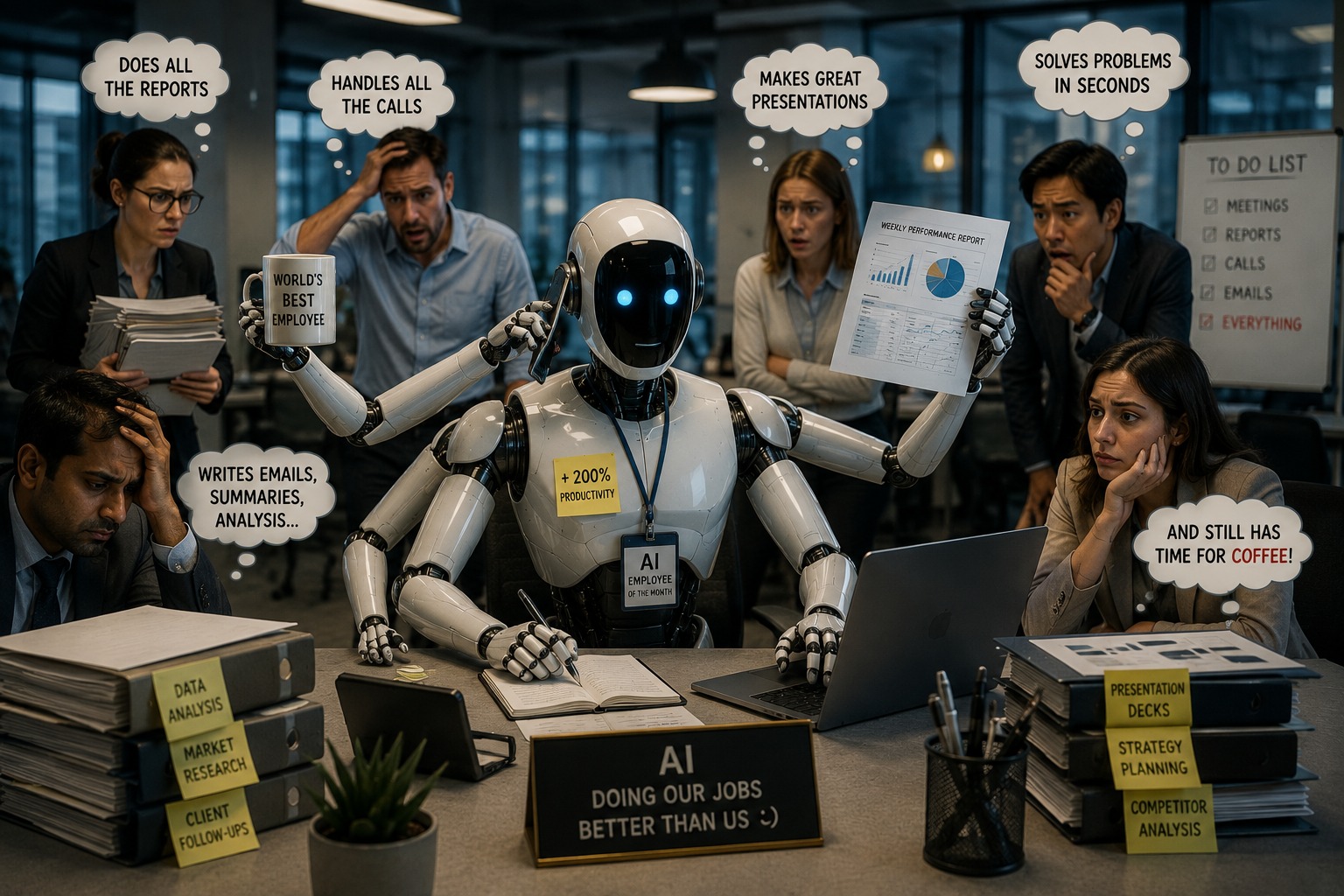
Every major technological revolution will impact employment. AI will be no exception. Some routine jobs will decline. Entirely new professions will emerge. History provides ample testimony and perspective.
The automobile reduced demand for horse-related industries but created mechanics, traffic engineers, automobile manufacturing, logistics, and highway construction.
Likewise, AI will create demand for AI Engineers, Prompt Specialists, AI Auditors, Ethics Consultants, Data Scientists, AI Safety researchers and Human-AI collaboration designers.
The challenge is managing the transition rather than resisting change itself.
AI’s creative ability has baffled everyone. For decades creativity was considered uniquely human. Today AI writes poetry, paints portraits, composes music, produces films and generates architectural designs. This raises some valid questions.
If AI creates a beautiful painting, who is the artist? If AI writes a bestselling novel, who owns the copyright? If AI composes a symphony that moves audiences emotionally, is creativity still uniquely human?
These questions have no easy answers.
Every transformative technology brings difficult choices. AI presents several of them.
If there is Bias, AI will amplify it. Fairness is therefore one of AI’s greatest challenges.
AI thrives on data. The more information systems collect, the better they perform. But how much personal information should society be willing to share?
AI can generate convincing fake text, images, voices, and videos. Distinguishing truth from fabrication may become increasingly difficult. Truth itself becomes a technological challenge.
If an autonomous system makes a mistake, who bears responsibility?
Legal systems worldwide are still exercised about this and searching for answers.
Perhaps no question generates more debate. History suggests technology usually changes work more than it eliminates humanity’s role. Calculators did not replace mathematicians. Spreadsheets did not eliminate accountants. Photography did not end painting. The internet did not replace libraries. Instead, professions evolved. AI will almost certainly automate many routine cognitive tasks. But empathy, judgment, ethics, leadership, negotiation, imagination, wisdom, and human relationships remain profoundly valuable. The future may belong not to humans competing against AI, but to humans who learn to work alongside it.
Artificial Intelligence has become a geopolitical priority. Nations view AI as strategically important for economic competitiveness, healthcare, defence, education, and scientific leadership. The countries that successfully develop AI talent, infrastructure, and regulation will be frontrunners and may shape the global economic discourse for decades.
AI is no longer merely a technological issue. One Upmanship here has become a geopolitical imperative.
Governments face a delicate balancing act. Too little regulation may encourage misuse. Too much regulation may stifle innovation. The challenge is creating rules that encourage progress while protecting society. Issues like privacy, copyright, transparency, safety, accountability, competition and national security have to be discussed and deliberated up. The regulatory frameworks we establish today may influence AI’s trajectory for generations.
Technology is never only about technology. It changes culture. Relationships, Education, Politics, Business, Art, Identity. AI forces us to ask deeper and searching questions. What makes intelligence uniquely human? What is creativity? What is consciousness? Can machines ever understand or only imitate understanding? The AI revolution is as much philosophical as it is technological.
Artificial Intelligence is still in its early nascent and evolutionary stage. Future systems may become more capable in scientific reasoning, healthcare, engineering, education, and creativity. Human-AI collaboration may become as mundane & commonplace as internet connectivity is today. Yet uncertainty remains. Predictions range from extraordinary prosperity to profound disruption. The truth will likely lie somewhere between technological optimism and dystopian pessimism.
Most revolutions arrive with a lot of noise, fanfare and chest thumping. Artificial Intelligence arrived quietly. It slipped into search engines before becoming a household name. It organized our photographs before writing our reports. It recommended our movies before helping write our software. Then, almost suddenly, everyone realized they had been living with AI for years. The significance of AI lies not merely in smarter machines but in a profound shift in the relationship between humans and technology. For centuries, machines amplified our muscles. Computers amplified our calculations. Artificial Intelligence is beginning to amplify our thinking.
Whether this ultimately becomes humanity’s greatest invention or its greatest challenge will depend not on the intelligence of machines, but on the wisdom with which humans choose to build, govern, and use them.
Naysayers and doomsday prophets always play on our psyche and portend the worst but mankind’s progress was always forward looking. Human ingenuity will always triumph in the end.
The AI revolution has already begun and is on us.
As they say, the greatest of armies cannot stop the onward march of a great idea whose time has come!
Related Stories
 AI News
'Not his fault': Belgium coach consoles Balogun after World Cup controversy
33 minutes ago
 AI News
World Cup: Disastrous U.S. sequence with goalie Matt Freese out of box allows Belgium to double lead in 4
34 minutes ago
 AI News
Belgium beats U.S. 4
34 minutes ago
 AI News
France's Mbappé condemns 'despicable' Paraguayan senator over racism
34 minutes ago
 AI News
Resistance and revenge
34 minutes ago
 AI News
Germany says TKMS submarine win would bring Canada closer to Europe
35 minutes ago
 AI News
First Express Entry draw of July sees lowest PNP cut
36 minutes ago
 AI News
"Australia
39 minutes ago