
It’s crunch time for Canada’s trade deal with the U.S. and Mexico

The Canada-U.S.-Mexico Agreement is up for a joint review on July 1 that will determine whether the deal is renewed or renegotiated. While the U.S. and Mexico are currently in talks and have two more rounds of meetings scheduled in the coming weeks, Canada and the U.S. have yet to begin formal negotiations.
Mike Crawley (new window) · CBC News ·
Sluggish trade negotiations between Canada and the U.S. are finally showing faint signs of life as a milestone looms for renewal of their three-way trade deal with Mexico.
The minister responsible for Canada-U.S. trade, Dominic LeBlanc, says he will travel to Washington, D.C., next week.
Although the Canada-U.S.-Mexico Agreement (CUSMA) is due for its first-ever joint review on July 1, LeBlanc has held just one day (new window) of in-person talks over the past seven months with his Trump administration counterpart, U.S. Trade Representative Jamieson Greer.
The slow pace of negotiations, along with the way U.S. President Donald Trump's tariff regime (new window) has punched holes in the free-trade deal, have combined to raise doubts about the fate of an agreement that is crucial to the Canadian economy.
CUSMA covers roughly $1.3 trillion (new window) in annual Canada-U.S. trade in goods and services and currently shields (new window) a large swathe of Canadian exports from Trump's tariffs.
According to the text (new window) of the agreement, the three countries are to notify each other of changes they want made by next Monday, one month ahead of the formal review, which comes six years after the sweeping trade deal took effect.
The U.S. and Mexico are holding two days of bilateral talks (new window) on CUSMA starting today and have scheduled two further rounds of negotiations in June and July.
Meanwhile, Greer is portraying Canada as far more recalcitrant in coming to the table — at least on terms acceptable to the Trump administration.
Greer criticizes Canada's retaliation on tariffs
"Canada's approach has been different", Greer told an audience at the Council on Foreign Relations in Washington on Tuesday.
"We've spent the past year and a half going to countries telling them we have to have some level of tariffs", Greer said.
"Two countries in the world retaliated against us: the People's Republic of China and Canada. So they're just in a different spot, and it's hard to see necessarily where that ends".
The Carney government has looked to the CUSMA renewal talks as an opportunity to negotiate relief (new window) from Trump's tariffs.
In contrast, Greer and other Trump administration officials have repeatedly insisted (new window) that tariffs will be a fact of life for Canada, regardless of the free-trade deal.
The U.S. has also indicated it wants concessions from Canada — described by multiple sources as an "entry fee" — before it will begin substantive negotiations on CUSMA, Radio-Canada reported (new window) in April.
Those concessions include ending provincial boycotts of U.S. alcohol sales (new window) and scrapping the federal Online Streaming Act (new window), which requires large providers like Netflix and Disney+ to contribute a share of their revenue to support the production of Canadian content.
"We have been clear and consistent with the United States that we are ready to launch the joint review the moment they are", LeBlanc's press secretary, Gabriel Brunet, said Wednesday in an email to CBC News.
Ottawa seeking 'real relief' from tariffs
Canada has put forward proposals with "the potential to generate hundreds of billions of dollars in economic value for American industries and workers in exchange for real relief from the unfair tariffs imposed on Canadian products", Brunet said.
So far, the only tariff relief the Trump administration is offering to Canada would apply only to steel and aluminum companies that commit to move production to the U.S. (new window)
Eric Miller, a Canada-U.S. trade expert based in Washington, says the two countries have "some pretty fundamental areas of disagreement" before they can get down to the nitty-gritty of negotiating specific trade-offs.
"I think it's important that Canada move as quickly as possible to try to get a deal, but not in such a way that it is willing to take any deal", Miller told CBC News.
"Anybody can negotiate a bad deal quickly. But what Canada needs is a good deal", said Miller, president of Rideau Potomac Strategy Group, a consulting firm.
Miller does not believe it's particularly significant that Mexico is currently further ahead in its CUSMA renewal talks than Canada. However, he says the significance ramps up if Mexico reaches its own separate deal with the U.S., without Canada soon doing the same.
Mexico and Canada have been communicating (new window) directly about trade, although their annual two-way commerce in goods is around $56 billion (new window), a mere fraction of each country's trade with the U.S.
Any country can withdraw from CUSMA by giving six months' notice. Such a withdrawal by the U.S. would end the tariff exemption currently granted to most Canadian exports.
"President Trump is notoriously fickle and he could wake up and decide, 'You know what? I don't want to do this [tariff exemption] anymore'", Miller said.
Trump was in his first term as president when the U.S., Canada and Mexico negotiated CUSMA as a successor to the North American Free Trade Agreement. At the time, Trump hailed it as "the largest, most significant, modern, and balanced trade agreement in history".
Christopher Sands, director of the Center for Canadian Studies at Johns Hopkins University, says that when Trump has threatened to withdraw from CUSMA, something he first floated last fall (new window), it's a bargaining tactic to try to win more concessions.
"Canada can play it cool, I think, as long as no one is actually withdrawing", Sands said in an interview.
"I think the U.S. is just going to keep trying to heap pressure on everyone to get as many concessions as possible before it says, 'Yes, we'll renew"', he said.
It's not precisely clear how the Canada-U.S. trade talks will proceed.
Brunet declined to give any details of LeBlanc's upcoming trip to Washington, including who he'll be meeting with or the scope of any scheduled talks.
A spokesperson for the Office of the U.S. Trade Representative did not respond to a CBC News query on Wednesday about Greer's plans for negotiating with Canada.
Related Stories
 Canada
Ottawa removes counter
58 minutes ago
 Canada
Canada is bolstering its defence industry as U.S. relations fray. A boom is on for local contractors
58 minutes ago
 Canada
LeBlanc welcomes U.S. decision 'withdrawing positions' on language, culture
58 minutes ago
 Canada
‘Nonsensical’: We asked Americans what they think about the trade war
58 minutes ago
 Canada
Canada tweaks tariff reprisal after industry input
1 hour ago
 Canada
Nelson: Danielle Smith faces Canada's wrath over Trump tariff fight
1 hour ago
 Canada
Ontario’s order for new subway trains could be hit by Canadian counter
1 hour ago
 Canada
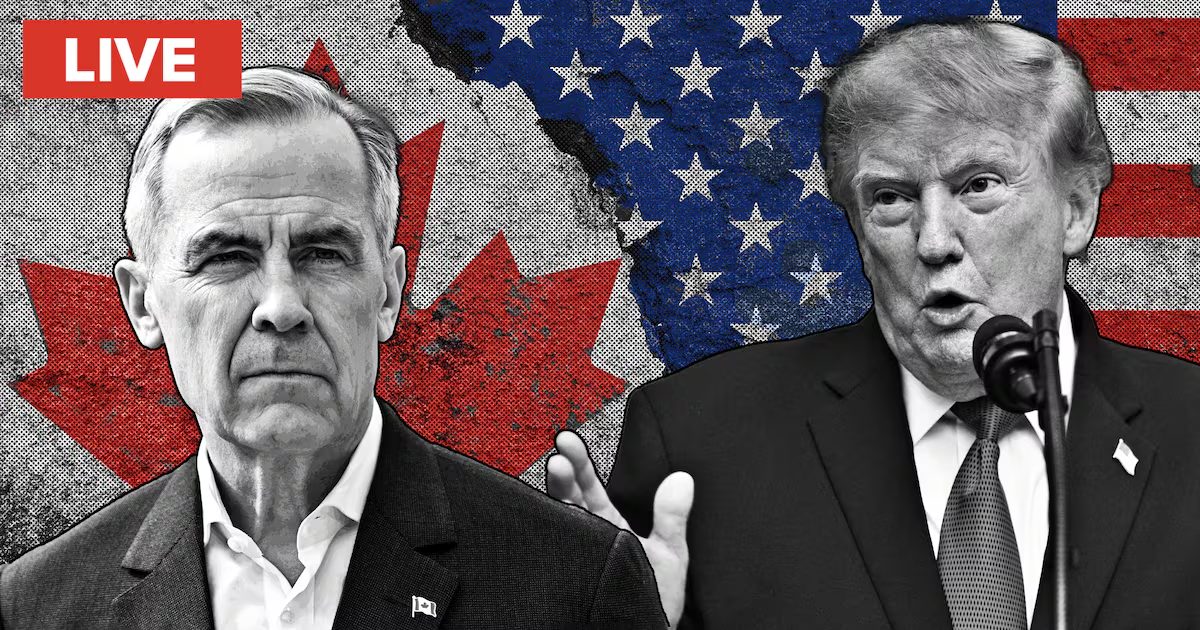
U.S. won’t include French language promotion in future trade actions, LeBlanc says. Follow for live updates.
1 hour ago