
'It's like nobody cares': Indigenous leaders say their issues took a back seat this election
'It's like nobody cares': Indigenous leaders say their issues took a back seat this election
'It's total silence and silence kills,' says Quebec Native Women president
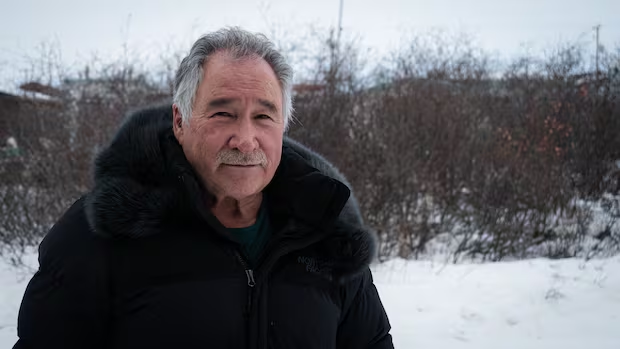
William Tagoona says he feels left out of every provincial and federal election that's been held — and Quebec's 2026 campaign is no different.
The president of Avataq Cultural Institute, which organizes language, heritage and cultural programs in Nunavik, feels his vote doesn't count.
It's partly because candidates in his Ungava riding aren't visiting communities in person, he says.
"It's like nobody cares about our vote," said Tagoona, an Inuit musician and former longtime CBC host for Tuttavik, broadcast out of Kuujjuaq.
"They're not here. They're not sending any information."
Less than a week out from Quebec's provincial election, chiefs and Indigenous leaders say issues impacting their communities have taken a back seat on the campaign trail.
While some provincial parties have noted they will forge partnerships and prioritize nation-to-nation approaches with First Nations and Inuit, concrete plans are lacking , say advocates.
In the days leading up to Wednesday's National Day for Truth and Reconciliation, a dozen Innu, Wendat, Atikamekw and Anishinabeg leaders and chiefs met in front of Quebec City's National Assembly to highlight missed opportunities to collaborate with First Nations throughout the campaign.
Francis Verreault-Paul noted that while Indigenous communities represent a small part of the provincial vote, building relationships remains important.
The chief of the Assembly of First Nations Quebec-Labrador (AFNQL) pointed to economic development and natural resources, as an example.
Quebec parties face scrutiny over silence on Indigenous election priorities
Indigenous people in Quebec are pushing for progress. Is the province doing its part?
"It's undeniable the role that First Nations [are] going to have to play. But we don't hear anything from the party engaging themselves in how are they going to [partner] with First Nations," Verreault-Paul said.
"We cannot only hear, 'Oh yeah, we're going to'.... No, we need to go beyond that. How are you going to implement that?
He recalled leaders speaking about prioritizing Quebec enterprises for major projects and ensuring money stays within the province, but questioned what consideration was given to developing small and medium Indigenous enterprises.
"Are you willing to do that as well for First Nations?" he asked.
Marjolaine Étienne, president of Quebec Native Women, spoke about what she says is an absence of any real progress since the death of Joyce Echaquan, who died in a hospital just north of Montreal on Sept. 28, 2020.
In her final moments, the Atikamekw woman livestreamed racist comments directed at her by hospital staff. Her death led to the creation of Joyce’s Principle, which included a call to action for the Quebec government to address systemic racism. But Étienne says that fell flat.
"It's total silence and silence kills," she said. "It's a huge lack of respect toward Indigenous women and Indigenous peoples across Quebec."
During the final leaders' debate, there was zero discussion about issues affecting Indigenous communities.
Several parties revealed commitments to Indigenous communities Wednesday, including Conservative Party of Quebec Leader Éric Duhaime.
He met with the grand chief of the Huron-Wendat Nation, Pierre Picard. After the meeting, Duhaime shared his vision for Indigenous relations, which includes collaborating with nations on economic development projects and consulting them when a project will affect their territories.
A spokesperson for Québec Solidaire (QS) told CBC News in an email earlier this month that the party would adopt the United Nations Declaration on the Rights of Indigenous Peoples (UNDRIP) and create the constituent assembly process with First Nations and Inuit so they can "participate as they see fit in Quebec’s independence process."
Indigenous leaders remind Quebec: you can't legally separate without our say
A QS government would also co-draft bills with Indigenous people, the spokesperson said, noting that the party had tabled a similar bill in May, during the last parliamentary session.
"We want to establish new partnerships with First Nations for all future renewable development on their territories," read the statement .
A spokesperson for Quebec Liberal Party Leader Charles Milliard said the party would bring a "much-needed change in tone" to the provincial government's relationship with Indigenous communities.
"Communities deserve to be considered, consulted and stakeholders in decision-making and in projects that impact their reality," read the email.
Compare the promises of Quebec’s major parties in the 2026 election
Representatives for the Coalition Avenir Québec (CAQ) and Parti Québécois (PQ) did not respond to CBC's request on Tuesday for further details about their respective plans for Indigenous relations.
But on Wednesday, the PQ issued a news release containing some of its goals. It said the party would consult First Nations and Inuit to create a plan to reinforce Indigenous language vitality in Quebec — notably through the development of language and cultural courses in elementary and secondary education.
At the beginning of September, the CAQ committed to launching a national forest strategy initiative with all partners in collaboration with First Nations.
At a news conference Wednesday, CAQ Leader Christine Fréchette said Indigenous nations are partners with her government, and reiterated the need to work closely with them.
Calls for more collaboration, respect
Top of mind for Lucien Wabanonik, chief of the Lac-Simon Anishinaabe Nation, is the future of the caribou species. He said there are many solutions on an array of issues coming from within communities, but a "lack of openness from the last government."
"We would like to see more collaboration, more openness and more respect, especially with our realities, but with our people, with our governance," he said.
Currently, he says First Nations often don't recognize themselves within the government.
Dr. Stanley Vollant, who is Innu from the community of Pessamit and a surgeon at Montreal's Notre-Dame Hospital, agrees, saying it's almost like "we didn't exist."
Events across Quebec mark National Day for Truth and Reconciliation
"I'm very disappointed because we are on this land and the province is taking the energy from our land," he said, pointing to the fact that his community produces a significant percentage of Quebec's hydroelectricity.
He's optimistic that discussions can turn around in the last week of the campaign, but notes some Indigenous people will not see the point in voting.
"People said, 'they don't care about us so why should [we] care about the election?'" he said, adding that he is personally unsure about whether he should cast a vote.
"But I think maybe I'm going to vote because maybe that's the only way we can change things."
Rachel Watts is a journalist with CBC News in Quebec City. Originally from Montreal, she enjoys covering stories in the province of Quebec. You can reach her at rachel.watts@cbc.ca.
With files from Charlotte Lepage, Kwabena Oduro and Radio-Canada's Félix Lebel
Related Stories
 Canada
Tennessee unable to carry out the execution by lethal injection of Christa Gail Pike
48 minutes ago
 Canada
How will the 'Super El Niño' impact fall colours in Ontario?
1 hour ago
 Canada
BC marks National Day for Truth and Reconciliation
1 hour ago
 Canada
Ontario ministers defend secret payout to Elon Musk's SpaceX over nixed Starlink deal
1 hour ago
 Canada
Ontario completes latest push to raise highway speed limits
1 hour ago
 Canada
Craig Rowe soars to new heights
1 hour ago
 Canada
Environmental groups anxious over Canada's pipeline decision
2 hours ago
 Canada
How Canadians marked 6th National Day for Truth and Reconciliation
2 hours ago