
Jensen Huang’s return to Nvidia fuels Washington fight over China’s chip access
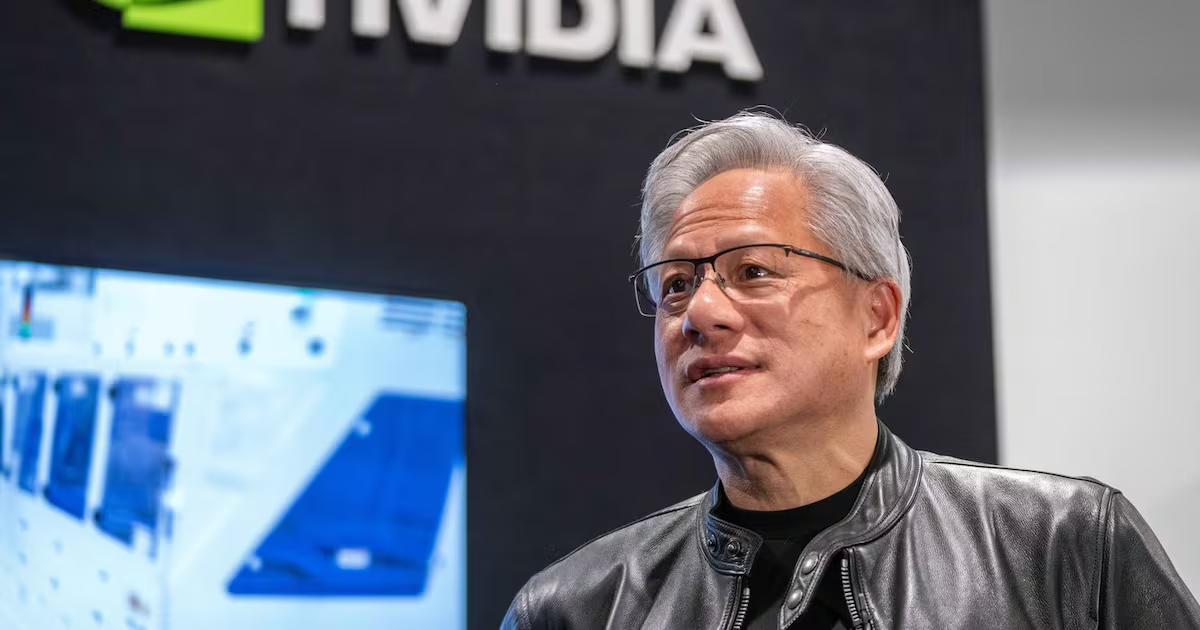
WASHINGTON -- U.S. President Donald Trump’s intervention to save the career of Nvidia CEO Jensen Huang may have settled the question of who will run the world’s most valuable chipmaker, but it has only intensified Washington’s bigger fight over artificial intelligence, chips and China.
On Monday, Nvidia reinstated Jensen Huang as chief executive officer under pressure from Trump, a stunning reversal following his resignation over revelations of extramarital affairs, including with Alice Huang, a former executive at Singapore-based company Megaspeed accused of having ties to Chinese intelligence.
The decision drew applause from Wall Street. But it worried some U.S. officials and infuriated many lawmakers, both Democrats and some of Trump’s fellow Republicans, who said Huang’s return imperiled U.S. security and called for tighter control of China’s access to advanced chips used in artificial intelligence.
“I have warned the administration from the start about Communist China obtaining our most advanced chips through both smuggling and remote access,” said Senator Tom Cotton of Arkansas, the Republican chairman of the Senate Intelligence Committee, in a social media post.
“The controversy with Nvidia and Megaspeed is just the tip of the iceberg, and it’s not resolved because Jensen Huang has his job back.”
Nvidia shares were down more than seven per cent on Tuesday after leaping on Monday on news of Huang’s reinstatement.
His return to the helm of Nvidia has renewed the debate over how the U.S. should compete in the race to dominate artificial intelligence.
On one side are business figures close to Trump, including Jensen Huang, who have helped steer the administration to a more lenient policy. They contend that the best way to keep China from becoming an AI powerhouse is to sell it high-end American semiconductors, weakening Beijing’s incentive to learn how to make them itself.
On the other are China hawks in Congress and some parts of the administration, who want to choke off Beijing’s access to the advanced chips that power the leading AI models and that only Nvidia and AMD produce.
Huang is due to be interviewed in Congress next week.
Since the news about his relationship with Alice Huang, and midterm elections that signalled voter unhappiness with the AI industry, U.S. policy has become more hawkish. The U.S. Commerce Department on Monday added Megaspeed and several other firms to a trade blacklist, barring U.S. companies from selling them chips and other technology.
Experts doubt that the Nvidia CEO’s return will alter that course.
“I think it’s going to lead to a tightening,” said Aaron Friedberg, a professor of politics and international affairs at Princeton University. “There’s going to be a lot of pressure from the Congress to tighten the existing restrictions.”
Friedberg added: “This intervention by Trump, it’s triggering what I think is going to be a much broader reaction, and it’s not just going to be about Nvidia and it’s not just going to be about China.”
Trump celebrated his victory on Monday, taking credit for the turnaround in a long interview on CNBC and calling Huang a “national treasure.”
“The board decided to do what we wanted to do. And one of the things the board wanted to know: Is there a national security problem?” Trump said. “And after a lot of research ... we said, ‘No, it’s not a problem,’” he said.
Even before this week, Trump’s administration had taken a conciliatory approach to China, reversing some restrictions on chip exports imposed under Democratic President Joe Biden.
Trump last December gave the green light to sales of Nvidia’s advanced H200 AI chips to China, drawing criticism from both sides of the aisle.
Beyond the argument that allowing China to have Nvidia chips would make its tech industry dependent on U.S. technology, there has been fear that tougher restrictions could prompt retaliation like extending a ban on exports of rare earth minerals used in electronics, AI hardware and military equipment.
Some analysts say China is keenly aware of the dangers of relying on U.S. exports. “They want PRC companies using Huawei chips, not Nvidia chips. The real speed bump in selling chips to China recently has not been export controls, essential as they are to protect sensitive technologies, but that they’ve been slow to buy,” said Michael Schiffer, a senior fellow at the U.S. Center for American Progress.
In recent weeks, U.S. authorities have taken a tougher approach, tightening licensing rules for some chip shipments and overseas data centers serving Chinese companies.
Three bills making their way through Congress would further tighten China’s access to semiconductors: the AI Overwatch Act, which would give Congress power over advanced chip exports, the Chip Security Act, which would require businesses to track their chips to combat smuggling, and the Match Act, which would push U.S. allies to restrict chipmaking equipment.
The Match Act in particular would be seen by Beijing as infringing on China’s right to develop, a red line set out by Chinese leader Xi Jinping, Paul Triolo, tech policy lead at advisory firm DGA-Albright Stonebridge Group, said.
“These would also be major breaches of the U.S.-China truce, and Beijing will retaliate strongly to all of these measures, creating another dangerous tit-for-tat cycle of escalation that could undermine the truce and significantly worsen bilateral relations,” he said.
Even if tightened restrictions on China do not pass before the end of 2026, Democrats will control large majorities in both the House of Representatives and Senate after January 3. With Republican China hawks, they could pass bills with majorities large enough to override Trump’s veto.
For their part, China’s policymakers are unlikely to sit still.
“Beijing is unlikely to stake everything on Trump’s goodwill and the next president,” said Lizzi C. Lee, an expert on technology and the Chinese economy at the Asia Society Policy Institute.
“If anything, expect the push for domestic substitution to accelerate after this episode which already exposed the vulnerability of China’s AI ambition.”
(Reporting by Patricia Zengerle and Simon Lewis; Additional reporting by David Brunnstrom; Editing by Don Durfee and Alistair Bell)
Related Stories
 AI News
Can AI chatbots really help shoppers find the best deals?
37 minutes ago
 AI News
AI’s ‘opportunity divide’ could deepen global inequality, UN official warns
40 minutes ago
 AI News
US nonprofits sue tech giants to halt AI development
40 minutes ago
 AI News
Barbados Hosting Global Conference on Artificial Intelligence Safety
40 minutes ago
 AI News
US stocks fall further as fears over AI intensify
1 hour ago
 AI News
What Comes After Artificial Superintelligence? Universal AI and The Limits of Machine Intelligence
2 hours ago
 AI News
When Excellence Becomes Evidence of Artificial Intelligence
2 hours ago
 AI News
RWS launches AI living lab with IMDA, STB to advance tourism technology
2 hours ago