
Kelowna ER physician says he's 'experiencing severe exhaustion'
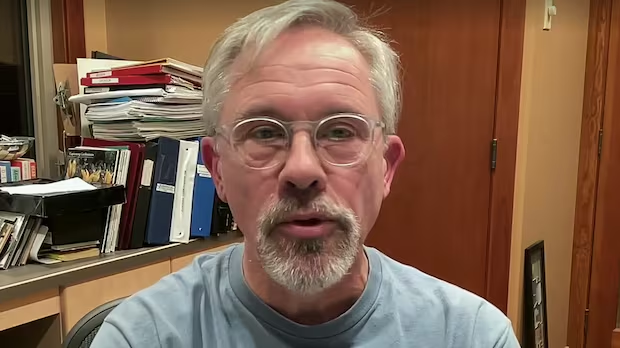
Kelowna ER physician says he's 'experiencing severe exhaustion' — and he's not alone
New survey shows 1 in 10 ER doctors leaving their specialty, others taking time off for burnout
If you’ve visited an emergency department in recent years, it probably comes as no surprise to you that emergency physicians are tired.
Jam-packed waiting rooms, hallways lined with beds for patient overflow and patients using the emergency room in place of a family doctor or specialist, because they’re unable to get that kind of care otherwise.
New survey data published in the Canadian Medical Association Journal shows one of every 10 emergency physicians in Canada have left their specialty — while the majority of others are reducing hours or taking time off to deal with burnout.
The reason? Survey respondents pointed to three things: a broken health-care system, unrealistic societal expectations and insurmountable workplace challenges.
1 in 10 emergency physicians leaving Canadian ERs, national survey suggests
Dr. Jeffrey Eppler is an emergency physician at Kelowna General Hospital. He discussed the survey with CBC Daybreak South host Chris Walker.
This interview has been edited for length and clarity.
What do you make of these survey results? Do they match up with what you're seeing day-to-day?
Oh, absolutely. I think that really kind of speaks to the experience of emergency physicians and departments across the country.
I can't speak to all departments, but certainly in Kelowna General Hospital — which is the second-busiest ER in the province — I think we're doing better than almost any other tertiary academic centre in the country in terms of wait times.
But even we have our struggles every day. We face overcrowding, we often have staffing shortages in terms of nursing and other staff. So we have our challenges, but I think we're doing a little better.
I am in contact with physicians across the country. I have family members who work in other departments, and I can tell you that in some places it's quite a difficult situation.
What does a broken health-care system actually mean in practice? What's an insurmountable workplace challenge?
I mean, treating people who are in septic shock sitting in chairs, people waiting eight, 10, 12 hours to be seen, people with heart attacks sitting in chairs and actually being treated in a chair until a bed can be found for them. So this is difficult.
More stories from the B.C. Interior
Even the workplace environment, coming into a department that's full of patients who have been admitted to hospital and languished in hallways for days.
We go into medicine, we want to help people and then to see these things, it can be quite disheartening and creates a lot of what we call moral injury where you really want to do the right thing, but circumstances prevent you from really achieving that goal.
How do you handle that personally?
I think you have to focus on the reason we do this, which is to help people.
We've been very creative in our department. We make sure that we have sufficient staff to meet the needs. But there are problems that are beyond our control, and I think that's what leads to the burnout, the moral injury.
There's been, I think, poor planning across the country.
I don't think that health authorities and the governments have not really planned for population increases. They haven't really planned as well as they should have for the fact we have an aging population. They didn't really plan for the growing medical complexity. Patients are actually much more difficult than they were when I first started my career 30 years ago.
Have you experienced burnout yourself?
The job is getting, it's tiring. I mean, such a fulfilling career.
It's interesting, every day I get to help people. So I've never worked a day. I literally never worked a day where I haven't felt like I haven't helped people, but I am exhausted.
In this survey, I would definitely be reflected in the half of the respondents who are experiencing severe exhaustion.
The survey also mentions unrealistic societal expectations. How do you view that?
Most patients I see are very gracious. But some people don't understand that not every problem can be solved in the emergency department, not always because of limited resources. Some problems are very complex, some problems need to be managed rather than cured.
People are sometimes dissatisfied with the system. They think they can get a quick fix in the emergency department. Sometimes we actually can really expedite things in a good and positive way, but other issues are just complex and really are not solvable in the emergency department, and are better probably suited to be solved elsewhere.
I believed compassion could lead to change. Then I learned its limits and felt burned out
You mentioned planning for an aging population, a more complex population. Are there any easier, perhaps smaller things that can be done to ease the burden on emergency physicians and departments?
There are, and they've all been done. Those of us who work in the emergency system, we've done what we can do.
So really, most of the solutions actually are higher up. We need greater accountability, greater transparency and also governments at the provincial and federal level, they need to listen to us more because they don't really want to hear our input. They impose these things on us and it's very frustrating.
You're just about to go to work. What do you look forward to?
I work with great people. I mean, we have a great culture there overall, I really find medicine still very, very interesting. It's a very rewarding career, but it's also very tiring.
With files from Daybreak South and Lauren Pelley
Related Stories
 Careers
Canada 'will continue to fight' for auto jobs, says industry minister
1 hour ago
 Careers
U.S. trade rep disputes why talks fell apart | Canadian exclusive
1 day ago
 Careers
Kremlin confirms CIA director's meeting with Russian counterparts in Moscow
1 day ago
 Careers
B.C. cat found on dock after Bradley Creek wildfire, burned and alone
1 day ago
 Careers
Northern N.B. site near Belledune chosen for new explosives factory
1 day ago
 Careers
Trump faces backlash from Republicans over plan to lift tariffs on beef imports
2 days ago
 Careers
SpaceX will build a second, $100B ‘Starbase’ spaceport in Louisiana
2 days ago
 Careers
Woman allegedly repeatedly stabbed with scissors while protecting son from ‘random’ Melbourne CBD attack
2 days ago