
Launch of EOSC AIssistant
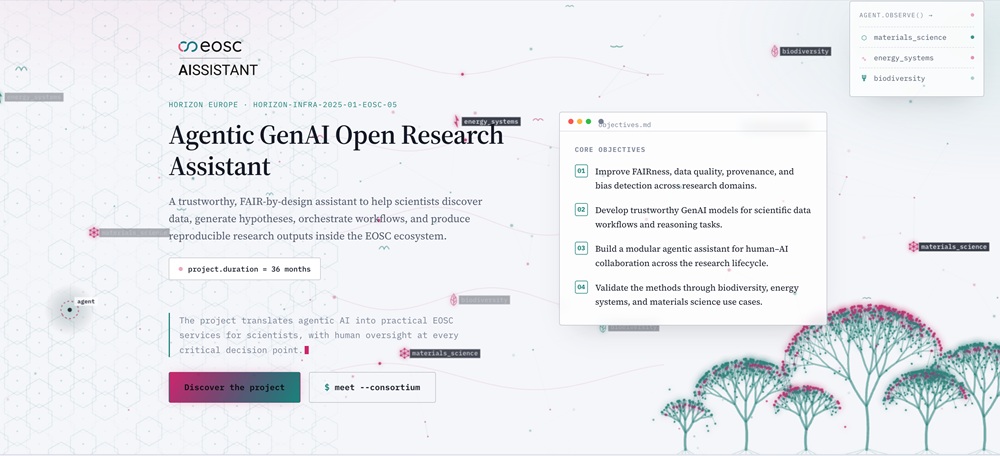
Towards an open European approach to agentic AI for science: TIB coordinates a new Horizon Europe project bringing together 12 partners from seven countries to develop trustworthy, open AI services for the European research infrastructure.
Artificial intelligence is rapidly changing the way science is conducted. As AI systems move beyond answering questions towards agents that can search, reason, use tools and participate in increasingly complex research processes, a new challenge is emerging: What kind of scientific ecosystem should these AI agents become part of?
This question is at the heart of EOSC AIssistant – Agentic GenAI Open Research Assistant, which was officially launched on 1 September 2026.
Coordinated by TIB – Leibniz Information Centre for Science and Technology, the three-year Horizon Europe project brings together 12 partners from seven European countries.
Its ambition is to develop an agentic Generative AI research assistant for the European Open Science Cloud (EOSC) – and, more broadly, to help shape an open, trustworthy and European approach to AI for Science.
From AI assistants to Co-existence of AI agents for science
AI for Science is entering a new phase. Future systems will not simply provide conversational answers. AI agents will increasingly interact with scientific knowledge, data, software, computational resources and research workflows.
EOSC AIssistant aims to make these capabilities available within an open and federated research environment, rather than as an isolated or closed AI system.
The project will develop intelligent agents that can support researchers in activities such as discovering relevant data and scientific resources, analysing knowledge, accessing computing services, improving the FAIRness of research outputs and orchestrating complex scientific workflows.
The goal is not to replace scientific judgement, but to give researchers new ways to interact with the growing complexity of digital science.
An open European ecosystem for trustworthy AI in science
A central principle of EOSC AIssistant is that powerful AI for Science should remain transparent, reproducible and verifiable.
The project will therefore connect agentic Generative AI with technologies such as FAIR Digital Objects, Research Objects, knowledge graphs and provenance information. This will make it possible to trace the sources, data and processes behind AI-supported research activities.
Human researchers remain in control of scientific decisions.
At the same time, embedding these capabilities within the EOSC Federation creates an opportunity to develop AI for Science differently: as part of an open European research infrastructure in which data, services, knowledge and AI agents can work together across institutional and national boundaries.
“The next generation of AI for Science should not be a closed system. It should be open, verifiable and reproducible – and it should enable researchers to remain in control of the scientific process.
With EOSC AIssistant, our ambition goes far beyond building another chat interface. We want to explore how intelligent AI agents can become part of an open scientific ecosystem – working with research data, knowledge, computational resources and scientific workflows across the EOSC Federation. This is an opportunity to help shape a distinctly European path for trustworthy and agentic AI in science.”
Professor Sahar Vahdati, Professor of AI for Science at TIB and Leibniz University Hannover and coordinator of EOSC AIssistant
Demonstrating agentic AI in real scientific environments
The technologies developed in EOSC AIssistant will be demonstrated in three scientific domains:
These use cases will allow the consortium to investigate how agentic AI can support researchers in real scientific settings while meeting the requirements of transparency, provenance, interoperability and reproducibility.
The project brings together expertise from research infrastructures, artificial intelligence, knowledge technologies, high-performance computing, Open Science and scientific domains across Germany, Poland, Italy, Serbia, the United Kingdom, Greece and the Netherlands.
Over the next 36 months, the consortium aims to contribute not only new AI technologies, but also to a broader question facing European science:
How can we ensure that the emerging generation of AI research agents operates within an open, trustworthy and human-centred scientific ecosystem?
Related Stories
 AI News
Bill Gross bets AI can help mass
3 days ago
 AI News
Nigeria records 93% rise in AI micro
3 days ago
 AI News
The Italian gelato maker using AI to invent new flavours
3 days ago
 AI News
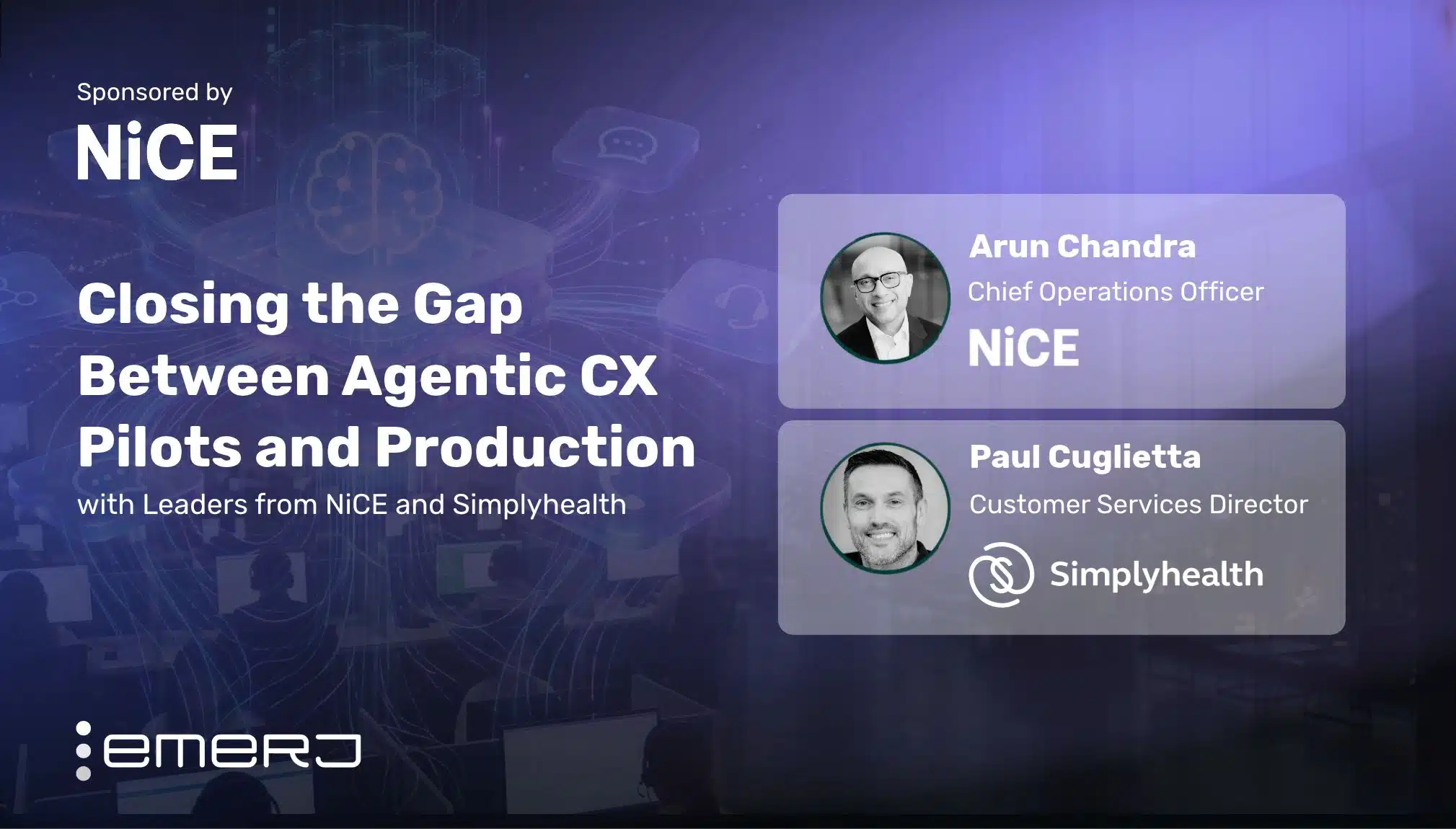
Closing the Gap Between Agentic CX Pilots and Production
3 days ago
 AI News
New Brunswick data centre debate highlights cross
3 days ago
 AI News
How to Structure an AI Agent Referral Fee Agreement Between Startups
3 days ago
 AI News
No, AI didn’t delete a Swedish reality TV series
3 days ago
 AI News
There is no AI in Armageddon. Artificial intelligence is a tool, not an apocalypse
3 days ago