
Leaked Police Drone Videos Highlight Need For Independent Review of the Technology’s Usefulness
Leaked Police Drone Videos Highlight Need For Independent Review of the Technology’s Usefulness
Subscribe to the Free Future Newsletter Or get immediate notifications of new posts via Substack Free Future home
Videos from drone flights by the San Francisco Police Department were accidentally streamed onto the open internet, providing a revealing snapshot of today’s police “drones as first responder” programs.
The videos were discovered by two security researchers, who captured 48 hours of drone flight video and shared it with Wired Magazine reporters, who in turn shared it with me so that I could provide the magazine with comment for their story. (I wrote an ACLU white paper on these drone programs in 2023.) Watching the more than three hours of flight videos, I had several takeaways.
A very powerful surveillance technology As I told Wired, one of the most striking things I found watching the videos was just how much life is captured by all the drones flying around a busy city, and what a powerful surveillance tool this technology is.
One use of the drones in the videos is to effortlessly follow cars driving around the city, an activity that would absorb significant resources if carried out with a car — and which, importantly, would give the subject at least a shot at recognizing that they are being watched.
I found it remarkable that nobody in these videos ever looks up or otherwise appears aware that there is a drone above them and recording them. I used to hear all the time, “We’ve had police helicopters for decades, so what’s the big deal about drones?” These videos make obvious that one big difference is that unlike a noisy helicopter, nobody knows these drones are there. A helicopter can watch people, but it can’t watch people who don’t know they’re being watched. When you’re in public, you are of course subject to observation by others — but throughout all of history humans have generally been able to observe all of those who were able to observe them. One of the things technology like drones make possible is scaleable asymmetric public observation — the ability for the police to watch people who don’t know they’re being watched.
Since we’re social animals highly attuned to who is watching us and how we appear to others, the persistence of such police drone flights means that everybody will eventually internalize the reality that such assymetric public observation is underway — and then at all times outdoors behave like people being watched by the police. In other words, not freely.
Constitutional questions A lot of the incidental and sometimes not-so-incidental video in the SFPD drone recordings raise serious, perhaps even constitutional questions about the level of intrusion involved. Some of the flight videos clearly show the interiors of apartments — furniture, a Persian carpet, people, and other details are visible through windows as the drones fly around. The drones also capture a lot of private rooftop spaces.
And these aircraft possess powerful zoom lenses, as well as thermal imaging cameras for night vision. None of the leaked videos were taken at night, early dawn, or dusk, but it stands to reason that the privacy issues would be intensified at such times. Homes on high floors of apartment buildings would be lit up from the inside and their interiors much more visible to a drone hovering outside. And night vision cameras would even more dramatically violate people’s expectations of who they are visible to.
It’s pretty clear that a police drone hovering, say, outside a 2nd story window in a suburban backyard would violate “reasonable expectations of privacy” and thus the Constitution’s Fourth Amendment, but it’s less clear what the courts would find to be a reasonable expectation of privacy in a city, where people are already susceptible to Rear Window-type observation. Still, based on this 48-hour snapshot of flights, it is uncomfortable to think what kinds of details these drones are likely picking up over time, even if we assume they’re piloted by officers making a good faith effort to comply with the SFPD policy requiring minimization of incidental video collection (efforts that were not always in evidence in these videos). Given the relative novelty of this form of policing, the courts may look dimly upon it.
Effectiveness questions The videos show a lot of flights that don’t appear to accomplish anything. In many, the drone takes off, wanders around an area somewhat aimlessly, zooms in and out on various things, and then flies back to its dock. In a few cases it flies to places where police officers are already on the scene, hovers, appears to add nothing to the police response, then flies home.
Even given that a few of these were training flights, to me that raised the question of how often drone deployments actually prove useful. That would be important information for policymakers and the public deciding whether drones are the best way to spend limited public funds. Law enforcement may say that in at least some cases the absence of anything of interest is itself helpful, such as after a 911 call reporting something suspicious and where the drone finds no such thing, saving officers the effort of making an in-person visit. But there sure was a lot of “nothing there” in these videos.
The SFPD did provide Wired with the public flight logs corresponding to each of the deployments represented in the dataset. Overall, however, those didn’t shed much light on the videos I watched. One call categorized as “Criminal Investigation” had a purpose listed as “Check on Well-Being,” which doesn’t seem to line up and suggests the whole thing is kind of sloppy and pro-forma. We’ve seen similar things in other departments, and overall, as we’ve discussed, purpose logging is a very thin form of oversight that is flawed and susceptible to manipulation (even as it’s better to have than not have).
All of this points to the need for independent evaluation of the frequency of valuable flights and the value of the program overall. Ideally, disinterested parties such as academic criminologists could observe drone operations from top-to-bottom (including the call for service that prompted each call, officer communications during the deployment, etc) and report to the public the percentage of actually useful flights under these programs. Or even better, such oversight should be done regularly by people in empowered independent police oversight positions of the kind that most police departments have fought the establishment of.
Other take-aways A few other thoughts on the videos:
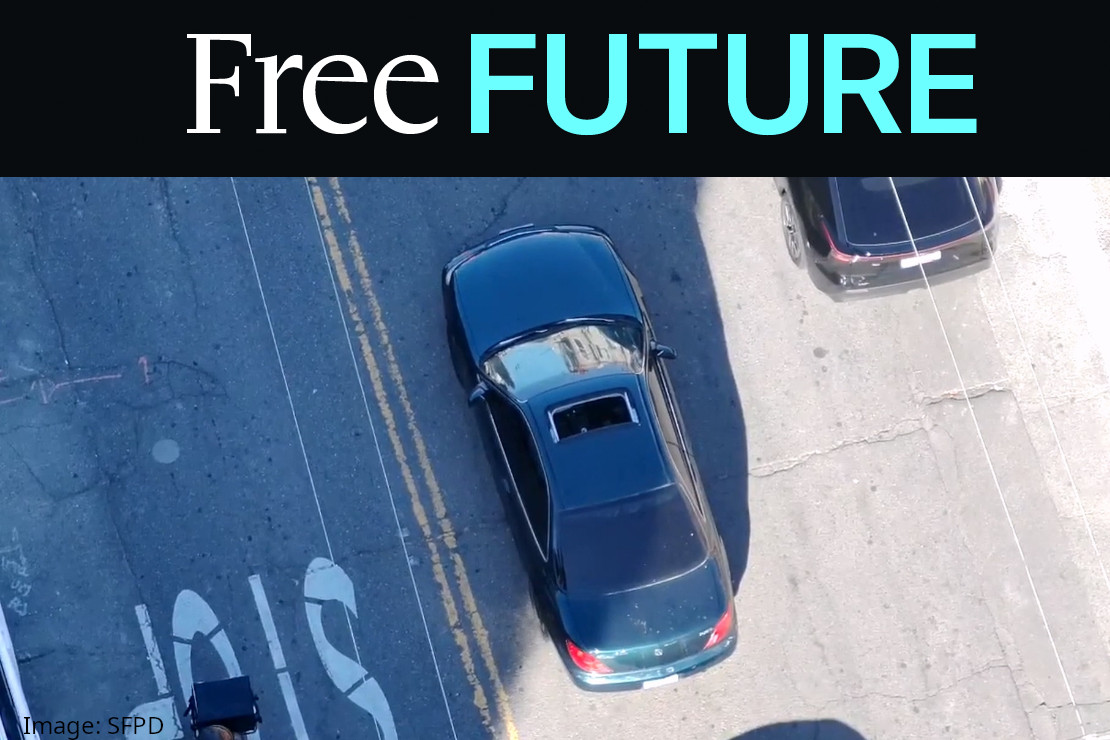
Finally, there was one video in the set that stands out most in my memory. In it, a car occupied by two men is followed as it wanders somewhat aimlessly around the city, and pulls halfway into a driveway for a minute waiting. The drone zooms in and looks at the car’s occupants through its open sunroof, where the passenger’s lap and phone screen are clearly visible.
Watching this, I couldn’t help but wonder exactly what kind of report may have prompted this surveillance, and started to think maybe their movements were, perhaps, suspicious. Thus implicated in the mindset of a surveiller, I then watched as the car parks, the driver gets out, opens the trunk — and takes out a basketball. The two men then head to the courts. The drone flies home. The purpose of the flight was reported by SFPD as “investigation by plainclothes (Suspicious person in a vehicle)”
The lesson I abashedly took from this was that if you’re primed to be suspicious, even something as boring as trying to find parking in a big city can look shady. And, that an awful lot of people are being watched from the air these days who are just living their lives.
Related Stories
 AI News
Emergency relief fund created for laid off Telus World of Science workers
46 minutes ago
 AI News
Judge blocks South Dakota abortion advertising ban against nonprofit
46 minutes ago
 AI News
Local Regina mosque puts out survey for feedback on call to prayer
46 minutes ago
 AI News
Corus rebuts misinformation about future of Global News in Alberta after layoffs
46 minutes ago
 AI News
AFN calls on Ottawa, provinces to protect treaty rights in wake of Alberta separatism
47 minutes ago
 AI News
Government says it's investigating CN's actions after rail crew surrounded by wildfire
47 minutes ago
 AI News
Bear viewing area in Hyder, Alaska, closed due to flooding
47 minutes ago
 AI News
Accused Bishnoi gang associate agrees to deportation order
47 minutes ago