
Lessons learned from Canada's recent big wildfires
Lessons learned from Canada's recent big wildfires
Also: You can book ticket to ride on an electric plane
Welcome to our weekly newsletter where we highlight environmental trends and solutions that are moving us to a more sustainable world.
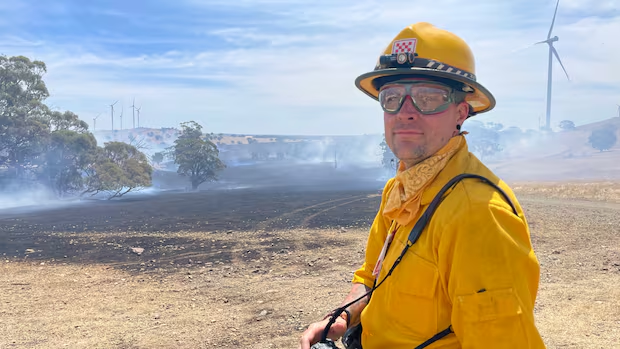
Hi, it’s Dannielle! As wildfire season ramps up in Canada, we’re looking back at some of the country’s gnarliest fires and lessons learned with award-winning journalist and author Jesse Winter.
Globe and Mail reporter Jesse Winter knew he wanted to do more than write stories from behind a desk in a newsroom; he wanted to be on the ground where the stories were actually taking place. Fifteen years later, he’s also a photojournalist telling stories from a different lens and challenging his assumptions about wildfires and firefighting.
“I didn't understand what the crews were going through. I didn't understand how fires were fought. And [being there] really forced me to kind of re-evaluate a lot of the questions that I was asking,” Winter told What On Earth guest host Michelle Eliott.
Recently, Winter laid out what he's learned in a new book, Wildfire: Dispatches from a Country Ablaze, in an effort to understand how climate change has supercharged wildfires in Canada and how to get better at living with this new reality.
This interview excerpt has been condensed for clarity.
Q: What are the challenges within the current system of firefighting?
A: One of the biggest challenges is the retention and turnover because the system was designed around a seasonal workforce of mostly young people. There aren't a lot of really good systemic paths to [a] long-term career. You tend not to have crew leaders with 10 or 12 years of experience. They might have four or five, and the fire service is working really hard to change that. They're working to create a 365-day-a-year all-hazards response agency, which is a huge job. But right now, there's not a huge bench depth basically. And that was fine when we were facing wildfires that didn't do what they do now. I had a crew leader tell me a couple of years ago that if you haven't fought fire on the ground since 2017, then you have no idea what crews are up against because that's how quickly things have changed.
Q: You write about that relationship between the wildfire service, firefighters, politicians and communities. How important is that going to be moving forward?
A: I think it's going to be critical. The other challenge that we run into all the time is communities increasingly don't feel empowered to be part of the solution themselves and that leads to all kinds of conflict with firefighters.
That's where, you know, if there's a bad outcome or houses are lost or something, there's this tendency to blame the folks in red shirts for failing to stop the fire.
Evacuation hesitancy is a big problem, and I think a lot of it is because communities want to help. In a lot of cases, especially in rural communities, they have the skills and the ability to help. They just need the respect and they need a way to help that is managed and safe so that they can be involved and they can contribute.
If you look to places like Knutsford, B.C., where folks have gotten organized and they've done the training that they need to and they've organized as not-for-profit agencies or charities and they've done all the things that they need to do to be able to work alongside the BC Wildfire Service effectively, it's a really good model. And there's tons of human power there that we can leverage if we were willing to put some agency and trust back in the hands of communities as well.
Q: You got to see the aftermath of the Jasper wildfire in Alberta. Can you tell us about that?
A: Almost a year later, and I remember standing just below Marmot Basin, the ski area in Jasper, with Dr. Lori Daniels. And we were looking at a place where experts believe a fire tornado touched down.
At Marmot Basin, the soil is not sterilized. It's completely gone, completely incinerated down to bedrock and mineral soil with boulders shattered from the heat. There's an area where 100-year-old trees were torn from the ground across the whole mountainside, root balls and all, and scattered like pickup sticks across an area many kilometres wide.
The Canadian Forest Service issued a report that found that at its height at that site, the fire was producing what they believed to be 386,000 kilowatts of energy per metre of fire front, which is analogous to seven nuclear weapons.
That's what's possible now because of climate change and because of 100 years of bad forest practices.
That's when I really started to understand Jasper is what success looks like in this context now. That whole town should be gone, and the fact that it isn't is down to some really good planning, some really good fuel treatments around the town and some truly heroic firefighting.
Old issues of What on Earth? are here. The CBC News climate page is here.
Check out our podcast and radio show and hear the full interview with Jesse Winter.
What On Earth drops new podcast episodes every Wednesday and Saturday. You can find them on your favourite podcast app or on demand at CBC Listen. The radio show airs Sundays at 11 a.m., 11:30 a.m. in Newfoundland and Labrador.
Check the CBC News Climate Dashboard for live updates on record-breaking weather and current conditions across the country. Set your location to find out how today's temperatures compare to historical trends.
Last week, Emily Chung looked at floating solar designed by Ontario researchers for icy winters like ours.
John Sherk of Verona, Ont., wrote: "We have about 6 kW of rooftop solar at our cottage, and a 25 -acre pond, so the floating solar installation was interesting to us. In our pond, we have muskrats, beaver, otter and geese. These like to climb on our raft. The muskrats pile reeds on top. They also chew into the styrofoam base, so I have covered the bottom of the raft with roll (sheet) aluminum. Something like that would be needed where these creatures are present. Ponds like ours benefit greatly from aeration, so this kind of installation could be very helpful."
A number of readers expressed concerns about the fact that the solar panels block light to the water and prevent ice formation in water that normally freezes. Dorothy Clippingdale asked, "What about the wildlife of the pond if it loses the weather cycle they are adapted to?"
Koami Soulamane Hayibo responded that the researchers tried to minimize the ecological impact by using non-heated air for the bubbler. "The bubblers only prevented ice formation around the solar panels while the rest of the pond remained frozen. The [United Nations] Food and Agriculture Organization's recommendation is to cover less than 30 to 50 per cent of a water surface by solar to allow wildlife to continue thriving, depending on the type of water. We respected those limits by covering less than six per cent of the pond. The influence of solar panels on living organisms in the water is a topic that we hope to formally analyze in the future. From what we have preliminarily observed during our experiment, the fish seem to love swimming under the solar panels during hot days. "
Linda Matheson suggested that high winds in winter could whip water on top of the panels, and asked if that could interfere with their functioning.
Hayibo responds: "The current system we developed is only adapted to inland waters (human-made structures) where the wave impact is usually small. In case water [were] to cover the panels, they will still work as they are designed for marine environments. They will, however, produce less energy, which is why one of our next steps is to experiment with different tilt angles to raise the panels above the water surface."
Write us at whatonearth@cbc.ca (and send photos there too!)
The Big Picture: Solar parking lots
In my day job for CBC, I host and produce Newfoundland and Labrador's lunchtime radio program, The Signal. We regularly cover climate change on the show, so climate solution efforts tend to catch my attention.
Cue my trip to South Korea back in June.
I was on vacation with my wife, who is Korean. It was a visit to see family and friends. One of our outings took us to the Sejong National Arboretum, which was lovely, but it was the parking lot outside that captured my eye. As I stepped out of my brother-in-law’s Hyundai EV, I noticed each parking spot was covered by solar panels. And in the corner of the lot, charging stations.
This parking lot wasn’t a one-off either. It turns out, it’s mandatory — any public parking lot with more than 80 spaces is required to put in a solar canopy. That’s for new and existing parking lots.
The idea here is to give a boost to renewable energy as part of the country’s decarbonization efforts, along with a smart use of space. So for the driver, it’s shade for the car or a weather cover, plus the charging infrastructure and knowing that what’s covering you is also putting carbon-free power back into the grid and your car.
So yes, upon returning to St. John’s and looking at all the uncovered space above parking lots, my mind has drifted to thoughts of what-ifs for smart use of space and renewable energy.
Hot and bothered: Provocative ideas from around the web
You can now take a scenic flight aboard an electric plane in southern Ontario
If you want to take a ride in one of Canada's first certified electric aircraft, the Waterloo Wellington Flight Centre in southern Ontario is offering scenic flights to the public aboard the plane.
The Pipistrel Velis Electro aircraft has been a partnership between the flight centre and the University of Waterloo's Institute for Sustainable Aeronautics (WISA). The centre operates two electric aircraft — one for public flights and the second supports ongoing research.
The aircraft itself is small, with enough room to fit the pilot and a passenger.
Trent Harris, a flight instructor with the centre, describes the takeoff in the electric aircraft as "a lot more exciting" than the traditional gas engine planes.
"The electric motor gives the aircraft a very fast acceleration and so it gets going really fast and then you climb superquickly up into the air," Harris told CBC News.
"In that way, it's kind of like an electric car. When you step on that pedal, it gets going superfast, superquick."
Would you fly in an electric plane? Now you can at Waterloo region's airport
The aircraft operates on electricity, producing zero in-flight emissions and significantly less noise than the traditional fuel engine aircraft.
"Its electric propulsion system also has fewer moving parts than traditional aircraft engines, highlighting the potential for simpler, more efficient aviation technologies in the future," the flight centre said in a release.
People wanting to experience a flight in the aircraft can expect a 40-minute scenic tour across Waterloo region. The flight starts with a check of the aircraft's system, Harris said, with takeoff shortly after.
Harris said passengers should hold off on trying to speak to the pilot during takeoff and landing to allow them to focus during a critical phase of flight.
"It's superimportant to be paying attention and holding your questions back until we're in cruise, which is that quieter phase of flight," he said. "But definitely bring your camera and be excited because it's a superfun plane."
Electric aviation not a concept of the future anymore
Harris has been a flight instructor at the flight centre for more than a year and had the opportunity to learn how to pilot the electric aircraft shortly after he started.
He said there's still more work and research to be done in making longer-lasting batteries and the infrastructure to support it, but watching the aviation industry grow in this new phase is what excites him most.
Merhdad Pirnia, an associate professor in the department of management science and engineering at the University of Waterloo, said electric aviation is no longer a distant concept, with technology now available to allow electric planes to take off in Canadian skies and around the world.
"I believe that in the near term, right now to 2035 or so, electric planes can be very well integrated into pilot training, flight clubs and short regional routes even and longer term, regional passenger aircraft and hybrid-electric aircraft," Pirnia told CBC News.
Pirnia, who is the lead researcher of the project at the Waterloo Institute for Sustainable Aeronautics, also sees pilot training on electric aircraft as an important first step while the industry tries to lower flight emissions.
"There's huge emissions related to aviation, [with] up to 2.5 per cent of total emissions coming from aviation," he said. "If we can reduce that, it means megatons of carbon dioxide reduction."
Work to improve batteries, charging stations underway
Pirnia said work is being done to improve battery range on electric planes. The Velis Electro plane has a maximum range of about 40 to 50 minutes.
But Pirnia says electric passenger flights are not too far off either, as Air Canada purchased 30 electric-hybrid aircraft from Sweden’s Heart Aerospace.
"These ES-30 [planes] have capacity for 30 passengers and can go to 400 kilometres on an electric engine,” he said, noting they are supposed to be in operation by 2028.
Airports will also need sufficient charging infrastructure to support electric planes, Pirnia said, in particular "clean infrastructure" that stays away from using natural gas to produce electricity.
The good news is that for now, training airports like the flight centre only require modest charging installations.
"We've been able to create this type of infrastructure by changing the transformers and having chargers there that we can use from electric vehicles as well," Pirnia said, adding that research at the university is underway to create microgrids that contain renewable energy from sources like wind and solar to avoid having to pull from the electric grid.
Thanks for reading. If you have questions, criticisms or story tips, please send them to whatonearth@cbc.ca.
What on Earth? comes straight to your inbox every Thursday.
Editor: Emily Chung | Logo design: Sködt McNalty
Related Stories
 Canada
DEAR ABBY: Roommate's 'all
6 minutes ago
 Canada
Bank of Canada set to make 6th interest rate decision of the year
6 minutes ago
 Canada
Canada’s immigration changes open new pathways for Nigerians
8 minutes ago
 Canada
Lincoln Memorial Reflecting Pool named after ‘orange
1 hour ago
 Canada
The battle that made Canada bleed: Operation Medusa, 20 years later
1 hour ago
 Canada
He passed three extensive security checks in Canada. Now, a fourth has stalled his citizenship for 18 months
1 hour ago
 Canada
Apple Maps follows Google, changes name of Lake Ontario to 'Lake America'
2 hours ago
 Canada
B.C. boaters warned to avoid mysterious floating island
2 hours ago