
LLNL & Pacific Fusion Propel Pulsed
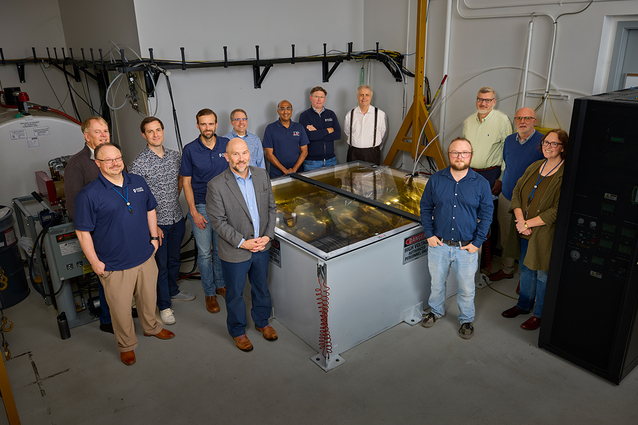
A pulsed-power prototype designed and built at Lawrence Livermore National Laboratory has surpassed 3,000 shots, a milestone researchers say demonstrates the maturity of a new accelerator architecture and marks an important step in evaluating how the technology could be scaled for future national and economic security applications, including fusion energy.
The campaign was supported through a Cooperative Research and Development Agreement (CRADA) with Pacific Fusion, a commercial fusion-energy company that is developing related pulsed-power technology as a means of driving inertial fusion energy.
SIRIUS is LLNL's four-stage prototype impedance-matched Marx generator, or IMG - a new type of pulsed-power architecture that forms the basis for LLNL's next-generation pulsed-power concept. Successful testing has moved the prototype beyond basic proof-of-concept and into a more mature stage of development.
Researchers say the campaign is a key step in advancing SIRIUS from Technology Readiness Level (TRL) 4 toward TRL 5, a Department of Energy benchmark for similar system demonstration in a relevant laboratory test environment. Data collected during testing will help document the reliability and lifetime performance needed to guide future scale-up.
Bill Stygar, an LLNL pulsed-power researcher and co-inventor of the IMG concept, said the long-term vision is to understand whether the technology can be scaled for accelerator concepts that could support high-fusion-yield experiments and other national and economic security applications, including fusion energy, high-energy-density science, dynamic materials experiments and stockpile modernization.
"For a future IMG-powered accelerator concept, reliability is a key requirement," Stygar said. "Such systems could need components capable of operating over long service lives, potentially at up to 100 shots per year for 30 years. We needed to show that our components could last 3,000 shots and that their reliability was high enough for a next-generation machine."
The 3,000-shot threshold is tied to the requirements researchers are evaluating for future accelerator concepts, including long component lifetimes, single-stage pulse compression and designs that avoid sulfur hexafluoride (SF6), a potent pollutant used in some conventional pulsed-power switches.
Initial development and demonstration of the SIRIUS prototype was funded by LLNL's Laboratory Directed Research and Development (LDRD) program between fiscal years 2020 and 2022. The experimental campaign focused on component lifetime and reliability was supported through the later CRADA with Pacific Fusion. The agreement required close coordination with LLNL's Innovation and Partnerships Office (IPO), which helped structure one of the Laboratory's first CRADAs with a private inertial fusion energy company. That groundwork that has since helped facilitate similar agreements. Fusion energy partnerships at LLNL are managed by the Livermore Institute for Fusion Technology (LIFT).
The partnership gave LLNL researchers and Pacific Fusion engineers an opportunity to compare models, evaluate hardware performance and learn from repeated operation of the prototype. The work is conducted in LLNL's Pulsed Power Lab, a controlled space staffed by the Engineering Directorate.
Keith LeChien, Pacific Fusion founder and chief technology officer, is a former LLNL researcher and co-inventor of the IMG concept. He said the collaboration builds on years of shared work to mature the architecture.
"This milestone shows what close collaboration between national laboratories and private industry can accomplish," LeChien said. "The CRADA gives Pacific Fusion and LLNL a shared testbed for refining components, validating models and understanding how IMG systems perform under repeated operation. Pacific Fusion is rapidly building an IMG module for our high-yield fusion system that is roughly 40 times larger in parallel, advancing IMG technology for energy and national security applications."
Pulsed-power accelerators deliver large bursts of energy to tiny samples on 100-nanosecond time scales, creating extreme states of matter for high-energy-density science experiments. Unlike conventional Marx generators, which stack voltages, the IMG architecture stacks waves: the system charges capacitors in parallel, then discharges them in series through carefully timed stages that launch a traveling electromagnetic wave down an internal transmission line. LLNL researchers have described it as a pulsed-power version of a laser.
"The appeal of the IMG approach is its relative simplicity. Conventional pulsed-power machines often require several stages of pulse compression, which can add complexity, maintenance demands and safety considerations," said Kumar Raman, LLNL project manager. The IMG approach generates the needed fast pulse in a single step and transmits it directly to the load, reducing the hardware required. The four-stage prototype delivered 60 gigawatts to a resistive load in a 100-nanosecond pulse, with 95% energy efficiency.
The test campaign also provided information that computer simulations alone cannot provide. Models are key to designing systems like SIRIUS, but real hardware testing is needed to understand how components behave over many repeated shots. "A computer simulation won't tell us what a component lifetime is, or a switch pre-fire rate, a capacitor failure rate," Raman said.
Results showed that the prototype's switches operated through the full 3,000-shot campaign and that component failure rates, including capacitor failures, remained within established requirements - increasing confidence in the IMG architecture and providing reliability data needed to evaluate larger accelerator concepts.
For Raman, the significance of the milestone links a practical engineering demonstration and a much larger scientific question: whether a simpler, more efficient pulsed-power architecture could be scaled for high-energy-density physics and fusion energy, with applications for national and economic security.
"The implications of the results are quite significant," Raman said.
Related Stories
 Technology
Richard Valtr, founder of Mews, joins the EU-Startups Summit 2027
37 minutes ago
 Technology
Dropbox says about 5,000 accounts compromised in August hack
37 minutes ago
 Technology
The EU-Startups Podcast | Interview with Oana Jinga, co-founder and Chief Commercial & Product Officer at Dexory
1 hour ago
 Technology
Egypt, China agree to broaden security and technology cooperation
1 hour ago
Regina’s tech renaissance: How a new batch of startups try to become the next big thing
2 hours ago
 Technology
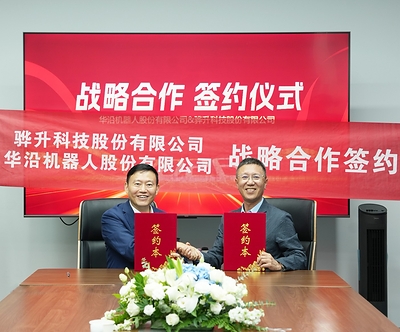
Wieson Technology and Guangdong Huayan Robotics Announce Strategic Partnership
2 hours ago
Belkin Introduces New Solutions to Power, Locate and Personalize Everyday Technology
2 hours ago
 Technology
Ex
2 hours ago