
London startup’s pizza robot success fuels Canadian expansion
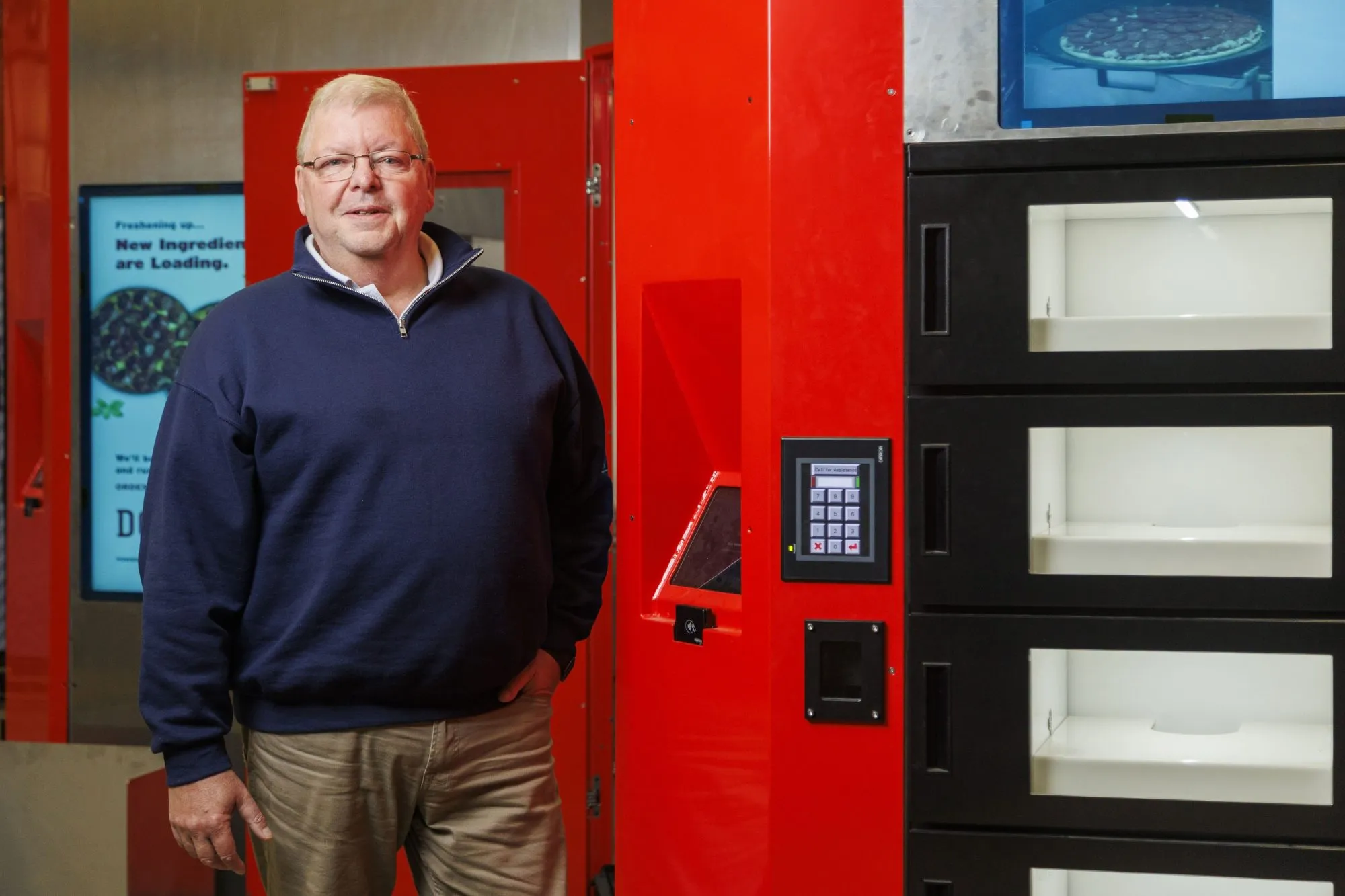
Following the early success of its pizza-making robot south of the border, a London startup is looking to expand its operations and menu offerings in Canada with a new machine capable of making Mexican food.
The new direction for Appetronix Inc. comes about a year after it partnered with U.S. pizza chain Donatos Pizzeria LLC to develop and install one of its machines at John Glenn Columbus International Airport in Columbus, Ohio. The company said it has sold more than 15,000 pizzas there in about 10 months.
Appetronix’s machine resembles a vending machine but is capable of cooking fresh food in minutes using robotic arms and physical AI.
One robotic arm takes the dough shell, which is spread out on pans in a shelf area, and moves it through stations where toppings are added before placing it in a conveyor oven to bake for about two-and-a-half minutes.
A second arm removes the pizza, slices it, places it in a cardboard box and delivers it to a holding area with a large window that opens. The robot uses vision cameras to ensure the correct amount of dough, sauce and toppings.
Appetronix’s early success has led it to work on installing two more robots at a hospital and the Center of Science and Industry in Columbus in the coming weeks.
The company is also working to install its first machine in Canada next month at a yet-to-be-finalized location in Toronto’s financial district, where it will make Mexican-style bowls rather than pizza, said Nipun Sharma, Appetronix’s chief executive.
“The food is identical to what you would get at Chipotle. It’s the same process. You get to choose the rice, the beans, the meat, the salsa … it’s all sequential,” he said.
“You get to see your bowl getting prepared, and when it’s ready, it goes into a locker. You get a notification on your phone … and you have your freshly made meal for you.”
The company was recognized Tuesday by the Canadian Food Innovation Network with its Foodtech Frontier award, a list that aims to showcase Canadian businesses at the cutting edge of the food-tech sector. It is the second year Appetronix has been included.
Dana McCauley, CFIN’s chief executive, said food tech is a fast-growing sector within the Canadian food industry, with new venture creation rising by 88 per cent over the past seven years.
Food tech includes everything from automation and robotics in food processing to novel ingredients. McCauley said Canada is already gaining global recognition in areas such as plant-based protein ingredients, upcycling and side-stream valorization, which turns food waste into other products such as pet food.
“One of the reasons Canadian companies didn’t look for Canadian solutions in the past was that they weren’t really there,” she said. “Now, we’ve got a lot more innovators in this space.”
Sharma said one of Appetronix’s biggest advantages is that its machines can operate 24/7, with the company’s margins staying around 40 per cent compared with the six or seven per cent a typical restaurant would make.
“The restaurant business, as everybody knows, is a very tough business because labour is a universal problem now,” he said. “Not only is it extremely expensive, but it’s also hard to find in some places.”
For example, Sharma said all restaurants in the Columbus airport close at 7 p.m., making Appetronix’s machine “the only restaurant that’s open” after that.
That is why Sharma said Appetronix, which is still in its seed-financing stage, is targeting high-foot-traffic locations such as airports, hospitals and universities that also offer the potential for around-the-clock service.
“Restaurants work on razor-thin margins, so the moment the food costs go up, minimum wage goes up, restaurants go down. There’s a disconnect between supply and demand,” he said. “When you put in robotics and automation, you solve that problem.”
The biggest challenge now is scaling up production, Sharma said.
Each machine costs about $500,000, and Appetronix is capable of building only one every four to five weeks.
Sharma estimates the price could fall to about $250,000 once the company can produce the machines at scale.
By comparison, the cost of opening a restaurant in Canada in 2026 ranges from $250,000 to $400,000 for small, quick-service restaurants to between $700,000 and more than $1 million for full-service, premium concepts, according to 360 Restaurant Consultant.
“We’ve proven (our concept), and we’ve done it in a very difficult environment and with one of the top brands in the world,” Sharma said. “Now, our biggest challenge is how do we increase the supply of the machines? How do we get to making 20, 30 machines a month? That’s where our energies are going.”
With files from LFP reporter Norm De Bono
Related Stories
 Business
Wealthy Chinese couple accused of abusing 21 children born through surrogacy in ‘house of horrors’
9 minutes ago
 Business
Lee So-young launches reform to cut red tape, boost Korea SMEs in strategic sectors
12 minutes ago
 Business
Small Business Insider: Policy Update, Tips & Intelligence, More
3 hours ago
 Business
Quebec's next premier says he promises to hit the ground running as PQ takes power
4 hours ago
 Business
AngelNV Opens 2026 Entrepreneur Bootcamp With $400,000 Startup Investment Opportunity
9 hours ago
 Business
Liberia Participates in the 2nd Economic Community of West African States (ECOWAS) Startup Awards
9 hours ago
 Business
CrowdStrike Launches Fourth Cybersecurity Startup Accelerator With AWS and Nvidia
9 hours ago
 Business
Norwegian princess Märtha Louise and husband sue ex
10 hours ago