
Magnifica Humanitas, Artificial Intelligence, and Amish Country
They say that kids these days can’t get along without screens, but my teenaged daughter is an exception. On our most recent road trip, she came up with her own form of screen-free entertainment: she decided to keep a running tally of Teslas spotted along the way.
The first few hours were a bit disappointing. West Virginia and Pennsylvania offered little in the way of Tesla sightings, as they also offered little in the way of the wealth that produces them. Things were not much better when we reached Ohio, alas, and by the time we pulled into our hotel in Shipshewana, Indiana that night, my daughter had only made a few marks on her notebook page.
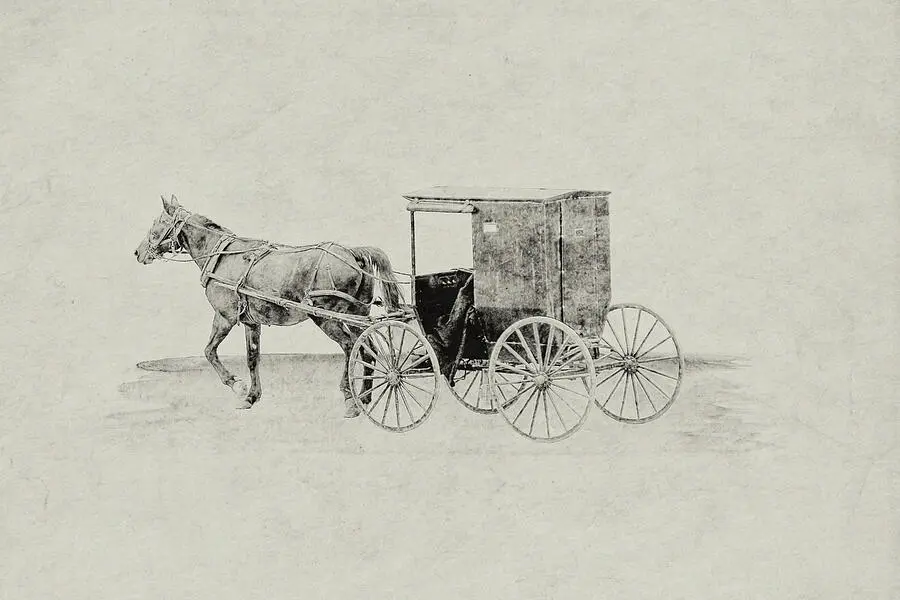
Fortunately, when morning dawned we discovered a more rewarding alternative: finding ourselves in the heart of Indiana Amish country, we would now begin counting horse-drawn buggies instead. Before we reached I-90 we had spotted 26 such carriages; the Tesla tally, by contrast, didn’t really start to pick up until we reached the North Chicago suburbs.
It was only a couple of days after our trip that Pope Leo XIV released his new encyclical on the social doctrine of the church and its application to the digital age, Magnifica Humanitas. What, the encyclical asked, should Christians and other people of goodwill do in response to the promise and challenges of this rapidly changing world and its astonishing technologies, especially AI?
Well, what would the Amish do, I wondered? We know what they would do in response to a Tesla, should it ever occur to them to consider allowing their members to own one. They would not respond reflexively; instead, as individual communities, they would discern through prayer, careful consideration, and deliberation whether or not to allow Tesla ownership as part of their particular Ordnung. As part of their approach (here’s a quick run-down), they would ask whether the innovation in question would draw them closer to God and each other or draw them away from Christian principles. And then together they would decide on (and abide by) a rule.
Some of the common Amish decisions against technologies may seem insignificant to us, of course; we would never spend time worrying about whether shirt buttons are morally dangerous. But we have our own tech issues to consider. It does not seem insignificant to worry that smartphones might ruin our enjoyment of face-to-face conversation, for example, or that AI bots might educate our children into inhumane practices or philosophies.
As the new encyclical explains, these technologies pose significant threats to humane society as well as offering opportunities. “AI can be a valuable tool and, at the same time,” Pope Leo writes, “[call] for a measured and vigilant approach” (3.100). We must consider A.I. without fear, the encyclical urges, but still with great attention and careful discernment, for “we cannot consider AI to be morally neutral” (3.104). Leo goes on to suggest that Pope St. John Paul II’s question about whether a particular technology makes life “more human” is a good place to start in our discernment about new technologies (3.129, quoting Redemptor Hominis). The encyclical also discusses the broad application of the Church’s social doctrine to these matters at considerable length, reminding us that the ancient principles of Christianity are relevant even in this far-flung millennium.
I’m glad to see all of this, as calling the myriad actors in a difficult situation to virtuous discernment is one of the most important things that a spiritual leader can do. Yet as Leo notes, even those who are creating these technologies lack full understanding of how they work and seem reluctant to discipline their development wisely. How can ordinary people and communities, not to mention lumbering, inefficient governments and profit-driven corporations, possibly keep up?
It’s hard enough for me to discern how to handle a laptop or a smartphone so that its temptations don’t overwhelm me; I can’t possibly wisely discern about every new form of AI that pops up on my screen or in my life and offers to solve my problems. It’s too many decisions to make, with too little information—and yet in aggregate, these decisions matter greatly not just for my quality of life but for the dignity and wellbeing of my family and community. And since we know that the companies that develop and market these technologies are not animated by wisdom or concern for the well-being of, say, the schoolchildren whom they deliberately distract with YouTube videos—well, I’m not sure I have it in me to be vigilant enough to keep things straight, even in a community setting. I believe in nuance, but that is more than a full-time job, and most people will eventually just give up.
In other words, it may be too late for us to sit down and consider hooks-and-eyes, and then laces, and then buttons, because by the time we’ve spent a single hour on the first of these, the techbros will have invented not just the zipper, but the AI-seamless-fastener-blood-pressure-regulating-girlfriend-suspenders-educate-your-kids-bot. We might need to make some kind of decision about fasteners overall, rather than thinking about them one-by-one.
We might also remember, however, the Amish approach to categorical discernment: when the Amish rejected owning and driving cars categorically long ago, that actually left them with the space they needed to discern when they might ride in one. So if they really were to start to discern about Teslas in particular someday, they wouldn’t be starting from square one: they’d already have an understanding of the nature of cars and how they interact with human beings. Maybe we, too, need stronger principles about categories and applications of technology to begin with and only then will we be able to practically apply nuanced discernment to specific cases.
For example, if we focus in education on catching our schools up with technology and promoting digital literacy, as Magnifica Humanitas implies we ought, we skip the step of asking ourselves what role (if any) generative AI (for example) ought to play in education, and instead just start chasing after it. At the speed of the chase, we can’t discern much at all about individual applications and technologies—we just adopt and adapt. We have ceded control; we are no longer making real choices; we are thinking about tech from within its own framework of instant acceptance and constant motion.
But if we think about the nature of AI when applied to education, and whether or not it’s overall trustworthy and enriching, then we can develop a principle to start from that will allow us to actually discern about particulars. Such a principle would establish whether we allow AI into schooling—with some carefully discerned exceptions—or we do not allow AI to significantly influence the classroom—with some carefully discerned exceptions. To use the car analogy, the Amish need to know first whether cars are generally good to integrate into our community life—and only then can they practically discern about specifics like occasionally riding in them.
I’m grateful to the Pope for his call to principled and humane responses to the digital age. AI is moving very quickly, and we do need to know what our principles should be if we choose to move along with it. But we also need to make that choice to begin with in various categories, and for that we need to understand how human nature and AI interact overall, not just what questions to ask of AI as we adopt it. Practically speaking, to maintain and enrich a humane society, we may need to find ways to respond to technological innovations that are somehow both nuanced and categorically decisive—else I suspect that we, like the passengers in the North Chicago Teslas, may find that we are no longer really driving.
Related Stories
 AI News
Using AI for just 10 minutes erodes your ability to persist at hard things
41 minutes ago
 AI News
Meta Won't Say If It Violates Its Policies to Upload AI
41 minutes ago
 AI News
Governed context: The key to scaling enterprise AI
1 hour ago
 AI News
Lessons from the Public Sector Artificial Intelligence Adoption in Developing Countries: An AI Life Cycle Perspective
1 hour ago
 AI News
Local Living: world of artificial intelligence
3 hours ago
Artificial intelligence giants are preparing for the ‘Day After’: Report
3 hours ago
 AI News
Artificial intelligence and social integration paradox
3 hours ago
 AI News
Oracle reportedly lands $7B GPU deal for Tencent
4 hours ago