
Maine governor says her state is ‘not the enemy’ in ongoing trade war
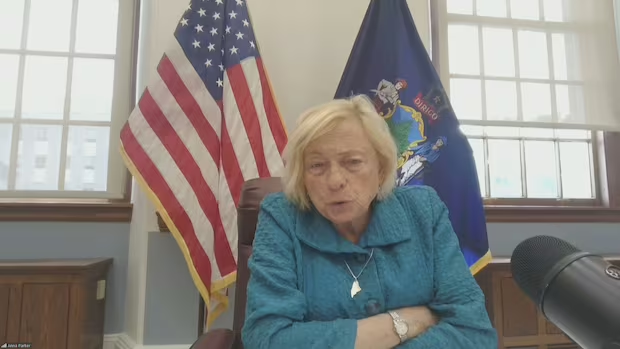
Maine governor says her state is ‘not the enemy’ in ongoing trade war
Janet Mills says Mainers want Trump’s ‘irrational’ trade war to end
Maine’s governor says the ongoing trade war between the United States and Canada is “irrational,” and that she wants it to end.
Janet Mills said she's heard the same from residents of her state.
“They want the war to stop,” the Democratic governor said in an interview with CBC News.
“I mean, it's not rational. This president says he's trying to secure a, quote, fair deal. This isn't how you negotiate.”
Mills said Maine and New Brunswick share close family and cultural ties, and she has respect for Prime Minister Mark Carney and Premier Susan Holt, along with other premiers she's met.
Maine governor weighs in on relations with Canada
Mills also distanced her state from the trade war coming out of Washington.
“This war that the president has waged, is waging on Canada, is not our war. It's not Maine’s war with New Brunswick or Quebec or any part of Canada,” Mills said.
She said she doesn't want Maine's relationship with Canada to be damaged by tariffs, and she wants Canadians to know that they are “always welcome here, your products are always welcome here and that we will always be friends in my book.”
Mills said the tariffs have driven up "the cost of everything that we do here in Maine," and many of the state's industries have been damaged.
"And I understand the anger that Canadians are expressing at our administration, the administration in Washington, D.C. I share that anger because it's hurting us economically, just as it's hurting you economically and your industries."
Last summer, Mills visited New Brunswick and Nova Scotia and heard from many people who were boycotting travel to the United States. This year, Mills said tourism from Canadians is still down in Maine.
“We miss you guys. We miss you at Old Orchard Beach and Kennebunkport and Ogunquit and Bar Harbor and all up and down the coast,” Mills said.
The latest statistics from the U.S. Department of Transportation show that the number of personal passenger vehicles crossing the border into Maine is slightly up this year, with 280,046 trips in July 2026. That’s compared to 246,833 trips during July 2025, or 348,817 trips during July 2024, before President Donald Trump was elected for a second time.
Asked about Canada’s recent decision to remove seafood from the list of counter-tariffs coming into effect next week, Mills said she wanted to thank whoever made that call.
“The tariffs on lobster would have hurt us a great deal,” Mills said, citing how inter-connected the lobster industry is between Maine and New Brunswick.
“It would hurt primarily one state, and that's us. And we don't deserve that because we value our friendship. We're not antagonistic. We're not the enemy,” Mills said.
Kamala Harris won Maine, beating Trump by nearly seven percentage points in the 2024 election.
Mills also said Andy Beshear, the Democratic Governor of Kentucky, is a good friend of hers and has been “distraught” about Canadian bans on selling American alcohol as a countermeasure to tariffs, which includes Kentucky bourbon.
While New Brunswick has resumed selling its existing stock of American alcohol, Ontario, which is one of the largest purchasers of alcohol in the world, has continued their ban.
“We don't have the bourbon problem here in Maine, but it's affecting states that are friendly to Canada,” Mills said.
Kentucky did elect Beshear as a Democratic governor, but Trump won the state by over 30 percentage points in 2024.
Mills recently wrote an op-ed in the Toronto Star raising concerns about tariffs. Asked what else she is doing to fight the tariffs, Mills said speaking with Maine’s congressional delegation, as well as her move last summer to add signs along Maine’s border crossings to welcome Canadian travellers.
“There's not a lot I can do to have an influence over Donald Trump. I don't think he especially likes me either,” Mills said.
Early on in Trump’s second term, Mills told him to his face that she would “see you in court” when he was threatening to withdraw federal funding from the state over Maine’s refusal to exclude transgender athletes from school sports.
Mills, who is barred by term limits from running again after her term as governor ends in January, had unsuccessfully sought the Democratic U.S. Senate nomination for the election this fall to challenge incumbent Republican Sen. Susan Collins.
Carney says Trump and his cabinet should stop 'throwing shade' and get serious about a deal
Canadian seafood industry 'relieved' with removal of their products from retaliatory tariff list
The front-runner in the Democratic nomination race she lost, Graham Platner, later resigned following allegations of sexual assault and was replaced by Troy Jackson, who will now face Collins in November’s election.
All but two of Maine's towns and cities that border New Brunswick, Eastport and Lubec, voted from Trump in the 2024 election.
Asked how those border towns that voted for Trump are feeling the impact from the trade war, Mills said that Trump isn’t on the ballot this fall, “but they have a chance to have a voice this year in the elections for the U.S. Senate and Congress.
“And I hope that they think about those things.”
Sam Farley is a Fredericton-based reporter at CBC New Brunswick. Originally from Boston, he is a journalism graduate of the University of King's College in Halifax. He can be reached at sam.farley@cbc.ca
Related Stories
 Canada
George Clooney speaks out after Pete Hegseth mocks Canadian cadets
34 minutes ago
 Canada
Newfoundland welcomed them after 9/11. They're heartbroken by Trump's trade war
34 minutes ago
 Canada
Virtual classrooms organized in Canada offer lifeline to girls under Taliban rule
34 minutes ago
 Canada
7
1 hour ago
 Canada
American cruise ship passengers visiting Canada offer their views on the trade war
1 hour ago
 Canada
Sex offender who forcibly confined and repeatedly sexually assaulted woman expected to live in Winnipeg
1 hour ago
 Canada
More Canadians demand lemon laws following lengthy repairs on brand new vehicles
1 hour ago
 Canada
N.S. unions, top Canadian doctor oppose new Alberta health law
1 hour ago