
Manitoba adopts permanent daylight time
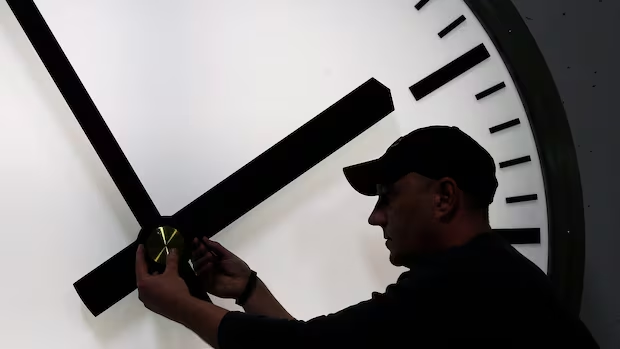
Manitoba adopts permanent daylight time after survey suggested overwhelming opposition to clock changes
More than 90% of 72,000 Manitobans who voted in online survey wanted to ditch twice-yearly changes: province
Manitobans no longer need to remember to spring forward or fall back one hour on their clocks.
Daylight time will be in place permanently, Premier Wab Kinew announced in a news release Thursday.
This change means clocks will not revert to standard time on Nov. 1.
Manitoba joins several other provinces and territories that have adopted or are moving toward a permanent time, including British Columbia, Yukon, the Northwest Territories, Alberta and Saskatchewan.
Just six months ago, Kinew said his government was too busy with more important matters to consider changes to the clocks.
He was asked about it in early March, shortly after B.C. announced it intended to remain on daylight time permanently.
He later softened his stance, suggesting it may be time to revisit the issue for Manitoba.
Days of time change 'pretty much at the end' in Manitoba, premier suggests
In April, Alberta announced plans to table legislation to cement a move to permanent daylight time. Days later, the Northwest Territories said it will also end time changes. Yukon has been on permanent time since 2020 and Saskatchewan since 1966.
In May, Manitoba launched a survey, asking the public to weigh in the issue. For those who did want to see the twice-annual changes halted, the survey asked if they preferred to stay on standard or daylight time.
In its news release at the time the survey launched, the province included a link to an analysis by Manitoba Health, which concluded that eliminating the time change would be better for population health.
On Thursday, the province said nearly 72,000 votes were submitted in its survey, with 92 per cent of respondents saying they wanted to see an end to seasonal time changes. Among respondents, 58 per cent preferred permanent daylight time and 34 per cent sided with standard time.
Permanent daylight time is good for health, business and families with young kids, whose routines, especially sleep cycles, can be disrupted for days with those one-hour time changes, Kinew said in Thursday's news release.
The province is working with organizations, businesses and industry partners to adapt to the change, he said.
Manitoba enacted the Official Time Act, bringing provincewide daylight time into official effect on May 12, 1963. However, some cities, like Brandon and Winnipeg, had been experimenting with daylight time off and on since as early as 1916.
Under the Official Time Act, daylight time began on the first Sunday in April and went until the last Sunday in October, when clocks fell back to standard time.
Daylight time was extended in 2007, starting the second Sunday in March and continuing until the first Sunday in November, to match U.S. changes.
Sunrise at 3 a.m.? How ending time changes would affect Manitobans
Darren Bernhardt has been with CBC Manitoba since 2009 and specializes in offbeat and local history stories. He is the author of two bestselling books: The Lesser Known: A History of Oddities from the Heart of the Continent, and Prairie Oddities: Punkinhead, Peculiar Gravity and More Lesser Known Histories.
Related Stories
 Canada
Republicans search for a winning message as Canadian tariffs bite
27 minutes ago
 Canada
Trump says the US doesn’t need Canada. But it’s the source of key minerals for the military | Vince Beiser
27 minutes ago
 Canada
RCAF receives the first of its new Siskin II trainer planes
27 minutes ago
 Canada
What could EU associate member status mean for Canada?
1 hour ago
 Canada
Carney welcomes EU's 'associate member' plan, while Trump lashes out
1 hour ago
 Canada
U.S. House closes until the midterms after Republican brings resolution to impeach Hegseth
1 hour ago
 Canada
Spain’s PM posts image of maple leaf on EU flag. Live updates here.
2 hours ago
 Canada
How EU leaders are reacting to Canada associate membership proposal
2 hours ago