
Manitoba farmers gather to learn how new technology can help them adapt to climate change
Manitoba farmers gather to learn how new technology can help them adapt to climate change
Grosse Isle event showcases tool that will help predict crop yields
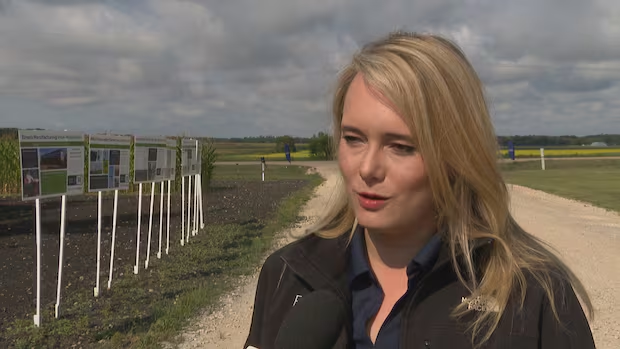
With this season's tumultuous weather, Manitoba farmers gathered in Grosse Isle on Wednesday to learn about how they can harness new technologies to help mitigate risks to their harvests and better adapt to extreme weather.
"I think this year is a good example of increasing variability and severity of weather," said Jacqueline Keena, chief executive officer of the Enterprise Machine Intelligence and Learning Initiative. EMILI is a Manitoba-based non-profit organization focused on agricultural innovations.
The organization hosted Agronomy Day at EMILI's Innovation Farms Grosse Isle location on Rutherford Farms, where it brought together industry experts, entrepreneurs, farmers and agronomists to learn about digital agricultural tools.
The event northwest of Winnipeg was meant to demonstrate how these technologies perform in a real farm setting using data and feedback, and to showcase how farmers in particular can introduce these new technologies into their farms.
This year, the event theme was "weathering change," with an emphasis on what this season's particularly wet weather will mean for crop health and future harvests.
Keena says their farming plans for the season changed overnight during June's rain storms, as Rutherford Farms got about 25.5 centimetres of rain one evening.
"We had some entire fields washed out, underwater for a number of days," she said of the 5,500-acre site. The group also operates on a 10,000-acre farm in MacGregor.
"And so, we think an incredibly important focus is the role that new technologies can play in helping to farm, helping farmers to address, deal with and mitigate effects of climate change and variable weather."
A major talking point was a data-driven agronomic tool called Crop Intelligence.
It operates like a weather station that captures information about precipitation, temperature and general environmental conditions. It interacts with an attached soil probe that allows the user to capture information about soil moisture, said Leanne Koroscil, Innovation Farms manager at EMILI.
"That is using an algorithm and a model to determine how much soil moisture is happening throughout the season in the field and how the crop is taking all that moisture up within the root zone," she said.
"It's able to basically predict how much yield you'll get at the end of the season, which allows you to make an informed management decision earlier in the season."
Charles Fossay farms near Starbuck and is a director at Keystone Agricultural Producers. He has been farming for more than 50 years, and grows a lot of wheat, barley, oats, canola and soybeans.
He says while farmers can sometimes get overwhelmed by data, an innovation like a soil probe can be a very useful tool, especially for irrigation farmers.
"Like, if you're in irrigation, the idea of having a soil probe that will tell you how much moisture is in the soil, how deep down that moisture is, how deep the roots are growing — because that's a very good indicator how much nutrients the plants using — has sort of an indication towards the size of the crop you might be harvesting," he said.
"So, some of that data can be very useful."
Keena says the industry has really changed from when EMILI started 10 years ago. In the beginning, the onus was on them to introduce and explain why they felt artificial intelligence could be an important tool for innovation in the agricultural industry.
"Obviously, 10 years later, that conversation has really changed, and everyone understands how impactful and transformative AI and new technologies are for agriculture," she said.
Now, their focus is on demonstrating the value for farmers like Fossay, and other industry members, in adopting new technologies into their farming practices.
"So many different things for them to manage that if new technologies are to be adopted on their farms, we want to prove them out at full scale before they make their own adoption decisions," Keena said.
Justin Fiacconi is a journalist with CBC Manitoba, where he has worked since July 2025. A former Joan Donaldson and Peter Gzowski scholar, he has worked in two different investigative units at CBC. He graduated from Carleton University in Ottawa, Ontario, with master's degrees in journalism, and international affairs, specializing in conflict studies. His primary journalistic interest is the intersection between geopolitics and sports. He can be reached at justin.fiacconi@cbc.ca.
With files from Juliette Straet
Related Stories
 Technology
What's up with those weird tech startup ads on the subway?
46 minutes ago
 Technology
Juul gets OK to sell updated vaping device with age-gating technology
1 hour ago
 Technology
Technology professional Jeremy Klix seeks Abbotsford council seat
6 hours ago
 Technology
Smart technology restores power automatically during storms and outages
7 hours ago
 Technology
Why Marvell Technology (MRVL) Shares Are Getting Obliterated Today
7 hours ago
 Technology
ONAM Cloud launched to provide enterprise
8 hours ago
 Technology
India, Denmark discuss deeper cooperation in MSME innovation, technology and startups
9 hours ago
 Technology
Biomaterials company Ponda closes crowdfunding round at €1.6 million - shattering their €230k minimum
9 hours ago