
Manuscripts
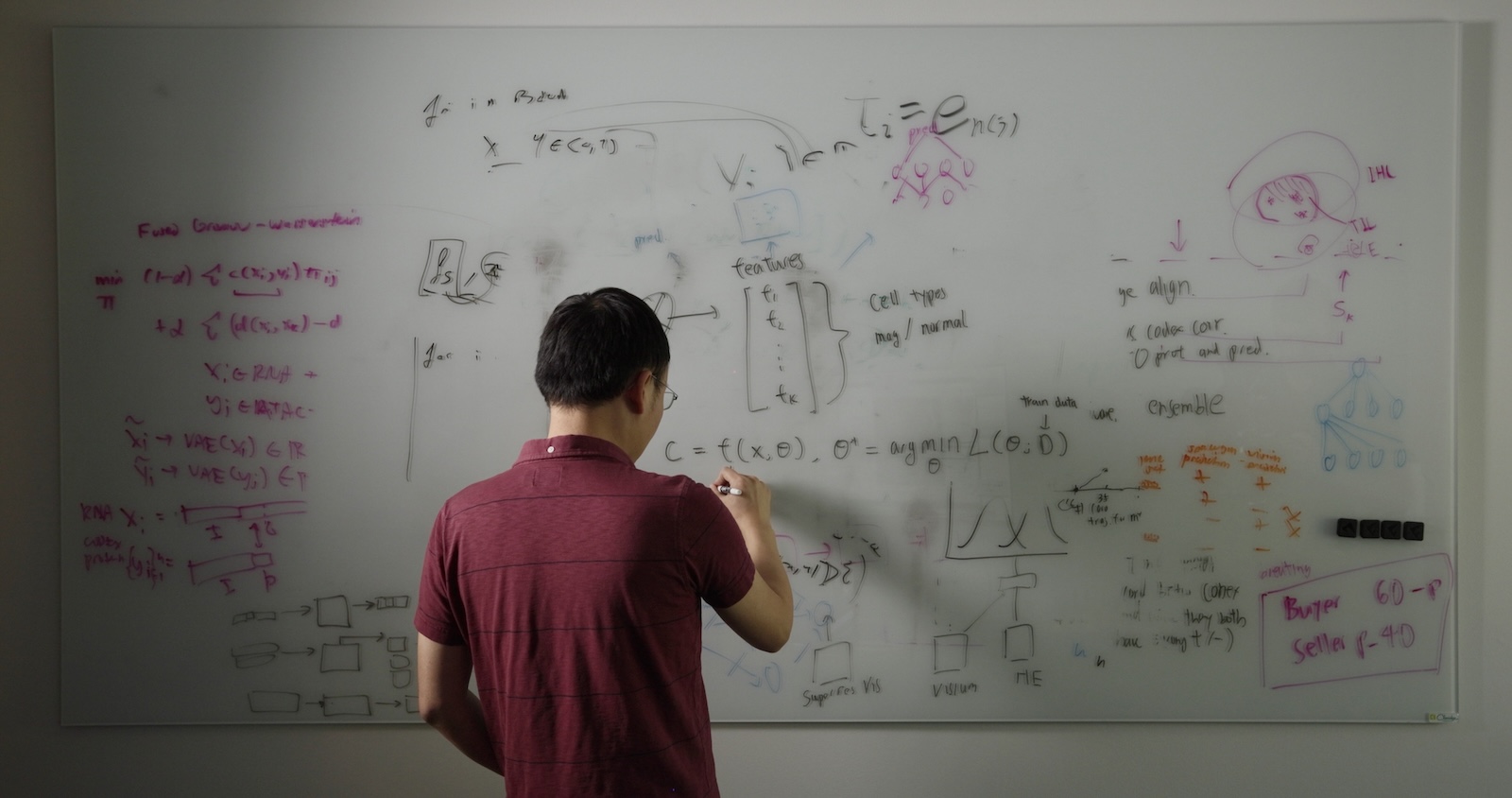
Since 1665, scholarly journals have stood as written record of scientific advancement — static words on a page, a reference written by people for other people to read. That’s about to change.
A team of Stanford Medicine researchers led by postdoctoral scholar Jiacheng Miao, PhD, and associate professor of biomedical data science James Zou, PhD, designed an artificial intelligence program called Paper2Agent that turns any scientific manuscript — including the text, figures and data — into an interactive AI agent that can chat about the paper and interact with other paper agents.
“For essentially all of human history, the way that we represent knowledge is in the form of these very passive artifacts,” Zou said. “In old times people carved knowledge into stones, and now we type knowledge into words on pages — but in some sense pages aren’t that much better.”
Zou is programming a major update to the centuries-old practice of manuscript publishing. “This is an opportunity to fundamentally reimagine what knowledge looks like. Instead of having only passive artifacts, why don’t we convert each static record into an active embodiment of knowledge?” Zou said. Think of it, he said, like a virtual author who knows how that knowledge is generated — one that’s capable of explaining it and extending it by connecting with other papers and initiating new collaborations.
A paper describing the AI work was published Sept. 16 in Nature. Zou is the senior author, and Miao is the lead author.
The paper agents can answer questions about the work, apply methods from the paper to new data and even engage in conversations with other paper agents. The transformation from paper to AI agent starts with a team of bustling AI “worker agents” that pore over a single published paper and any associated code and data. But they’re not just reading the paper. What’s the best way to learn? Do it yourself.
The agents try to reproduce the original research from scratch. In a virtual environment, the agents simulate the research documented in the paper, and through that process, they capture the know-how a reader would otherwise have to dig out manually, from reagents needed to the experimental setup and execution.
The agents store that knowledge using something called an MCP, or model context protocol.
“An MCP lets AI essentially represent a paper PDF in a form that’s easy for agents to access, almost like a filing system,” Zou said. Each section of the paper is stored in a different folder, while the introduction, methods, results and conclusion are all organized into a separate file that lives in a parent file of a given paper.
AI does the heavy lifting, but Zou and the other human authors still have a role. The manuscript won’t capture things like failed experiments or judgment calls behind experimental setups. So humans have to supply that context to the paper agent in conversational exchanges in which the agent can question the authors about the paper and research.
A “live action” embodiment of knowledge can be a boon for readers of scientific manuscripts who seek to deeply understand the research, but these paper whisperers can do something even more impressive. They can talk to each other. That kind of agent-to-agent collaboration could become a vast research network — one with potential to make real discoveries.
Zou and his team demonstrated the power of agent-to-agent collaboration by converting two unrelated papers into agents. One described a tool for predicting how genetic mutations affect the genome; the other described a genome-wide association study of the risk of developing attention-deficit/hyperactivity disorder. With both papers spun up into agents, the two began to find common ground. The genome prediction agent applied its knowledge to the ADHD dataset and flagged a molecular variant near a gene called MPHOSPH9 that’s associated with increased ADHD risk — a connection that, according to Zou, had not been reported before.
“In the past, if there are two research groups that publish two different papers, those two research groups have to somehow find each other,” Zou said. With paper agents, that overlap can surface without human legwork. Zou’s team chose these two initial papers and paired them for this demonstration, but the eventual goal, he said, is something closer to manuscript speed dating at scale: Millions of paper agents surfacing common ground among themselves and working together to produce new insights.
Zou is careful to note that attribution still matters. Agents that extend a paper’s reach are meant to help disseminate the original researchers’ work, not obscure whose work it is. “It’s still important to attribute the final discoveries and reference them back to original papers and original human authors,” he said.
Zou also noted that the parameters under which agents collaborate — and make new discoveries — should be closely guided and monitored to ensure the agents’ collaborations prioritize safety and ethical research.
The team is still expanding what a paper agent can do, including working out how, at scale, thousands or millions of these agents might productively find each other. Right now, the team has created more than 100 paper agents, but eventually, Zou hopes most manuscripts will have an associated paper agent. “Millions of papers are published every year,” he said. “There’s enormous potential here.”
This work was supported by funding from the Chan-Zuckerberg Biohub.
Related Stories
 AI News
The 2.5-hour AI
6 minutes ago
 AI News
Montreal AI research institute denounces violence after office vandalized
8 minutes ago
 AI News
ALL IN 2026 conference opens with focus on sovereign AI, digital trust
1 hour ago
 AI News
AI risks wider gender inequality in jobs market: WEF
1 hour ago
 AI News
Why this fast-growing German AI start
1 hour ago
 AI News
New AI technique could make minimally invasive surgeries safer and more precise
1 hour ago
 AI News
Improving HCLS AI reasoning with open
2 hours ago
 AI News
A Governor's Dozen: 13+ Bills Addressing Artificial Intelligence, Online Youth Safety, and Privacy Signed in California
2 hours ago