
Meet 2026’s award
Building reusable space capsules, making brain surgery safer and fighting child slavery in complex supply chains are not easy problems to solve.
But those are exactly the challenges that this year’s winners of the 2026 European Prize for Women Innovators, across three categories, are taking on with their startups.
Now in its 12th year, the award ceremony — jointly run by the European Innovation Council (EIC), the SMEs Executive Agency (EISMEA) and the European Institute of Innovation and Technology (EIT) — recognises women who are turning bold research into commercial, scalable businesses across Europe.
Sifted spoke to this year’s winners, announced last month at the EIC Summit in Brussels, to hear what’s driving them to solve complex problems, what it actually takes to get an idea out of the lab and into the world and how European public funding is helping to make that happen.
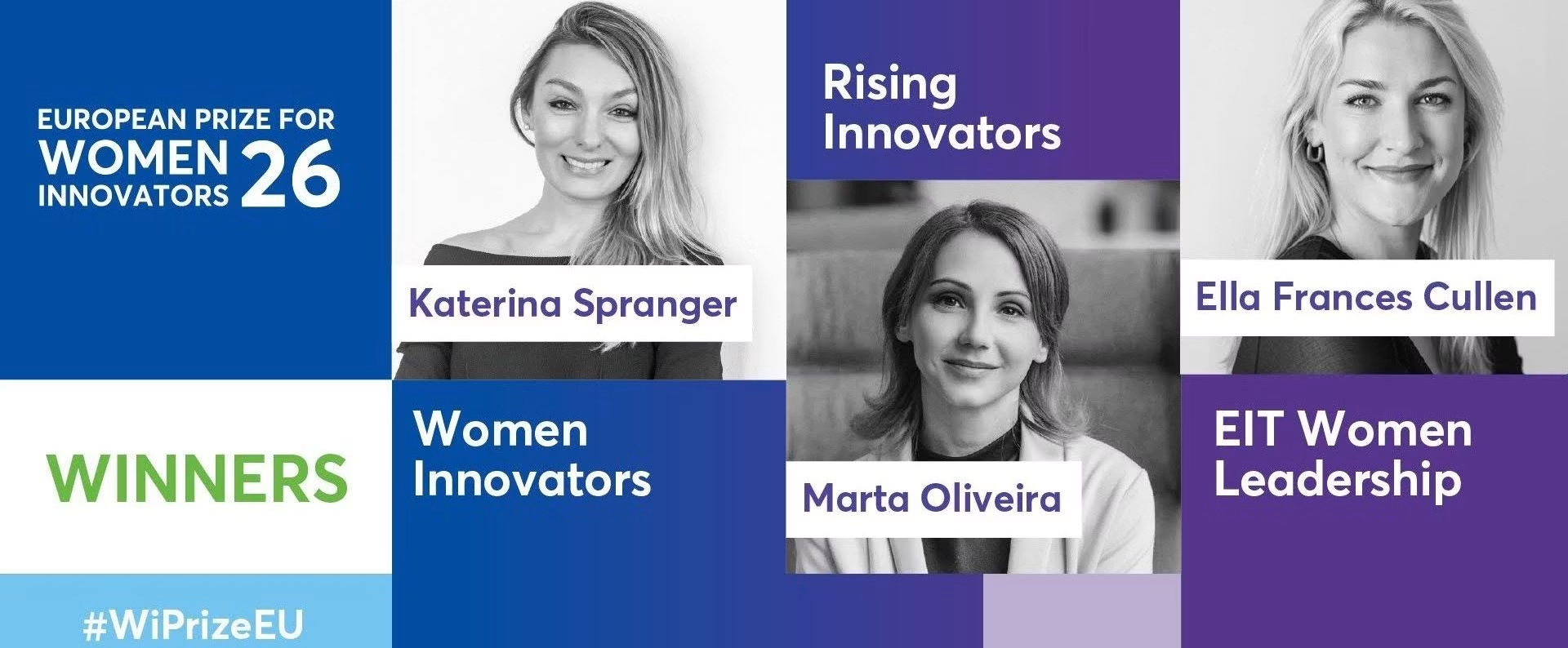
The prize is the Women Innovators award, which is open to all women founders and cofounders from EU member states and associated countries. This year’s winner is Katerina Spranger, founder and CEO of Oxford Heartbeat, an Oxford University spinout building AI software that helps clinicians perform less invasive surgeries when treating neurovascular and cardiovascular conditions.
The company’s platform helps clinicians more precisely predict and choose the correct-sized stent — a device that’s inserted into blocked or weakened blood vessels and acts like a scaffold to keep the passage open — for patients. Its first commercial product is for brain surgeries.
"When I was a child, I had to undergo a high-risk eye surgery [...] a fraction of a millimeter was the literal difference between me keeping my sight or being blind for the rest of my life,” Spranger says.
“When a patient is on the table undergoing a neurovascular procedure, a fraction of a millimeter dictates the entire rest of their life.”
Spranger says she watched a brain surgery while doing her PHD at Oxford and was taken aback by how manual and imprecise the work was.
“I was in absolute shock at the state of the technology the surgeons were forced to use. To select a brain stent, they were manually drawing lines on blurry, 2D, black-and-white X-ray images,” Spranger says.
Before Oxford, she worked in a robotics lab at Sony, and says she knew how good the tracking technology was for consumer hardware, which was one of the reasons she started Oxford Heartbeat.
“I could not believe that brilliant surgeons operating on the human brain were still just sitting there drawing lines,” she says.
Founded in 2015, Oxford Heartbeat has supported more than 1,000 surgeries across 14 European countries, but Spranger says it’s been an uphill struggle building a deeptech company as a female founder.
“A venture capitalist looked me dead in the eyes and told me to my face that I would have to work significantly harder than a man would to get funded. That is still happening today,” she says.
Oxford Heartbeat has won €2.5m in EIC accelerator grant funding this year, money that more women founders need, she says.
“To be completely blunt, if public grant funding did not exist, Oxford Heartbeat would not exist today.”
The Rising Innovators award is open to promising young women innovators under 35. This year’s winner is Marta Oliveira, cofounder and COO of ATMOS Space Cargo, a German company building reusable space capsules to return cargo from low-earth orbit.
The startup, founded in 2021, recorded its first flight in 2025, when its Phoenix 1 capsule was launched on board a SpaceX Falcon 9 rocket.
Oliveira says that the decommissioning of the International Space Station (ISS), scheduled for the end of 2030, will create a big demand for ATMOS’s services, as more spacetech companies conduct independent operations in low-earth orbit.
“All the companies conducting experiments in life sciences or space manufacturing are going to need return platforms once the ISS is retired,” she tells Sifted.
With her and her cofounders all coming from large aerospace companies or the military, Oliveira says that getting ATMOS to where it is today has been a big learning curve.
“Building a commercial company came with a lot of unknowns. Everything from building the team to finding a launch site was a hurdle,” she says. “Finding a launch spot is not as easy as it sounds, especially if you want to launch from Europe.”
Oliveira says that the support of public bodies like the EIC is helping ATMOS as it prepares for its future space launches. It was selected for the EIC accelerator, which injected €13.1m into the company, a mix of grant and equity funding.
“That backing directly covers our next two flights,” she says, adding that initiatives like the European Prize for Women Innovators are important for increasing the visibility of women entrepreneurs working in deeptech.
“Seeing other female founders succeed makes the next generation realise it is possible to make it out there.”
The EIT Women Leadership award is open to exceptional members of the EIT Community, whose achievements serve as an inspiration to others.
2026’s winner is Ella Cullen, cofounder and CMO at Berlin-based Minespider, a blockchain startup that allows manufacturers to trace the materials they use and identify problematic supply chains.
“Specifically, we look at the ‘3TGs’: tin, tantalum, tungsten, and gold,” Cullen says.
“These are minerals where you frequently encounter slave labour, child labour or extreme environmental devastation in places like the Amazon.”
The company received early validation for its product when it worked with Volkswagen after the carmaker was in the press over its supply chains being tied to labour issues in the DRC (Democratic Republic of Congo).
“They asked us to map their lead, and we ended up tracking 1,200 suppliers across 13 different supply chains,” Cullen says.
She adds that the work showed how big corporations were “desperate” for technology that could help them understand opaque supply chains, which involve different “tiers” of providers who supply each other.
Cullen says solving this complex problem with cutting-edge tech wouldn’t have been possible without a €2.8m European grant.“The EIC’s Horizon 2020 grant was the bridge that took us from an interesting prototype to an enterprise platform,” she says, adding that Minespider tracks roughly 10% of the world's global tin supply “We do not achieve that scale without European public funding,” she tells Sifted.
“The EIT— specifically EIT RawMaterials — has been our bedrock. Aside from project funding and a €500k investment two years ago, they provide an irreplaceable network.”
Cullen tells Sifted that winning this award is a big moment for her but that, more importantly, she hopes it inspires more women to build the products that women really need.
“Europe has a staggering pool of female talent, yet a microscopic percentage of the venture capital goes to them. We desperately need more women building female-first products, especially in wildly underserved sectors like women’s health,” she says.
“Look at the fellow winners standing next to me this year. Having them visible as role models is vital.”
Related Stories
 Technology
When Tech Companies Die, What Happens To The Products They Leave Behind?
2 days ago
 Technology
Two Finns supplying Russia with missile tech worth tens of millions
2 days ago
 Technology
Drones with pepper spray, four
2 days ago
 Technology
Micron Technology stock pre-market at EUR 800.50: memory storage - ad
2 days ago
 Technology
TAIEX Ends at 4
2 days ago
 Technology
ZAWYA: Technology, start-ups can double India
2 days ago
 Technology
Czech government to consider CZK 1 billion fund for startups
2 days ago
 Technology
GDIN Supports Eight Startups at CEATEC 2026 in Japan, Opens Door to Local Investor Collaboration
2 days ago