
Mindanao launches 1st circular economy accelerator program
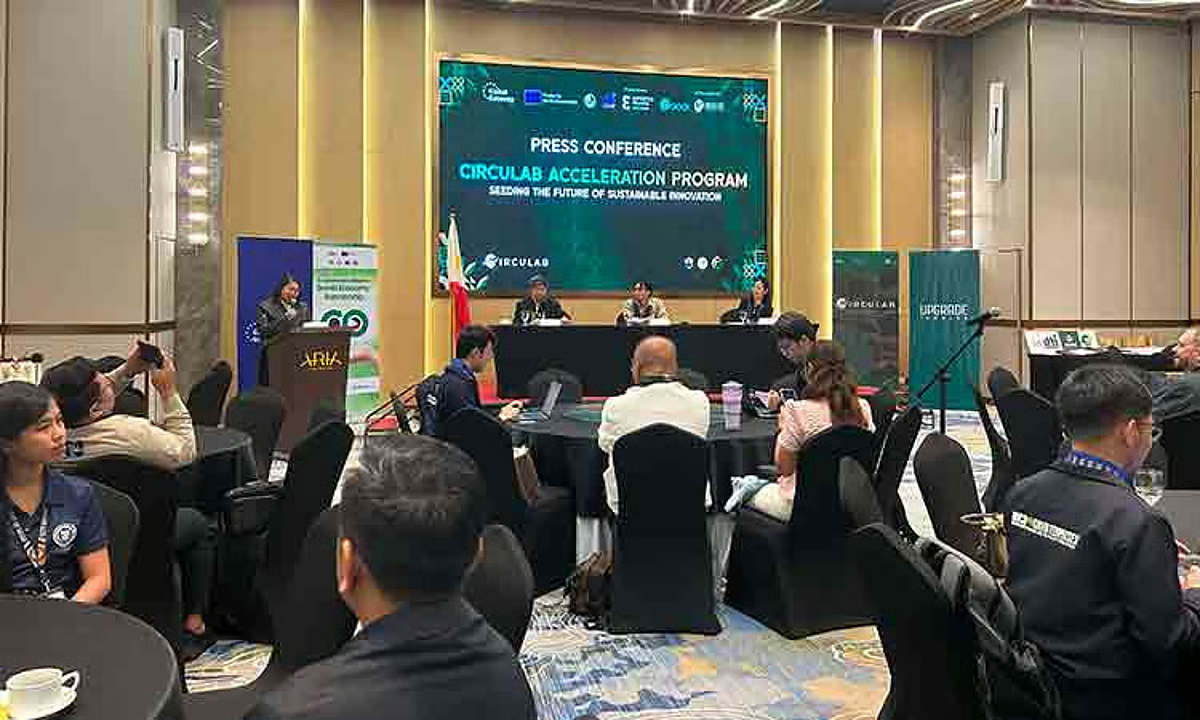
MINDANAO is positioning itself as a hub for green entrepreneurship with the launch of the island's first accelerator program dedicated to circular economy enterprises, an initiative designed to transform waste streams into business opportunities while creating sustainable jobs across the region.
The program, dubbed Circulab: Accelerating Circular Innovation from the Ground Up, was formally introduced on June 2, 2026 by Upgrade Innolab Inc., bringing together startups and micro, small, and medium enterprises (MSMEs) from Northern Mindanao, Davao Region, Soccsksargen, Caraga, and the Bangsamoro Autonomous Region in Muslim Mindanao (Barmm).
Backed by the European Union-Philippines Green Economy Partnership (EU-GEPP), the initiative seeks to address one of Mindanao's most pressing yet often overlooked economic challenges: the vast amount of recoverable waste that remains underutilized despite the region's strong agricultural and industrial output.
As one of the country's primary food baskets, Mindanao supplies roughly 40 percent of the nation's food requirements. However, the island also generates significant volumes of agricultural residues, industrial byproducts, and post-consumer waste.
Program organizers estimate that nearly 60 percent of recyclable and recoverable materials still end up in landfills, representing not only an environmental concern but also a missed economic opportunity.
For business leaders behind the initiative, waste is increasingly being viewed as a valuable resource rather than a disposal problem.
"By onboarding our first cohort of subgrantees and merging international standards with hyper-local entrepreneurial talent, we are building the technical and financial runway necessary to execute impactful circular economy pilots right here in Mindanao," said Upgrade Innolab President Richard Day.
The nine-month accelerator aims to help entrepreneurs convert sustainability-focused concepts into commercially viable ventures. Participants will receive business development assistance, technical mentoring, market linkage support, and access to grants of up to P1.3 million to help scale innovative solutions that reduce waste and maximize resource use.
The launch comes amid growing global demand for circular economy models, which prioritize extending the lifecycle of materials through reuse, recycling, refurbishment, and regeneration rather than the traditional "take-make-dispose" production system.
According to Day, Mindanao's economic structure makes it uniquely positioned to benefit from such an approach.
"We are the top producer of industrial waste, meaning there's also a big opportunity to make a circular economy," he said.
The program's proponents believe that by converting agricultural byproducts, food waste, discarded plastics, and other industrial materials into new products and services, entrepreneurs can unlock new revenue streams while contributing to environmental sustainability.
Beyond environmental benefits, organizers see the initiative as a platform for regional economic development. Green enterprises are expected to generate new employment opportunities, particularly in rural communities where agricultural production remains a major economic driver.
The accelerator is also expected to contribute to climate resilience efforts by reducing landfill waste, lowering emissions associated with resource extraction, and encouraging more efficient use of materials across supply chains.
Among the first cohort of participants is Anitu Forest Chocolates, a community-based enterprise founded by married couple Rogen and Marvi Montecillo. The entrepreneurs said circular economy principles have long been embedded in their operations, even before joining the accelerator.
"Important kaayo siya for us kay especially karon naay inflation. Dayon sa among community para maka-survive gyud ta, dapat kabalo gyud ta og reuse, reduce, recycle kung unsay naa sa atua (It is very important for us, especially now that there is inflation. In our community, if we want to survive, we really need to know how to reuse, reduce, and recycle whatever resources we have," Rogen said.
For small enterprises facing rising production costs, resource efficiency has become both a survival strategy and a business advantage.
Marvi echoed the sentiment, saying sustainability is increasingly becoming a necessity rather than a choice.
"Muabot ang time nga necessity gyud siya. Dili siya ingon nga char-char. Kailangan gyud siya mahimong way of living (The time will come when this will truly be a necessity. It is not just for show or a passing trend. It really has to become a way of life)," he said.
Day noted that many Filipinos are already familiar with circular economy practices, although they may not recognize them by that name.
"Circular economy is basically existing already. It's something we've been doing since time immemorial," he said.
He pointed to common Filipino habits such as repurposing household containers, repairing items instead of discarding them, and purchasing second-hand goods as examples of circularity in everyday life.
The launch of Circulab signals a broader shift in how sustainability is being integrated into business development strategies. Rather than treating environmental protection as a compliance requirement, the program frames circularity as a source of innovation, competitiveness, and long-term economic growth.
Supported by the European Union's €60-million (approximately P3.67-billion) Global Gateway investment package, the initiative is expected to help cultivate a new generation of Mindanao-based enterprises capable of turning environmental challenges into profitable and scalable business solutions.
For a region rich in agricultural resources yet burdened by mounting waste streams, organizers believe the future of green growth may lie not in producing more, but in making better use of what is already being discarded. DEF
Related Stories
 Business
New investors flip script to get into film funding, distribution as sector slump opens opportunities
1 hour ago
 Business
US nutrition startup Berry Street merges with India’s Healthify as GLP
4 hours ago
 Business
Global Expansion through 25
5 hours ago
 Business
Stand together, buy Canadian and 'diversify away from the United States of America': Manitoba trade minister
6 hours ago
 Business
Banks need tailored approach to start
8 hours ago
 Business
Carney unveils $11B in funding to make 6 icebreakers in Quebec
9 hours ago
 Business
Quincy fintech incubator Qubic Labs seeks support after losing out on state grant
9 hours ago
 Business
Startup news and updates: daily roundup (August 24, 2026)
10 hours ago