
Ministry of SMEs and Startups Selects 175 Innovative AI Service Companies… Predicts Seafood Prices, Caregiving, and Fire Risks
For small and medium-sized service enterprises (SMEs), the success or failure of their AI transition hinges not on the adoption of technology, but on the process of organizing data relevant to business operations and developing solutions for practical use in the field. The necessary functions also vary by industry, ranging from predicting seafood import prices and automating voice commands for caregiver platforms to pre-detecting fire risks. Companies lacking in-house development personnel and resources require support for both initial setup costs and business design. The Ministry of SMEs and Startups has selected 175 SMEs that will transform their service business models and operational methods using AI and digital technologies.
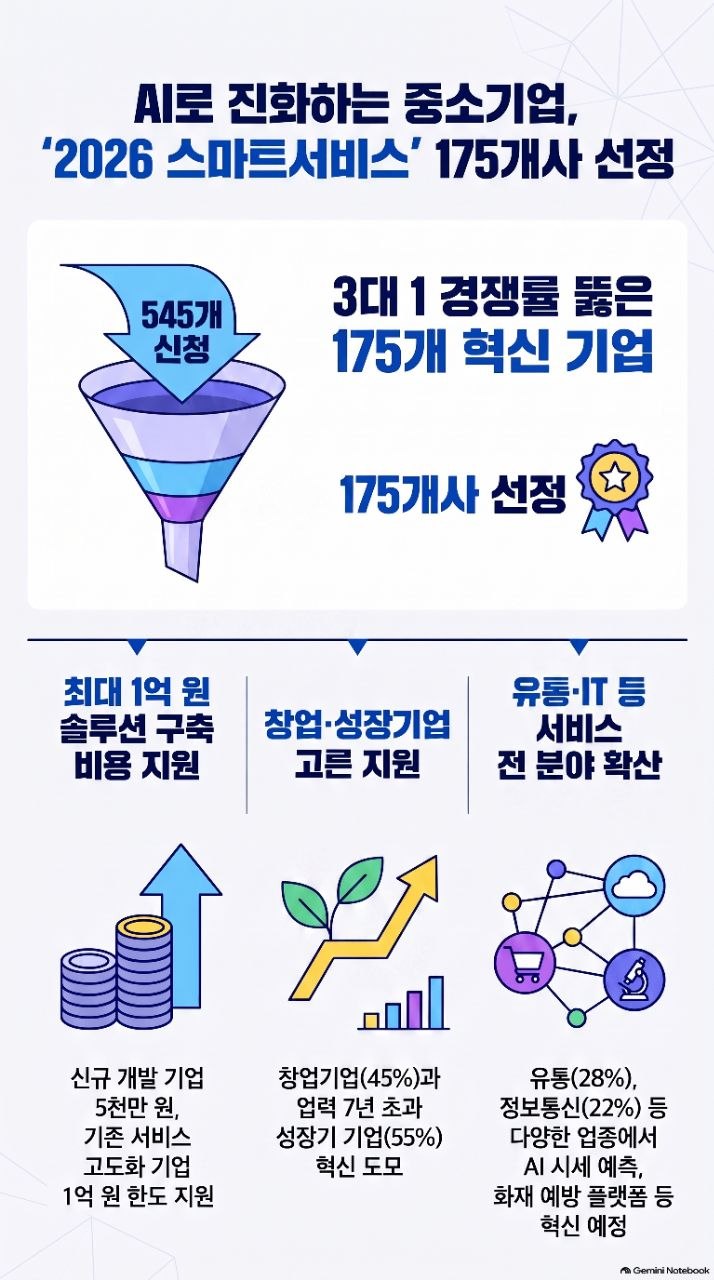
The Ministry of SMEs and Startups and the Korea Technology Information Promotion Agency for SMEs selected 175 companies as beneficiaries of the '2026 SME Smart Service Project.' The total project budget for this year is 10.9 billion won.
Support types are divided into new development, which creates new solutions, and enhancement, which improves existing services. The 150 companies selected for new development will receive 50 million won, while the 25 companies selected for enhancement will receive up to 100 million won.
This project supports small and medium-sized enterprises (SMEs) operating in the service industry in creating new business models and improving service delivery systems by utilizing advanced information and communication technologies (ICT), such as big data and AI. Support is provided for the establishment of solutions applicable to actual business operations, including logistics, supply chain management, marketing, and customer service. The Institute has included this project under the 2026 Real-Name Project Management System to monitor its implementation status and management structure.
Over the two months following the business announcement in March of this year, 545 companies applied, resulting in a competition rate of approximately 3 to 1. The Ministry of SMEs and Startups and the Institute of Technology and Information Technology comprehensively reviewed the necessity of support, the appropriateness of the implementation plan, the feasibility of building the solution, and expected effects through written and on-site evaluations.
Looking at the selected companies by industry, retail accounted for 50 companies, or 29% of the total. Information and communication accounted for 39 companies, or 22%, while science and technology services accounted for 34 companies, or 19%. Rather than focusing on a specific industry, AI application projects were selected to solve industry-specific problems across various fields, including retail, IT, and professional services.
The years of business experience were also distributed relatively evenly. Start-ups accounted for 83 companies (47%), while growth companies with more than 7 years of experience accounted for 92 companies (53%). The structure supports both the development of new services for early-stage companies and the business advancement of existing companies.
Sea Life Science Lab develops import price prediction solutions utilizing global seafood distribution and supply chains and market price data. The method calculates the estimated import price of seafood required by customers and recommends alternative species and origins based on price or supply conditions.
Seafood prices are highly volatile, influenced by catch volumes, exchange rates, transportation costs, and supply and demand conditions by country. If various data can be analyzed together to determine optimal purchasing timing and alternative sources, this can be utilized to reduce procurement costs and supply chain risks for food ingredient and distribution companies.
C-Plus, the operator of 'Care Plus,' a platform connecting caregivers and patients, is applying an AI voice automated response system to its existing app. It supports caregiver registration and log entry via phone or voice, and also improves operational management functions.
Even users unfamiliar with using apps can input necessary information via voice, improving service accessibility for caregivers and patient guardians. Automating repetitive registration and record-keeping tasks also reduces the management burden on platform operators.
Jeongpyeong E&C, a company specializing in the design, inspection, and management of fire safety facilities, is developing an AI fire prediction platform that utilizes multiple sensors and complex data, such as temperature and smoke. The goal is to identify signs of fire risk early by analyzing data from various sites, rather than relying on alarms from a single sensor.
Hwang Young-ho, Director General of Technology Innovation Policy at the Ministry of SMEs and Startups, stated, “The SME Smart Service Support Project will provide opportunities for service sector SMEs to create new business models and enhance productivity and competitiveness by incorporating AI,” adding, “We will continue to provide policy support to ensure that innovation among SMEs is achieved based on AI and digital technologies.”
The selected companies will build smart service solutions over a period of approximately six months after signing an agreement with the Institute. The Ministry of SMEs and Startups plans to support and manage the implementation process to facilitate project execution and the creation of results.
The success of this project should be judged not by the fact that 175 companies implemented the solution, but by the actual extent to which working hours, error rates, revenue, and customer service quality have improved. AI projects may see low usage rates after implementation if field data is insufficient or if the solution does not align with the workflow of the personnel in charge. Government support can lead to sustainable service innovation and new revenue when performance indicators for each company are defined in advance and employee training and data quality management are conducted in parallel.
Related Stories
 Technology
Juul gets OK to sell updated vaping device with age-gating technology
8 minutes ago
 Technology
Technology professional Jeremy Klix seeks Abbotsford council seat
5 hours ago
 Technology
Smart technology restores power automatically during storms and outages
6 hours ago
 Technology
Why Marvell Technology (MRVL) Shares Are Getting Obliterated Today
6 hours ago
 Technology
ONAM Cloud launched to provide enterprise
7 hours ago
 Technology
India, Denmark discuss deeper cooperation in MSME innovation, technology and startups
8 hours ago
 Technology
Biomaterials company Ponda closes crowdfunding round at €1.6 million - shattering their €230k minimum
8 hours ago
 Technology
Deepening Implementation of Technological Innovation, Accelerating Transformation of Productive Forces
9 hours ago