
Ministry touts benefits of its AI certification
Ministry touts benefits of its AI certification
TWO LEVELS: ‘The number of applicants reflects where the demand is,’ an official said of its program to train application-oriented AI talent for businesses
More than 21,000 people have signed up for Taiwan’s new “artificial intelligence (AI) application planner” certification since its launch last year, highlighting the demand for practical AI skills, a senior Ministry of Economic Affairs official said.
Introduced by the Industrial Development Administration, the certification attracted more than 10,000 applicants in its first year, with 8,464 people certified this year as of this month, Industrial Development Administration Director-General Chiou Chyou-huey (邱求慧) said.
The entry-level certification course runs four times a year, while the intermediate level runs twice per year, with pass rates averaging 40 to 50 percent, Chiou said.
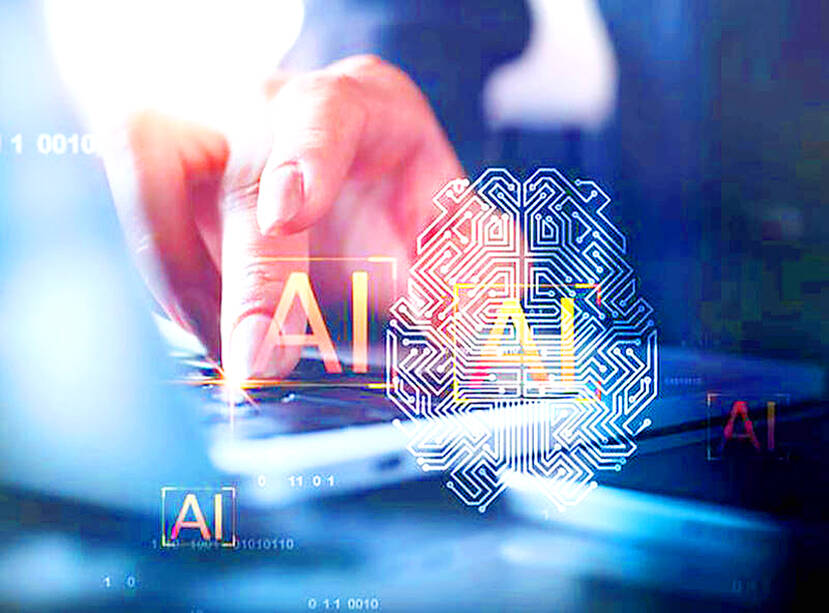
A representational image of artificial intelligence.
“The number of applicants reflects where the demand is,” Chiou said, adding that while certifications related to net-zero emissions had dominated in the past few years, AI has become the hottest field.
Unlike developer certifications offered by companies such as Microsoft and Nvidia, the government program focuses on cultivating application-oriented AI talent by teaching people how to use AI tools and simple programming to improve business operations, Chiou said.
The initiative is part of the government’s broader effort to help President William Lai (賴清德) achieve his goal of turning Taiwan into an “AI island” by accelerating AI adoption across industries, he said.
The ministry aims to increase AI adoption in the manufacturing sector to 50 percent by 2028, up from just 6 to 7 percent when the target was first set, Chiou said.
The push also reflects Taiwan’s shortcomings in AI, despite its global leadership in semiconductor manufacturing, he said.
Taiwan climbed to 16th from 21st overall in the Observer Global AI Index, but ranked only 33rd in AI talent and 30th in business environment, trailing Japan, South Korea, Singapore and China in both categories, Chiou said.
“Taiwan is a global leader in AI hardware, but much of what we produce is used by others,” he said. “There is still considerable room for growth in how we apply AI ourselves.”
The benefits of the AI boom have largely been concentrated in the semiconductor and high-tech sectors, while many traditional industries, and small and medium-sized enterprises remain in the early stages of AI adoption, creating an “M-shaped” pattern of development, he said.
To narrow that gap, the ministry has trained 700 to 800 AI consultants and aims to expand the team to 1,000, helping 14,000 businesses adopt AI over the next two years, he said.
The government subsidizes consulting services by about NT$410,000 per project, including up to NT$100,000 that companies can use to purchase software, he said.
Rather than encouraging businesses to deploy the most advanced AI systems, firms should focus on selecting tools that best suit their operational needs, Chiou said.
“Having more AI tools isn’t necessarily better,” he said. “The key is using the right tool for the right purpose.”
Related Stories
 AI News
Oracle reportedly lands $7B GPU deal for Tencent
1 minute ago
 AI News
Halton police are turning to AI to help hire, train 911 call takers
1 minute ago
 AI News
Startup news and updates: daily roundup (October 9, 2026)
59 minutes ago
 AI News
Lessons from Leo: University of Scranton
1 hour ago
 AI News
New study ranks how well AI tools help shoppers hunt for deals | Action on AI
1 hour ago
 AI News
Artificial intelligence: Risk management actuaries need to work across business units
1 hour ago
 AI News
Monte Carlo Capital raises €13 million for Fund II to invest in early-stage DeepTech, AI and SpaceTech
2 hours ago
 AI News
Anthropic bans 'cruel' behaviour against its Claude AI
2 hours ago