
Minns and Mookhey in India: Business, education, cricket
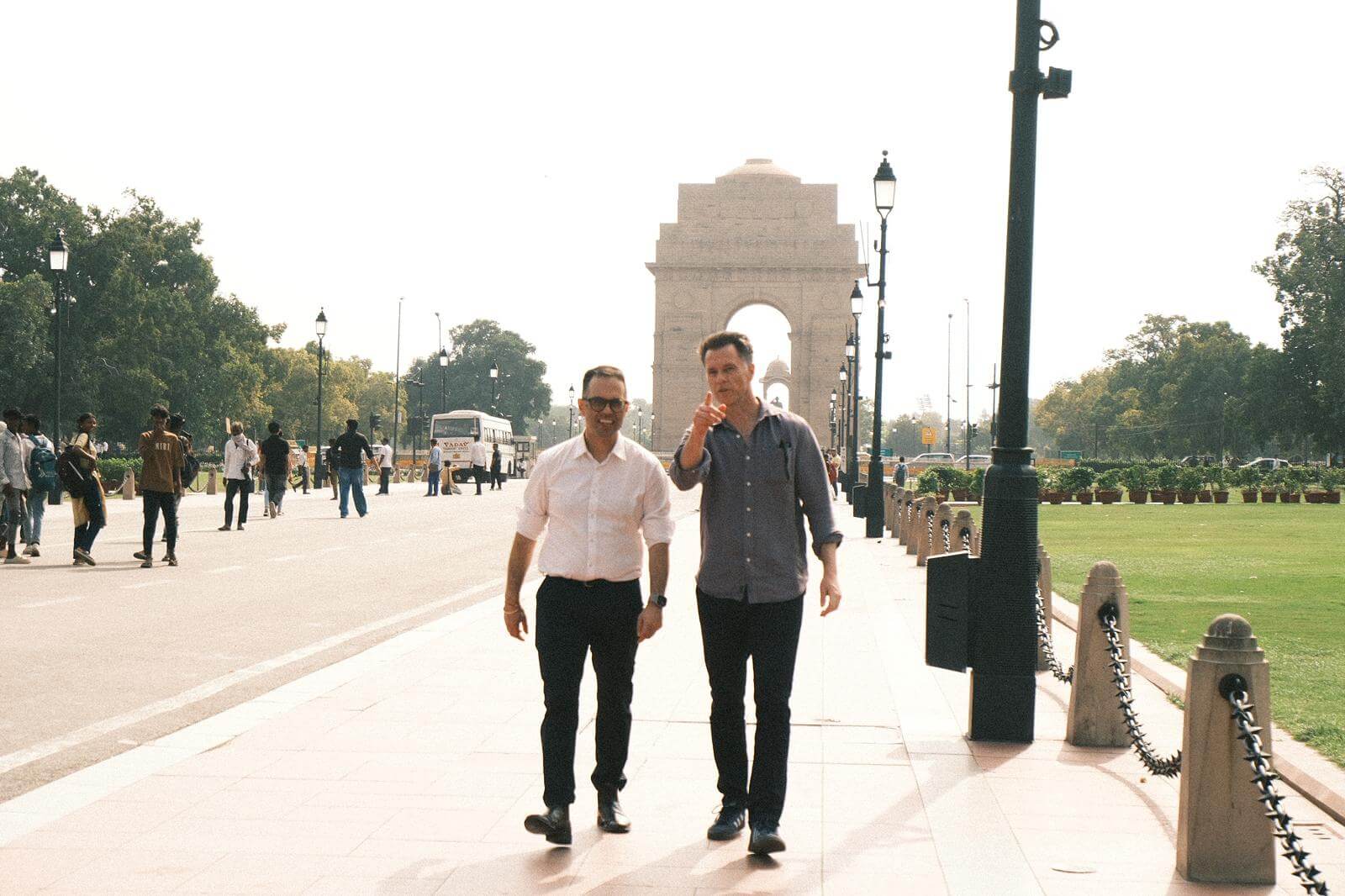
Over four days in New Delhi and Mumbai, the NSW Premier and Treasurer combined the serious business of trade and investment with the sort of images that play extremely well back home: rubbing shoulders with India’s political and corporate heavyweights, as well as moments at cricket, places of worship, dabbawalas, charity organisations.
And that was probably the point.
This was not simply a business delegation. It was a carefully managed exercise in showing that NSW understands India – not just its economy, but its culture, people and increasingly influential diaspora.
The NSW Government’s pitch was built around areas where the state has genuine strengths: education, technology, critical minerals, tourism, food and the creative industries, particularly film. The delegation held discussions with senior Indian political and business leaders, including Commerce and Industry Minister Piyush Goyal, Maharashtra Chief Minister Devendra Fadnavis, and corporates Air India, Mahindras, Tatas, while Mookhey and Minns promoted NSW as a destination for investment and deeper commercial partnerships.
There was plenty of substance behind the photographs. Education is an obvious area of mutual interest, given the enormous contribution Indian students make to Australia’s education sector and the growing appetite among Indian universities and institutions for international partnerships. Tourism is another natural fit, while food and the creative industries offer opportunities to build a relationship that extends well beyond traditional trade.
Film, another item on the Minns-Mookhey agenda, is an interesting part of the NSW pitch. India’s enormous entertainment industry and Australia’s sophisticated production capabilities provide plenty of scope for collaboration, and NSW is well placed to benefit from India’s growing global cultural influence.
But if the business meetings were the substance of the trip, the cultural visits were what made it visible.
Minns and Mookhey visited ASHA, Bangla Sahib Gurdwara, and Akshardham Temple in Delhi, experienced Mumbai’s famous dabbawala operation and, inevitably, picked up cricket bats. These were not simply tourist diversions. They were carefully chosen opportunities to demonstrate familiarity with aspects of Indian life that matter deeply to many Indian Australians.
Met @ChrisMinnsMP, Premier of New South Wales, Australia,, and discussed ways to further strengthen India-NSW economic and cultural ties and identify new avenues for collaboration across sectors.
Building on the strong India-Australia partnership and the positive outcomes of… pic.twitter.com/ZK2dAdYA1D
— Piyush Goyal (@PiyushGoyal) August 31, 2026
They signify that the relationship is not confined to boardrooms and trade statistics.
There was also, inevitably, a political calculation.
The Indian-Australian community in NSW is large, successful and growing, and its political influence is becoming harder for governments to ignore. It is not a single voting bloc, and it would be simplistic to suggest otherwise, but the community’s growing economic, social and political importance is obvious.
So while the India mission was clearly about trade and investment, it would be equally naïve to pretend that the optics had nothing to do with politics.
Minns has been particularly conscious of the Indian-Australian community’s contribution to NSW, and the trip gave him an opportunity to strengthen those relationships in a way that a series of meetings in Sydney never could. The cultural side of the visit allowed the Premier to connect with Indian Australians through familiar touchstones while simultaneously demonstrating to India that NSW values the diaspora as an important bridge between the two countries.
That is smart politics – but it is also smart diplomacy.
The one unfortunate footnote was Nepal.
Minns had originally planned to travel to Kathmandu after the India leg of the mission, but that visit was cancelled as devastating floods and the humanitarian crisis unfolded. Given the circumstances, the decision was entirely understandable. With lives at risk and Australians among those affected by the disaster, a political trade mission was clearly not the priority.
But the cancellation nevertheless represented a missed opportunity.
The Nepalese-Australian community is another emerging and increasingly visible community in NSW, and a visit by the Premier would have carried considerable goodwill, particularly at a time when Nepal was going through such a traumatic period.
Instead, India became the entire focus, and on that front the mission appears to have delivered a combination of substance and visibility.
The real test, of course, comes later. Trade missions are easy to judge via photo opportunities accompanied by announcements of new partnerships. The harder measure is what happens six, 12 and 24 months down the track: whether Indian companies invest in NSW, whether commercial partnerships develop, whether education and research links deepen, whether tourism grows and whether the promised opportunities translate into jobs and economic activity.
But first impressions matter, and this was a carefully executed one.
Minns and Mookhey played to NSW’s genuine strengths while making sure the trip was culturally recognisable to an Indian audience. They met strategic political and business leaders, promoted education, tourism, technology and the creative industries, and then stepped outside the conference rooms to engage with religion, food, community and cricket.
It made the mission feel less like a traditional trade delegation and more like a relationship-building exercise.
That is probably the right approach to India.
For NSW, the relationship is too important to be reduced to export figures. It is increasingly about the movement of students, tourists, capital, ideas, technology, culture and people – and the Indian-Australian community sits right in the middle of all of it.
So Minns can reasonably claim a successful trip, provided the business results eventually match the optics.
Read more: Beyond Dialogue: Building the next chapter of Australia–India Relations
Related Stories
 India
India
CJP’s Instagram hits 22 million followers in a week: Can online backlash influence election results? What t...
39 minutes ago
 India
India
Meta ramps up censorship of protest, political reels
40 minutes ago
 India
India
Cultural diplomacy: PM Modi showcases India's heritage gifts to French and Slovak leaders
41 minutes ago
 India
India
World Bank, Government of India Sign Agreement to Improve Air Quality in Uttar Pradesh State
1 hour ago
 India
India
When religion becomes the axis of India’s electoral politics
1 hour ago
 India
India
Canada says India no longer linked to violent crime ahead of Carney trip
1 hour ago
 India
India
India's growth defies oil shock but data faces credibility questions
2 hours ago
 India
India
Rupee Rally To Get Boost from India’s $127 bln NRI Deposits
2 hours ago