
Modi govt keen on key Constitutional amendments as monsoon session nears: The math, politics and fears, decoded
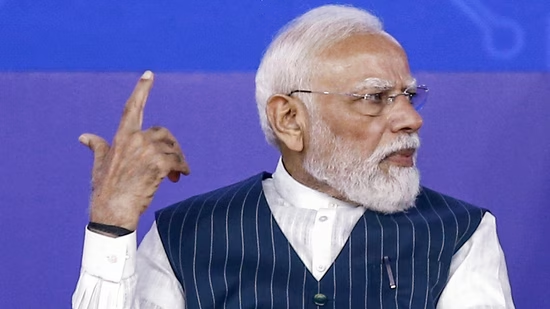
Modi govt eyeing Constitutional amendments as monsoon session nears: The math, politics and fears — decoded
“Despite many efforts, they didn't get a two-thirds majority... They're splitting parties,” Congress gen secy Jairam Ramesh said; monsoon session begins July 20
PM Narendra Modi's government enters the Parliament's monsoon session, set to start on July 20, with stronger numbers than it had just three months ago, and an agenda that might again include constitutional amendments.
Recent defections from Opposition parties have improved the BJP-led National Democratic Alliance's arithmetic in Parliament, reportedly emboldening the government to pursue an agenda that includes the 130th Amendment Bill on the removal of PM, CMs and ministers if they are jailed for 30 days even on mere allegations.
And then there's the 131st Amendment Bill on delimitation and operationalisation of the already-passed 33% reservation for women in legislatures; this was defeated in the last session in April as the government lacked the required two-third majority.
In the background lies the larger ‘One Nation, One Election’ (ONOE) project, still under parliamentary scrutiny.
The main Opposition party Congress has sought to cast this, again, as a grave danger to the Constitution at large, and even to reservations for distressed classes such as Scheduled Castes (SCs).
On Saturday, Congress general secretary comms head Jairam Ramesh noted that the BJP was seeking to improve its constitutional arithmetic through defections.
“Despite many efforts, they didn't get a two-thirds majority... They're splitting parties. But they're not going to get a two-thirds majority,” he claimed.
“Their real motive is to change the Constitution of India... The purpose of crossing 400 seats was to be in a position to change the Constitution,” he said, recalling the the BJP's ‘Ab ki Baar, 400 Paar’ slogan in the 2024 Lok Sabha polls, in which the BJP fell short of the majority mark of 272 on its own.
Why amendments don't pass easily
But, unlike ordinary legislation, constitutional amendments are governed by Article 368, where a higher threshold than mere majority determines success.
With the Lok Sabha's effective strength at 540 at present, an amendment requires not just the support of at least 271 members — a simple majority — but ‘yes’ votes from two-thirds of members present and voting. If all 540 members vote, that translates to 360 votes. Even if attendance drops, the threshold remains formidable. Say, with 500 members vote; then 334 votes are needed; with 480, the mark is 320.
The NDA's strength has crossed the 300-mark following recent defections and allied support from MPs who have left Bengal's TMC and Maharashtra's Shiv Sena (UBT). But that's still short of an assured two-thirds majority. The Rajya Sabha presents a similar challenge, making regional parties and possible abstentions among Opposition MPs critical to the government's prospects.
It is this arithmetic that has turned every defection into a constitutional story.
On the agenda purportedly is the 130th Amendment Bill, which proposes that the Prime Minister, Union ministers, CMs and state ministers would lose office automatically if they remain in judicial custody for more than 30 consecutive days in cases punishable with at least five years' imprisonment. This came up last year but was sent to a committee.
That Joint Parliamentary Committee is expected to adopt its report around July 17, paving the way for the bill to be introduced during the monsoon session, news agency PTI reported on Saturday citing sources.
Union home minister Amit Shah has already framed it as an issue of accountability. “No minister, Chief Minister or Prime Minister in the country can run the government while being in jail,” Shah said last year, also citing Arvind Kejriwal as an example at the time.
On concerns about mere allegations becoming a political weapon, he'd said, “If there is a fake case, the courts of the country are there to grant bail. If bail is not granted, then the person will have to quit.”
Shah has also stressed that “PM Modi himself brought the office of Prime Minister under the ambit of this constitutional amendment”.
Opposition parties counter that the proposal effectively punishes mere charges rather than actual conviction.
Delimitation and the women's quota
The 131st Amendment Bill is the more politically ambitious item on the government agenda — and a more recent burn too.
This proposal, defeated in April, seeks to increase the maximum strength of the Lok Sabha; permit delimitation or redrawing of constituency boundaries using the 2011 Census; and thus operationalise the women's reservation law before the 2029 general election.
While the government presents it as the mechanism for implementing the quote for women — that was already enacted in 2023 but linked to the next census and delimitation — the Opposition argues that the real intent is the redistribution of parliamentary seats.
The Congress and southern states' parties such as the DMK have alleged that the delimitation would favour more populous states in the north, such as UP and Bihar; and thus needs wider debate.
Some in the Opposition even asked why not effect the 33% quota in the current House strength. The government has argued a large House is necessary to protect everyone's interests.
The government's broader constitutional roadmap extends beyond the monsoon session. The Constitution (129th Amendment) Bill on One Nation, One Election remains before a 39-member Joint Parliamentary Committee chaired by BJP MP PP Chaudhary, whose tenure was extended by Parliament to continue consultations.
PM Modi has repeatedly argued that “frequent elections are creating obstacles in the country's progress”. Chaudhary has called the proposal “a historic reform” and said holding assembly and Lok Sabha elections together is “in the country's best interest”.
Yet constitutional experts remain divided. Former Chief Justice DY Chandrachud, in his submission to the JPC, reportedly said the Constitution does not mandate separate elections but cautioned against giving the Election Commission “unbridled” powers to extend or curtail assembly terms to achieve ONOE.
Senior advocate Raju Ramachandran, writing in The Indian Express, has argued that the ONOE plan's main constitutional challenge is that it challenges the idea of federalism. Political scientist Milan Vaishnav has also cautioned that “the fundamentals of democratic institutional design should not be reimagined without first achieving broad consensus”.
The renewed constitutional agenda has also revived one of the defining political narratives of the past few decades — the fears around reservation.
The issue first surfaced prominently during the 2015 Bihar assembly elections, when Rashtriya Swayamsevak Sangh chief Mohan Bhagwat's call for a relook at the reservation policy became a major campaign issue. The BJP spent much of that election distancing itself from the remarks, while the Grand Alliance of Congress, JDU and RJD successfully framed the contest around the “protection of quotas”.
A decade later, the Congress-led INDIA bloc revived a similar argument during the 2024 Lok Sabha elections, alleging that the BJP's “Beyond 400” campaign was aimed at securing the numbers required to amend the Constitution and weaken reservations for Scheduled Castes, Scheduled Tribes and Other Backward Classes.
Prime Minister Modi has rejected the charge repeatedly, declaring that “as long as Modi is alive, no one can end reservation”.
The Congress has nevertheless continued to frame the government's constitutional initiatives through that lens.
Jairam Ramesh alleged that the BJP's “real and ultimate target” was to amend the Constitution and “end reservation”, arguing that delimitation was merely the immediate objective in a longer political strategy.
There is no constitutional amendment proposal currently before Parliament for changing reservations for SCs, STs or OBCs.
Aarish Chhabra is an Associate Editor with the Hindustan Times online team, writing news reports and explanatory articles, besides overseeing coverage for the website. His career spans nearly two decades across India's most respected newsrooms in print, digital, and broadcast. He has reported, written, and edited across formats — from breaking news and live election coverage, to analytical long-reads and cultural commentary — building a body of work that reflects both editorial rigour and a deep curiosity about the society he writes for. Aarish studied English literature, sociology and history, besides journalism, at Panjab University, Chandigarh, and started his career in that city, eventually moving to Delhi. He is also the author of ‘The Big Small Town: How Life Looks from Chandigarh’, a collection of critical essays originally serialised as a weekly column in the Hindustan Times, examining the culture and politics of a city that is far more than its famous architecture — and, in doing so, holding up a mirror to modern India. In stints at the BBC, The Indian Express, NDTV, and Jagran New Media, he worked across formats and languages; mainly English, also Hindi and Punjabi. He was part of the crack team for the BBC Explainer project replicated across the world by the broadcaster. At Jagran, he developed editorial guides and trained journalists on integrity and content quality. He has also worked at the intersection of journalism and education. At the Indian School of Business (ISB), Hyderabad, he developed a website that simplified academic research in management. At Bennett University's Times School of Media in Noida, he taught students the craft of digital journalism: from newsgathering and writing, to social media strategy and video storytelling. Having moved from a small town to a bigger town to a mega city for education and work, his intellectual passions lie at the intersection of society, politics, and popular culture — a perspective that informs both his writing and his view of the world. When not working, he is constantly reading long-form journalism or watching brainrot content, sometimes both at the same time.Read More
Related Stories
 India
India
Centre forms panel to finalise 'permanent political solution' to Gorkha issue
3 hours ago
 India
India
India news: Gandhi's notes sold for $1.7 million at auction
8 hours ago
 India
India
Inside BJP’s 10-point Vande Mataram resolution: ‘No vote bank' politics, cites Mahatma Gandhi’s ‘anti
11 hours ago
 India
India
'Against communal pressure, appeasement and vote-bank politics': BJP's Vande Mataram salvo at Congress over two
13 hours ago
 India
India
The Cost of Cash Transfers: India’s Welfare Dilemma
14 hours ago
 India
India
Gen Z: India's BJP mastered WhatsApp and X. Now it is trying to crack Instagram
14 hours ago
 India
India
How BJP and Congress are chasing Gen Z: Inside the battle for India’s youngest voters ahead of 2029
15 hours ago
 India
India
Charanjit Singh Channi’s academic pursuit: A new model in indian politics
18 hours ago