
Most wildlife AI focuses on the ground. This model looks up in the trees
When it comes to decoding camera-trap images, artificial intelligence has become all the rage, especially for terrestrial animals, or those that dwell on the ground. But for more evasive species living high up in trees, the technology is still lacking.
A newly developed AI model aims to fill that gap.
TropiCam-AI was developed to detect and identify arboreal, or tree-dwelling, species in a part of the world where they abound: the tropical forests of the Americas. Scientists built the model to address the voids that exist in identifying arboreal mammals and birds.
“We set up TropiCam-AI with the objective of developing a tool that is specifically meant for neotropical camera-trapping surveys targeting the canopy,” Andrea Zampetti, lead author of the study and Ph.D. candidate in animal biology at the Sapienza University of Rome, told Mongabay in a video interview. Zampetti’s work was done in collaboration with the TROPECOLNET project at the National Museum of Natural Sciences in Madrid, led by Ana Benítez-López.
Arboreal species play a key role in ecosystems. They serve as important seed dispersers, with studies finding that primates, small mammals and birds consume up to 90% of plant species in tropical rainforests. However, these are tree-dependent species that, by their very nature, are especially threatened by deforestation, underscoring the need to study, track and monitor them for conservation purposes. A study published earlier this year by Zampetti and colleagues notes that “arboreal camera trapping remains severely underrepresented compared to AI trained on terrestrial images.”
“It’s critical we speed up the pace at which we can gather and analyze data and transform it into useful information,” Zampetti told Mongabay. “And this tool was built to help ecologists and practitioners to quickly expedite the analysis of camera-trap data and automatically process millions of images and videos.”
The bulk of the data for training the model was gathered by Zampetti, who spent three months in Brazil as part of an expedition. He worked closely with local communities in Brazil as well as the NGO Instituto Juruá to gather the data. Since he wanted to expand the training data beyond the species and locations in the expedition, he also got camera-trap images from researchers working in other sites, including Peru, Costa Rica and French Guiana. He also tapped into the huge data set of images and videos available from citizen scientist platform iNaturalist. Once the data had been gathered, he worked with fellow researchers to go through each image and identify the species in them — a process known as manual annotation that could then be used to train the algorithm on what to look out for.
Scientists can now input their camera-trap images into the model and get the AI’s take on what species, if any, are present. The model has also been trained to inform users if it’s too difficult to return a species identification from a given image.
“Instead of forcing a prediction that may be wrong, it automatically jumps up on the taxonomic hierarchy and says that the species might be from a particular genus,” Zampetti said.
TropiCam-AI can now recognize 84 taxa including 63 species. According to the study, the tool has an accuracy of 95%, “with the majority of taxa (50 out of 84) achieving [more than] 90% precision and recall.”
Zampetti said the team will continue to refine the tool with more training data. They’re also in touch with more collaborators who are keen to provide data to further train the model. “At the end of the day, these kinds of tools are only able to do what you’re training them to do,” he said. “Going forward, we can start to increase the sample size and tweak it for improvements to make it more fine-tuned for any kind of applications.”
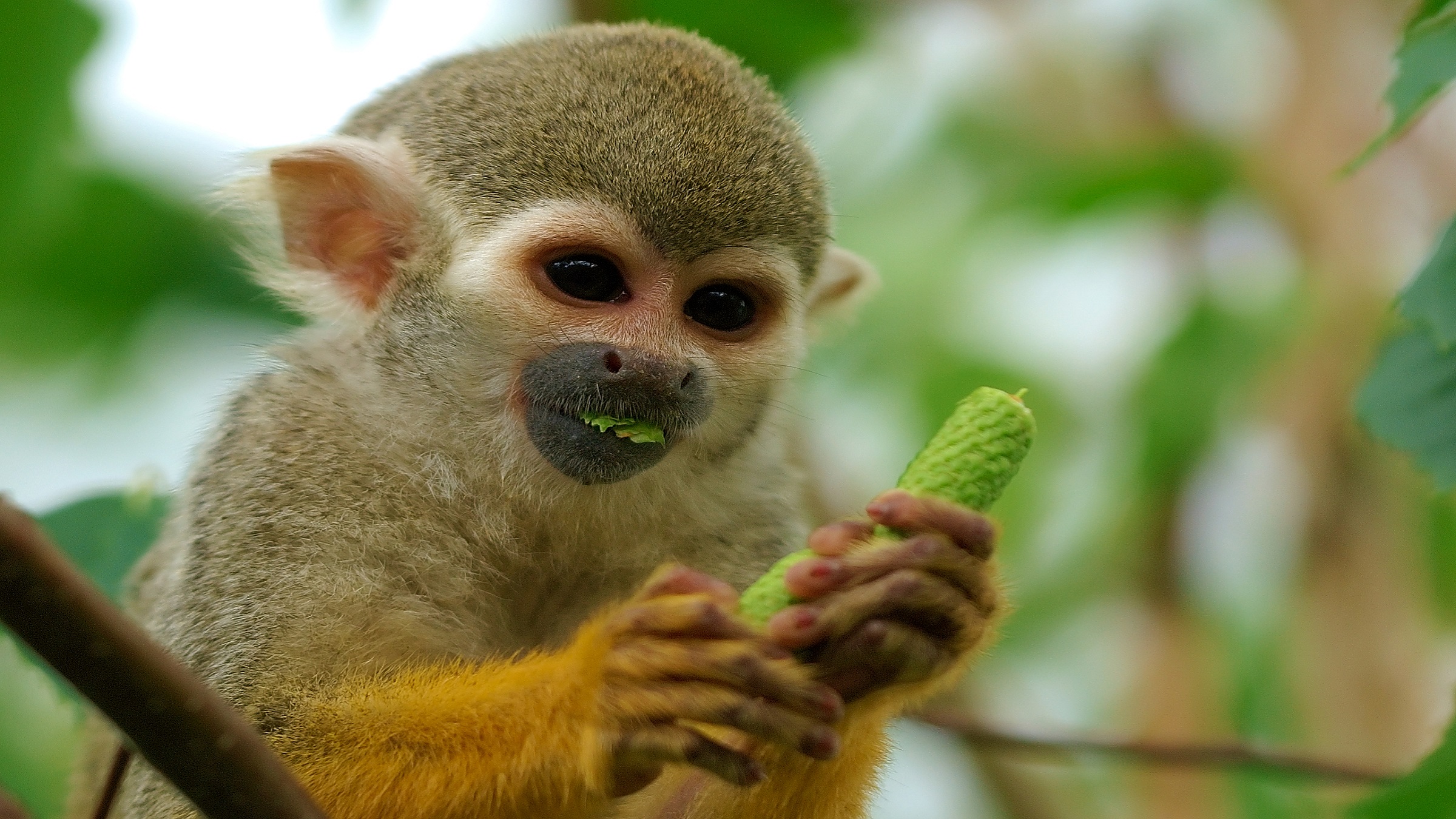
Banner image: The common squirrel monkey (Saimiri sciureus) is one of 63 species that can be recognized by TropiCam-AI. Image by Luc Viatour via Wikimedia Commons (CC BY-SA 3.0).
Abhishyant Kidangoor is a staff writer at Mongabay. Find him on 𝕏 @AbhishyantPK.
Howe, H. F., & Smallwood, J. (1982). Ecology of seed dispersal. Annual Review of Ecology and Systematics, 13, 201-228. doi:10.1146/annurev.es.13.110182.001221
Zampetti, A., Santini, L., Ferreiro‐Arias, I., Paltrinieri, L., Ortiz, I., Cedeño‐Panchez, B. A., … Benítez‐López, A. (2026). Introducing TropiCam‐AI: A taxonomically flexible automated classifier of neotropical arboreal mammals and birds from camera‐trap data. Methods in Ecology and Evolution, 17(4), 1235-1247. doi:10.1111/2041-210x.70213
Related Stories
 AI News
The Latest: Vance and Iranian negotiators are in Switzerland to work on details of deal
38 minutes ago
 AI News
Iran vs. Belgium: In L.A.'s 'Tehrangeles,' the World Cup weighs heavily on those who fled
38 minutes ago
 AI News
Disruption warning after fatal train crash
38 minutes ago
 AI News
Hunt for friends of woman who faked her death
38 minutes ago
 AI News
Villagers object to homes plan for 'landmark' farm
38 minutes ago
 AI News
Sharing traditional knowledge strengthens Buffalo Narrows power couple's bond
39 minutes ago
 AI News
He hadn't heard the news about Hockey Night in Canada. Then came the orders for his vintage HNIC merchandise
39 minutes ago
 AI News
Age of Empires II’s goats used as AI building blocks to build a neural network
43 minutes ago