
Multidisciplinary Scientific Expedition Sets Sail July 10 Aboard the CCGS Amundsen
Multidisciplinary Scientific Expedition Sets Sail July 10 Aboard the CCGS Amundsen
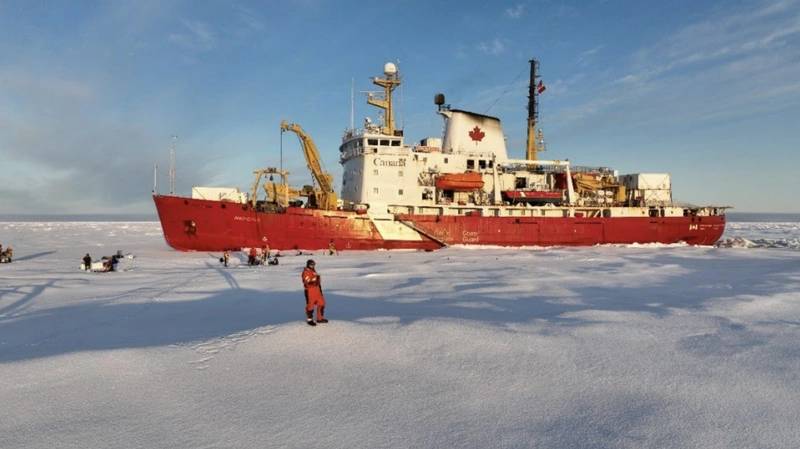
The Canadian Coast Guard research vessel, the CCGS Amundsen, in the ice of the Queen Elizabeth Islands during its 2025 expedition.© CCGS Amundsen/Amundsen Science
An international, multidisciplinary scientific expedition will set sail on July 10 aboard the Canadian research icebreaker CCGS Amundsen. Until November 25, research teams will conduct operations across several strategic regions of the Canadian Arctic and Greenland, collecting samples and data to better understand the environmental and ecological changes affecting the North. The expedition will also help strengthen Canada's scientific presence in Arctic waters.
Coordinated by Amundsen Science in partnership with the Canadian Coast Guard, this 139-day expedition will enable research teams to explore several key regions, including the Labrador Sea, Baffin Bay, the Northwest Passage, Nares Strait, the Tuvaijuittuq Marine Protected Area, and several fjords along West Greenland and in the Canadian Arctic Archipelago. The expedition will involve more than 200 participants, including scientists, students, engineers, research professionals, Inuit and northern partners, artists, and media representatives, from close to 50 Canadian and international institutions and organizations.
Organized into five-month legs, the 2026 Amundsen Expedition will support seven scientific programs with the overarching goal of improving our understanding of the rapid environmental, and societal changes reshaping the Canadian Arctic and adjacent Greenland waters, while providing knowledge for science-based decision-making. Integrating Inuit knowledge and local priorities with scientific approaches is a key aspect of the expedition.
In the Labrador Sea, collaborative work over July will generate critical knowledge on high-biodiversity habitats and fragile ecosystems to support the implementation of proposed marine protected areas as part of Nunatsiavut's marine planning efforts. As part of this work, Amundsen Science will deploy its scientific remotely operated vehicle, ASTRID, to document and sample six biological hotspots of particular importance for benthic biodiversity and marine conservation.
In August, multidisciplinary international research teams will investigate changes associated with glaciers connected to the Greenland Ice Sheet, the largest ice mass in the Northern Hemisphere. Their work will help improve understanding of how glaciers melt affects Arctic marine ecosystems and productivity, northern communities and global sea levels. These teams will return aboard the Amundsen in November to study how Arctic sea ice forms and evolves during ocean freeze-up, a critical but understudied period that influences heat and gas exchanges across the air-sea interface, ecological cycles at the onset of the polar night, and the predictability of changing ice conditions.
Three major research programs will join forces in September to investigate how glacier melt, sea ice dynamics, ocean circulation, seafloor processes, and marine ecosystems interact in these remote regions, while also conducting targeted coastal and land-based sampling near glaciers, lakes, and fjords. This work will strengthen Canada's capacity to monitor, understand, and safeguard remote Arctic environments of strategic scientific, ecological, and national importance.
In the month of October, two research programs will work alongside each other across Baffin Bay and Davis Strait to inform ecosystem-based management of marine populations and improve long-term observations. One program will focus on biological productivity, marine habitats, and ecosystem monitoring, while the other will turnaround ocean observing arrays to document ocean circulation and environmental variability at a critical gateway between the Arctic and North Atlantic.
Beyond advancing Arctic science, the expedition will train nearly 75 students in a field environment and preparing the next generation of Arctic specialists. It will also strengthen collaboration with northern communities through the participation of Inuit and northern researchers, technicians, and community representatives, as well as planned community visits that will create opportunities for engagement between locals, scientific teams and Canadian Coast Guard members.
Read more about CCGS Amundsen and its mobilization period in our May/June 2026 issue.
Related Stories
 World
World
Best 50 bars in the world have been revealed
50 minutes ago
 World
World
Arctic Open: Lee Rediscovers Spark
51 minutes ago
 World
World
World Trademark Review Recognizes Morgan Lewis in Inaugural Copyright 1000 Rankings
51 minutes ago
 World
World
South Africa
51 minutes ago
 World
World
From Supply Security to Artificial Intelligence: Issues Bringing Global Energy Leaders Together in Riyadh
55 minutes ago
 World
World
Cop31 host urges wealthy countries to spend ‘much more’ on climate than defence
1 hour ago
 World
World
Panama rocked by 2 powerful earthquakes and multiple aftershocks, prompting evacuations
1 hour ago
 World
World
World Mental Health Day: let’s talk and listen
1 hour ago