
New U.S. tariffs in effect after trade talks fail, Carney says Canada plans to match levies
New U.S. tariffs in effect after trade talks fail, Carney says Canada plans to match levies
Leaders across Canada continue to respond to Trump's trade war. This morning, Christine Fréchette, the premier of Quebec, issued her own statement.
"The American administration has again chosen confrontation," she wrote on X in French, noting that the tariffs will have a "direct impact" on Quebec's economy and workers.
"As the premier of Quebec, my priority is clear: protect our economy, our businesses and our workers," she wrote.
Fréchette also said she is meeting with her cabinet this morning to discuss "necessary measures" that will be put in place to support businesses and workers that will be affected.
"Quebec will be present to defend its interests and will do everything that is necessary to protect our economy," she wrote. "Our team is mobilized."
Alberta Premier Danielle Smith also responded to the news last night after it broke, writing on X overnight that she is "deeply disappointed that Canada and the United States have not been able to reach a trade agreement."
Smith reiterated that the province will continue to advocate for a tariff-free relationship between Canada and the U.S.
"My first concern today is for the Albertans and Canadians whose livelihoods are at risk from these new tariffs and counter-tariffs," Smith wrote. "I welcome the federal government’s intention to provide relief for those businesses that are impacted."
She said she will be pushing the federal government to resume negotiations with the U.S. as soon as possible.
Reactions from Canada's premiers have been trickling out since the news broke that Prime Minister Mark Carney suspended trade talks with the U.S., citing "unfair" last-minute changes to the anticipated deal. As a result, U.S. President Donald Trump's latest tariffs went into effect, placing 50 per cent tariffs on some $28 billion worth of goods.
British Columbia is disproportionately impacted by Trump's trade war, and B.C. Premier David Eby was quick to respond to Carney's bold move.
"British Columbians will always stand with Canada," Eby wrote last night. "Our politeness should never be mistaken for weakness."
"We'll always defend ourselves. We didn't ask for this, but we'll keep fighting for as long as it takes."
50% tariffs in effect after U.S. and Canada fail to reach a deal
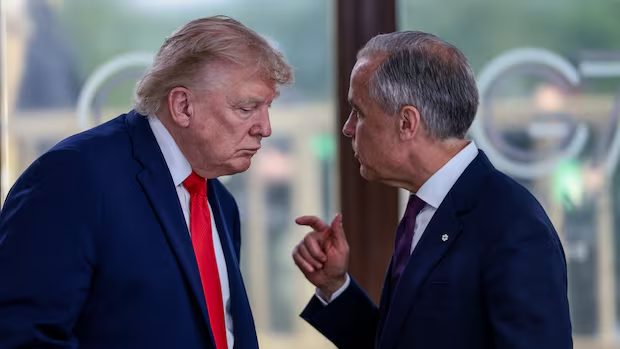
Prime Minister Mark Carney said Canada is planning to match U.S. levies ‘dollar for dollar,’ after the 50 per cent tariffs took effect on Aug. 21 at 12:01 ET. The two countries had ramped-up trade talks over the last three days after Trump extended the tariff deadline earlier this week.
The ongoing trade dispute between Canada and the United States has deepened after high-stakes negotiations fell apart at the 11th hour on Friday.
Prime Minister Mark Carney said Ottawa would retaliate "dollar for dollar" after the Trump administration delivered on its threat to impose crushing 50 per cent tariffs on billions of dollars worth of Canadian goods. The two governments' trade representatives said they had come close to finalizing an agreement in recent days, but Carney said Ottawa couldn't accept the terms on the table.
"Last-minute changes in the U.S. proposed terms were unfair, uneconomic, and called into question the reliability of any deal," Carney wrote in a statement.
U.S. President Donald Trump did not immediately comment. His government's trade representative, Jamieson Greer, said Ottawa had declined to accept the administration's proposed deal.
The fresh American tariffs and the promise of Canadian counter-tariffs are a significant escalation in the dispute between Canada and the U.S., two countries once seen as being as close as can be on trade. Canada's trade minister was locked into negotiations with Greer, his American counterpart, throughout the week in Washington to try to find an agreement before Friday's deadline.
While much of the tariff discussion this week has revolved around the highest echelons of political power, businesses on both sides of the border waited to see whether the latest threat to their livelihoods would come to pass.
"This will be a body blow to North American competitiveness in this self-defeating trade saga," Candace Laing, president and CEO of the Canadian Chamber of Commerce said. "A whopping, non-absorbable tariff is not sustainable or viable for business."
Greer said the United States proposed granting Canada better trade privileges by offering "significant tariff reductions on steel, aluminum, autos and lumber in exchange for other concessions from Canada."
He added that the offer included "a historic economic and national security partnership" aimed at co-operating on export controls, combatting transshipment, enhancing digital trade and aligning select external tariffs.
The proposal, he said, outlined supply chain co-ordination on aerospace, co-ordinated efforts to tackle unfair trade practices, co-operation on critical minerals, stricter enforcement against goods made with forced labour and the announcement of formal CUSMA negotiations.
Let's look at which provinces stand to take the biggest hit.
Items subject to the new tariffs represent more than 13 per cent of the B.C.'s total exports to the U.S. in 2025, which is higher than any other province, thanks in part to the wood and paper products being targeted.
Quebec also stands to take a major hit, with about 10 per cent of its exports exposed to Trump's duties. These latest threats are on top of the already crushing 50 per cent tariffs on steel and aluminum hobbling one of Quebec's major industries.
Interestingly, only about one per cent of exports from Alberta and Saskatchewan to the U.S. are under threat.
These new 50 per cent tariffs hit a wide swath of goods made in Canada, but the electronics sector stands to take the biggest hit.
Canada exported more than $4 billion US worth of electronics equipment that would be subject to Trump's new tariffs.
In fact, certain electrical boards and controllers are on the list and are the largest value export to the U.S. of any impacted category.
In a statement to CBC News, Candace Laing, president and CEO of the Canadian Chamber of Commerce, said under the new trade conditions, "Americans will see their costs go up, and Canadians will see customers, investment and small businesses disappear."
Laing is also a member of the prime minister's advisory committee on Canada-U.S economic relations.
"This will be a body blow to North American competitiveness in this self-defeating trade saga," Laing said. "A whopping, non-absorbable tariff is not sustainable or viable for business."
Trump's threatened 50 per cent tariffs across nearly $30 billion of Canadian goods took effect at midnight after negotiators didn't reach a deal before the president's deadline.
"For a small Canadian exporter operating on tight margins, this isn't an abstract trade dispute," Laing said. "It means looking at your orders, your payroll and your employees and asking what you can still afford.
"From beer to benches, a diamond ring to molasses, plywood to winter jackets — this is no longer just 232s we are talking about," she said.
Carney said that in the coming days, the federal government would introduce additional measures to support Canadian workers and businesses.
Closing his statement, the prime minister reaffirmed Canadian sovereignty and underlined the government's core economic strategy: building strength at home and diversifying partnerships abroad.
"Canada has what the world wants," he said. "And we will not allow any nation to determine our future. We will set our own course to keep building Canada strong for all."
In a statement posted to X after Canada declined a trade deal with the U.S., Ontario Premier Doug Ford said "the prime minister has my full support for a strong response — tariff for tariff, dollar for dollar."
Carney said Canada would match the U.S. 50 per cent tariff on nearly $30 billion of Canadian goods dollar for dollar. Trump's threatened tariffs are set to take effect at midnight.
"Team Canada needs to stand together more united than ever before," Ford said.
During this week's negotiations, reporters and pundits noted that Ford, or Captain Canada, had been uncharacteristically quiet.
"As we fight to protect Canadian sovereignty and economic security, everything needs to be on the table.
"Ontario is ready to do its part."
Related Stories
 Canada
Ottawa school becomes first in Canada named after former PM Brian Mulroney
20 minutes ago
 Canada
Carney to attend pro
20 minutes ago
 Canada
From Potential to Prosperity: The urgent case for greater investment in Canada's SMEs
20 minutes ago
 Canada
Draft document maps Canada
20 minutes ago
 Canada
Canada women's rugby have two chances to take down England on home soil
1 hour ago
 Canada
Brian Mulroney Elementary School celebrates official opening
2 hours ago
 Canada
Undecided voter looks for answers ahead of Alberta’s referendum
2 hours ago
 Canada
Third death from Tsawwassen Mills crash
2 hours ago