
New Zealanders look for better Politics and Policies as E Day neighs
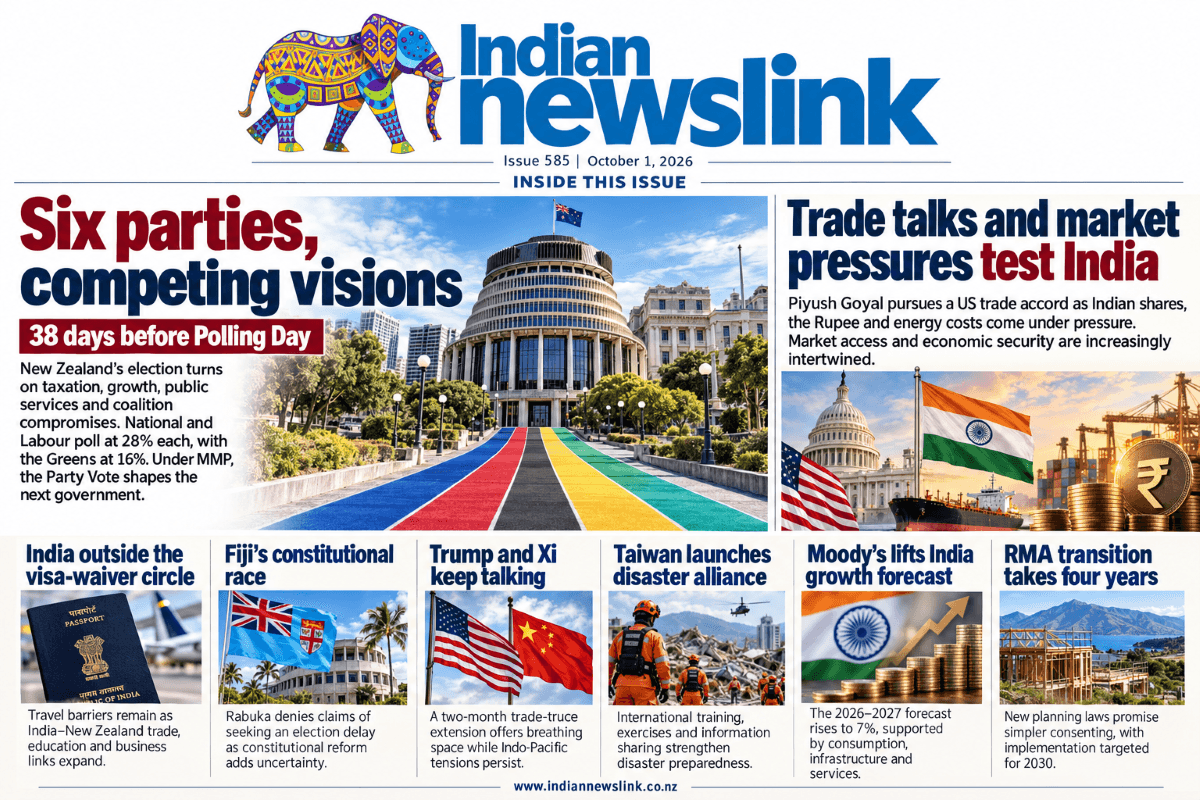
Welcome to Indian Newslink October 15, 2026
Venkat RamanAuckland, October 4, 2026
Thirty-eight days before Polling Day, New Zealand’s election has evolved into a contest of competing governing philosophies rather than a simple choice between two parties. The Party Vote will determine parliamentary entry and the policies required to form a government. A recent poll places National and Labour at 28% each, with the Greens at 16%, confirming that smaller parties hold decisive influence under MMP.
Voters face practical choices affecting taxation, business confidence, health access, home ownership, retirement savings, immigration, and climate obligations. The core question is which programme can be sustained through a coalition.
This election presents six distinct propositions. National backs growth, investment, and fiscal discipline. Labour calls for a fairer tax base to fund public services. New Zealand First emphasises national sovereignty. ACT offers economic reform and a smaller state. The Greens seek environmental repair and redistribution. Opportunity champions extended reform. None of these positions are costly, as lower taxes restrict spending and new taxes alter investments.
National campaigns on economic growth, no new taxes, a return to surplus, infrastructure, education, health targets, law and order, home ownership, and enhanced KiwiSaver balances. Its governing belief is that disciplined spending and a supportive economy will improve wages and public services over time. While this offers clarity for businesses wary of taxation, the risk remains that public expectations in health and education could outpace available spending allowances. National must prove that its growth strategy can successfully turn fiscal improvements around.
Trade talks and market pressures test India
India’s Commerce and Industry Minister Piyush Goyal is attending the G20 Trade Ministers’ Meeting in Milwaukee to advance the bilateral trade agreement and seek an interim settlement.
The diplomatic push coincides with severe pressure on Indian financial markets. On September 28, 2026, Bombay Stock Exchange listed firms lost ₹7.52 trillion in a single session, reducing total value to ₹474.36 trillion. The Sensex and Nifty closed at six-month lows, with the Nifty 50 dropping 5.7% for September. Foreign portfolio investors sold a net of US$3.83 billion of Indian shares during the month. Rising United States bond yields, higher oil prices, and a stronger dollar have reduced the appeal of Indian equities.
Economic security and market access are now closely intertwined. On September 29, 2026, the Indian Rupee touched ₹96.15 against the US Dollar. With India importing nearly 90% of its crude requirements and Brent Crude approaching US$108 a barrel, global geopolitical shifts translate rapidly into domestic transport bills, food prices, and family budgets. Washington and New Delhi face the challenge of aligning security, tariffs, and energy policies within a broader framework.
India remains outside New Zealand’s visa-waiver circle
India’s absence from New Zealand’s visa-waiver list remains a significant practical barrier to travel and cooperation. While passport holders from 60 countries can enter without a visitor visa, Indian travellers must complete pre-departure visa applications. This requirement affects holidaymakers, families, students, and business delegates.
The omission is particularly striking as an India-New Zealand free trade agreement approaches implementation. Commercial, educational, and professional links depend on direct human contact, from entrepreneurs inspecting opportunities to families attending weddings. New Zealand should recognise that excluding India from the visa-waiver group affects bilateral trust.
Rabuka’s constitutional race clouds Fiji election
Fiji’s upcoming general election faces intense uncertainty following allegations that Prime Minister Sitiveni Rabuka privately sought the support of the Great Council of Chiefs to delay the poll. Former Prime Minister Mahendra Chaudhry claimed Mr Rabuka lobbied the institution while publicly maintaining the election timetable, an assertion firmly denied by Mr Rabuka and council leaders.
Although no independent evidence substantiates the claim, it has heightened suspicion surrounding the national political calendar. Under the existing Constitution, the general election must take place by 6 February 2027, with the President issuing writs by 24 December 2026. Simultaneously, the government is pushing for a new constitution to come into force by that exact date. With parliamentary deliberations and a referendum planned between November and mid-December, this compressed transition window has raised profound questions for Indo-Fijians and the wider electorate regarding the future of democratic governance in the country.
Trump and Xi keep talking as Indo-Pacific watches
When US President Donald Trump welcomed Chinese President Xi Jinping at the White House on September 24, 2026, the meeting yielded a modest economic reprieve while leaving underlying Indo-Pacific tensions intact.
The most tangible result was a two-month extension of the US-China trade truce, granting negotiators more time to address tariffs and critical minerals. However, this serves as breathing space rather than a permanent settlement. With potential future encounters at APEC and the G20, frequent contact helps defuse crises. Yet, it raises concerns for smaller nations like New Zealand about whether their regional interests will be sidelined.
For New Zealand, whose two-way trade with China exceeded $41 billion, a renewed trade confrontation would disrupt shipping and market confidence. Global economic friction directly impacts international markets and households across the Indo-Pacific.
Taiwan sets up World Alliance for Disaster Management
Taiwan has established the World Alliance for Disaster Management to leverage its expertise in disaster prevention and expand international cooperation. Foreign Minister Lin Chia-lung noted that natural disasters cross borders, prompting the Ministry of Foreign Affairs and the National Fire Agency to spearhead the initiative.
President Lai Ching-te announced the official launch on September 19, 2026. 13 states, 17 observers, and 11 partners from nations including the United States, Japan, the United Kingdom, and Germany have joined. The alliance aims to strengthen global response through joint training, exercises, and information sharing, positioning the Zhushan training centre in Nantou as a primary Indo-Pacific hub.
The founding assembly took place in Taipei from September 19 to 21, 2026, alongside forums on societal defence resilience and disaster education. President Lai described the launch as a major breakthrough for Taiwan’s international participation, reinforcing its commitment to global humanitarian collaboration.
Moody’s lifts India’s Real GDP growth to 7% amidst constraints
Moody’s Ratings has sharply raised its forecast for India’s Real GDP growth for 2026-2027 to 7% from 6%, reflecting strong resilience against Middle East conflicts and expensive energy. This upgrade outpaces forecasts by the Reserve Bank of India, Fitch, and S&P, cementing India as the fastest-growing G20 economy.
Expansion is driven by steady private consumption, public infrastructure investment, robust services, and signs of a durable private capital expenditure cycle. Although global trade uncertainties and imported energy costs persist, India’s large domestic market acts as a vital economic shock absorber. The revival of private investment is especially crucial, as it will expand productive capacity, reduce reliance on government spending, and strengthen long-term confidence for international investors.
RMA era ends but the staged transition will take four years
New Zealand Parliament has passed the Planning and Natural Environment Bills to replace the 35-year-old Resource Management Act, marking a massive planning overhaul. Aiming for full implementation by 2030, the reform replaces over 100 planning documents with 17 regional combined plans to reduce consenting delays, accelerate housing and infrastructure, and standardise rules nationally.
RMA Reform Minister Chris Bishop notes that shifting major decisions upstream will provide greater certainty before applications are lodged. Officials estimate that roughly 45% of current consent and permit applications—between 15,000 and 22,000 annually—could disappear, easing burdens for homeowners and small businesses. While the government frames the overhaul as vital for economic growth, critics warn that environmental safeguards and council finances could face pressure during the transition.
Related Stories
 India
India
'No time to experiment': Shubman Gill wants full India squad at his disposal from next ODI series with less than a year left for World Cup
55 minutes ago
 India
India
Flydubai pilot attacked captain with cockpit’s crash ax in attempted terrorist attack, UAE official says
4 hours ago
 India
India
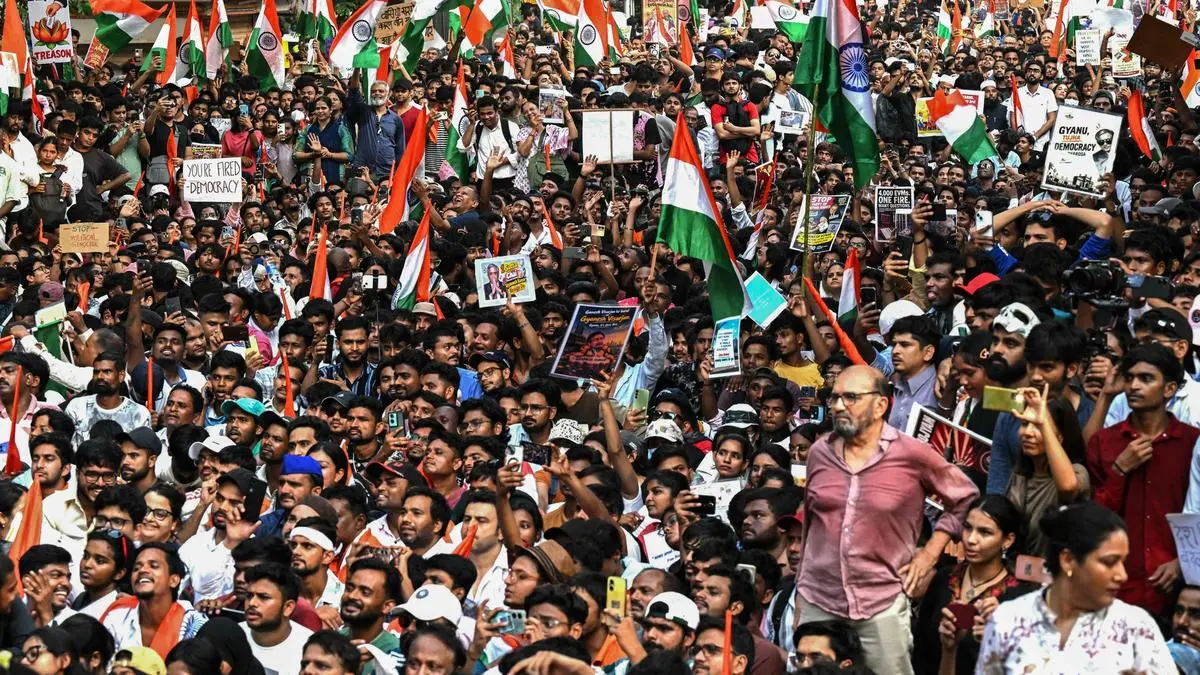
Mumbai Protest Demands Gyanesh Kumar’s Resignation Over SIR
14 hours ago
 India
India
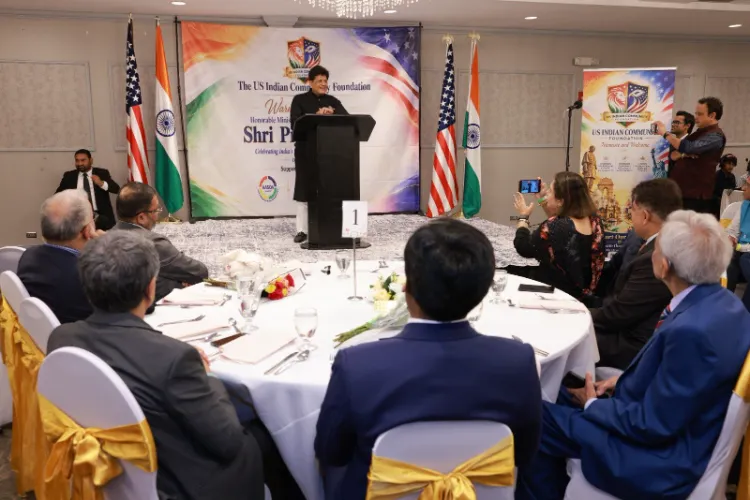
Piyush Goyal seeks deeper trade ties with US diaspora
15 hours ago
 India
India
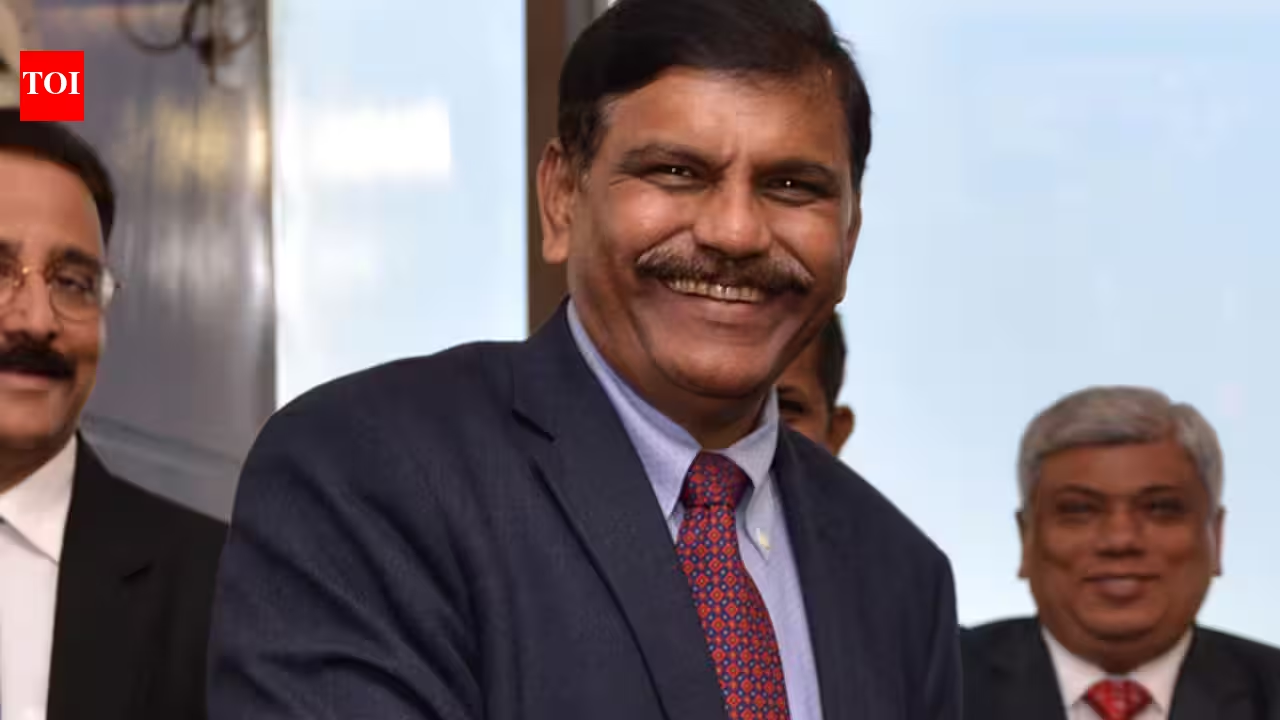
Former CBI Director M Nageshwar Rao enters politics, takes charge as Sarvajana Sanatan Party national pre
16 hours ago
 India
India
Statehood resolution, a political gimmick to hi…
19 hours ago
 India
India
Piyush Goyal urges US diaspora to deepen trade ties
19 hours ago
 India
India
Former CBI Director M. Nageshwar Rao enters active politics, elected National President of the Sarvajana Sanatan Party
20 hours ago