
News
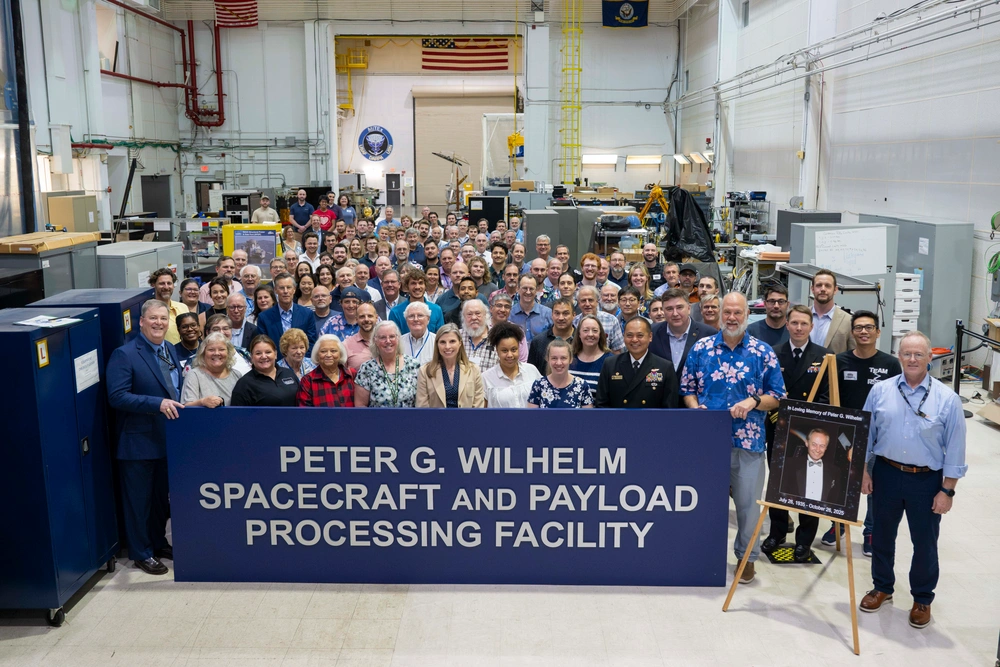
Spacecraft and mission systems designed and engineered at the U.S. Naval Research Laboratory’s (NRL) Naval Center for Space Technology (NCST) deliver tactical advantages to the nation’s warfighters. Established Oct. 1, 1986, to consolidate NRL’s space expertise, NCST marks its 40th anniversary as the Navy’s premier organization for pioneering national security space systems.
Throughout its seven-decade history in space science, NRL has designed, developed, integrated and operated more than 100 satellites and payloads. Today, this legacy continues through NCST, which for over four decades has delivered critical capabilities for the Navy, Department of War (DoW), and the intelligence community to secure American space superiority while driving global economic infrastructure.
The innovators at NCST continue to operate under their unofficial maxim: "To Boldly Fly What Has Never Been Flown Before."
"NCST develops technologies that yield asymmetric advantages directly to our warfighters," said NRL Commanding Officer, Capt. Randy Cruz. "We prototype and deliver these systems for the Sailors, Marines, and joint forces deployed worldwide. Whether it’s developments in secure communications, precision navigation, or maritime domain awareness, these technologies translate directly into Fleet readiness."
Bernard Kelm, acting NCST director and concurrent Spacecraft Engineering Division superintendent, and Linda Thomas, Ph.D., Space Systems Development Division superintendent, lead the center’s development of next-generation of resilient space technologies, software, robotic satellite servicing and advanced secure communications.
From Vanguard to the Birth of NASA NRL’s space legacy began decades before NCST’s formal establishment. Founded in 1923, NRL served as the Navy’s sole in-house organization with full responsibility for advancing naval radio capabilities.
In the late 1920s, NRL physicist Edward O. Hulburt, Ph.D., corresponded with rocket pioneer Robert Goddard to propose using liquid-fueled rockets for upper-atmospheric science. Following World War II, NRL scientists used captured German V-2 rockets to record the first images of Earth from space and detect solar X-rays. By 1949, NRL sensors made the first definitive detection of solar X-rays, proving that solar flares cause ionospheric disturbances and high-frequency radio blackouts.
In the 1950s NRL’s Viking sounding rocket program introduced pivotal engineering innovations, including gimbaled engines, and demonstrated the operational feasibility of shipborne launches from the deck of USS Norton Sound (AVM-1). NRL launched 14 Viking rockets between 1949 and 1957, continuously refining methods for orbital tracking, telemetry and structural design.
In 1955 NRL was selected to execute Project Vanguard, the nation's first official satellite program for the International Geophysical Year. Led by John Hagen, Ph.D., the NRL team launched Vanguard I on March 17, 1958. Introducing solar-powered payloads and transistorized electronics to spaceflight, Vanguard I remains the oldest human-made object in orbit.
To establish a civilian space program, President Eisenhower transferred approximately 200 space scientists and engineers, including the NRL Vanguard team and its global satellite-tracking network, in October 1958 to form the technical foundation of NASA’s Goddard Space Flight Center.
"Our Vanguard heritage established NRL's position in space research," said NRL Director of Research, Dr. Bruce Danly. "We continuously transition basic physical sciences into operational naval capabilities and study the space environment to master it for national defense."
Cold War Space Reconnaissance & Navigational Breakthroughs Retaining a specialized technical team after the NASA transfer, NRL pioneered space-based electronic intelligence (ELINT). In June 1960, NRL launched Galactic Radiation Background (GRAB) I, the world's first operational intelligence satellite, intercepting Soviet radar emissions under direct authorization from President Eisenhower.
From 1962 to 1977, NRL developed and operated the successor Poppy program. This multi-satellite constellation tracked Soviet naval deployments across the Atlantic and Mediterranean, delivering the Navy's first space-based ocean surveillance to Fleet commanders.
During the same era, NRL revolutionized maritime navigation. In the mid-1960s, NRL engineer Roger Easton conceived passive satellite ranging. NRL validated the concept through the TIMATION program, launching TIMATION I (1967) and TIMATION II (1969). In 1977, NRL launched Navigation Technology Satellite 2 (NTS-2), which carried the first orbiting cesium atomic clocks and broadcast the precise pseudorandom noise signal architecture used by the Global Positioning System (GPS).
The breakthrough earned the NRL team the Robert J. Collier Trophy in 1992, recognizing the system as the most significant development in navigation since the invention of radio.
Institutionalizing Space Engineering By the early 1980s, the Navy recognized the need to consolidate its space research, engineering and acquisition support. On Oct. 1, 1986, the [then] Department of Defense officially designated NRL's space directorate as the NCST under its first director, Peter Wilhelm. Under his 50-year tenure, the center institutionalized rigorous end-to-end testing and rapid prototyping and fielded multiple impactful systems. Highlights include:
The Strategic Shift: From Hardware to C4ISR Data In the post-Cold War era, the strategic landscape shifted. While maintaining its core competency in spacecraft engineering, NCST evolved its mission to focus heavily on how space-derived data is integrated, protected and delivered to the tactical warfighter. This "sensor-to-shooter” delivery, which led to the development of advanced Command, Control, Communications, Computers, Intelligence, Surveillance and Reconnaissance (C4ISR) data systems. NRL engineers pioneered Tactical Receive Equipment and the Improved Data Modem, funneling reconnaissance data directly to aircraft cockpits and ground units.
"Our engineers and scientists thrive on tackling the impossible," Kelm said. "As we look to the next 40 years, the challenges in the space domain are becoming increasingly complex, with near-peer adversaries contesting our dominance. But the culture at NCST remains unchanged. We live to design, build and fly the first-of-its-kind solutions our nation needs faster and more reliably than anyone else."
In 2011, NRL launched TacSat-4, its 100th successful satellite, placing a dedicated 10-channel Ultra High Frequency communications package into a highly elliptical orbit to cover tactical users in rugged terrain without requiring antenna repointing.
For maritime operations, the center integrates hyperspectral sensors and automated data-fusion tools to track shipping, detect illicit activity and maintain maritime domain awareness across vast ocean regions.
Boldly Flying Forward As the Navy’s self-sufficient engine for long-range exploration, NCST pioneers national security space systems that advance the boundaries of American space power.
Operating under a Working Capital Fund model, NCST receives no direct congressional appropriations; instead, it competes for sponsorship by delivering mission-critical capabilities directly to naval, DoW, and intelligence community customers.
NCST maintains specialized facilities to design, build, test, and operate spacecraft in-house, including the "Big Blue" thermal-vacuum chamber**,** cleanroom high bays, and the automated Blossom Point Tracking Facility in Maryland.
As NCST innovators continue to “boldly fly” into the future, they carry forward a legacy of trailblazing space research that pushes the boundaries of physics and engineering.
Recently, the Robotic Servicing of Geosynchronous Satellite (RSGS) payload, designed and developed by NCST under Defense Advanced Research Projects Agency (DARPA) funding, successfully launched into orbit as the first privately owned, operational robotic in-space servicing mission that extends the life and resilience of satellites in geosynchronous orbit (GEO) through on-orbit servicing.
“From the pioneering rocket soundings of the 1940s to the creation of GPS and modern tactical constellations, the Naval Center for Space Technology has built the modern world and safeguarded national security,” Kelm said. “As it celebrates 40 years of official excellence, the center stands ready to guide the Navy and the nation through the next frontier of the Space Age.”
About the U.S. Naval Research Laboratory NRL is a scientific and engineering command dedicated to research that drives innovative advances for the U.S. Navy and Marine Corps from the seafloor to space and in the information domain. NRL, located in Washington, D.C. with major field sites in Stennis Space Center, Mississippi; Key West, Florida; Monterey, and California.
NRL offers several mechanisms for collaborating with the broader scientific community, within and outside of the Federal government. These include Cooperative Research and Development Agreements (CRADAs), LP-CRADAs, Educational Partnership Agreements, agreements under the authority of 10 USC 4892, licensing agreements, FAR contracts, and other applicable agreements. For more information, contact NRL Corporate Communications at mailto:NRLPAO@us.navy.mil.
Related Stories
 Technology
Atlanta Built MarTech Giants. Is It Still a Powerhouse?
27 minutes ago
 Technology
New technology helps emergency vehicles from crashing
28 minutes ago
 Technology
REG - Bytes Technology Grp
1 hour ago
 Technology
Documenting the tech worker movement
1 hour ago
 Technology
How Technology Is Expanding the Possibilities of Aging at Home
2 hours ago
 Technology
Georgia Tech And Amazon Launch Joint Science Hub
2 hours ago
 Technology
IBM’s Bob wants to move in: Agent available for on
2 hours ago
 Technology
Documenting Tech Worker Movement
3 hours ago