
NextFloat Floating Wind Pilot Clears Key Spanish Regulatory Hurdle
NextFloat Floating Wind Pilot Clears Key Spanish Regulatory Hurdle
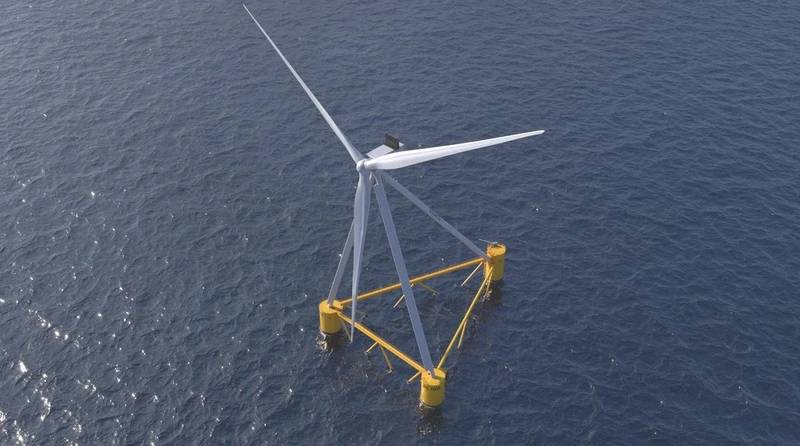
Rendering of X1 Wind's X100 8.5 MW floating wind platform to be deployed in PlemCat, Catalonia, Spain (Credit: X1 Wind)
The PlemCat floating offshore wind test site in the Spanish Mediterranean has secured a favorable Environmental Impact Assessment (EIA), clearing a key regulatory hurdle for deployment of X1 Wind's 8.5 MW X100 platform under the NextFloat project.
The approval was officially published in Spain's Boletín Oficial del Estado on July 8 and covers the PlemCat test site, located within the LEBA 1 commercial area.
The environmental assessment was carried out under the criteria of Spain's Ministry for the Ecological Transition and the Demographic Challenge. The EIA is a prerequisite for offshore wind installations in Spanish waters and for advancing toward occupation of the Maritime-Terrestrial Public Domain.
The NextFloat project, led by Technip Energies and X1 Wind, plans to deploy X1 Wind's first commercial-scale floating wind platform at the site.
The X100 combines a tension-leg platform mooring system with a tripod-shaped floating structure. Its vertical mooring lines reduce the seabed footprint compared with traditional catenary lines, while the absence of chains and use of vertically tensioned synthetic mooring lines avoid seabed dragging and minimize underwater noise.
The platform is designed for turbines with a 160-meter rotor diameter and has a primary steel weight of 1,500 tonnes. X1 Wind estimates this represents a weight saving of 30% to 50% compared with traditional steel floaters installed in European pre-commercial projects of a similar scale.
The X100 will feature a downwind turbine with a 160-meter rotor diameter and 8.5 MW nameplate capacity. The pilot is planned to operate in offshore conditions for several years, generating data to support final prototype certification and commercial-scale deployment.
The project is also intended to support commercialization of X1 Wind's X150 platform, designed for turbines of more than 20 MW.
The environmental approval follows a recent technical milestone for the X100, which received a Statement of Compliance for Basic Design from DNV. The assessment confirmed that the design meets international safety, engineering and technical requirements.
“Obtaining the EIA for the PlemCat site is a key achievement for the NextFloat project. Coupled with our recent achievement of DNV’s Basic Design Certification, it demonstrates that our technology is safe, environmentally responsible, and ready for deployment. This brings us one massive step closer to making floating offshore wind cost-competitive globally,” said Alex Raventós, CEO & Co-founder of X1 Wind.
“Securing this environmental approval is a testimony to the collaborative effort of all our partners and highlights the minimal environmental footprint of this innovative platform. We are now in a strong position to advance through the remaining financial close phase toward our commercial scale pilot deployment in the Mediterranean Sea, paving the way for a future of low-cost floating offshore wind,” added Jacques Vendé, NextFloat Project Manager at Technip Energies.
The initiative is supported by private capital, the EU-funded NextFloat and NextFloat+ projects, the PAREF project funded by the French state under France 2030 and operated by ADEME, and the Spanish government's RenMarinas program.
Related Stories
 Technology
South Korea's Atomic NEST Demo Day Set for Nov. 4, Spanning Nuclear Plant Maintenance to Space Propulsion
2 hours ago
 Technology
Waterloo Region lands in North American tech top 10: CBRE report
3 hours ago
 Technology
Utah Tech University receives National Institutes of Health flagship research grant
4 hours ago
 Technology
2 Utah dads create tech to protect children, shield investigators from traumatic evidence
4 hours ago
 Technology
Hunter First to Trial Tech to Avoid Adamstown Crossing Delays
5 hours ago
 Technology
Wittgenstein Was Wrong: Artificial Superintelligence and the Return of the Ghost
7 hours ago
 Technology
UQ Technology Opens New Front in Neurodegenerative Drug Discovery
9 hours ago
 Technology
Hokies handle Georgia Tech, 34
10 hours ago