
'No happy medium': Cape Breton farms adapt to weather extremes
'No happy medium': Cape Breton farms adapt to weather extremes
Farmers deal with effects of wet, cold spring after last summer’s drought
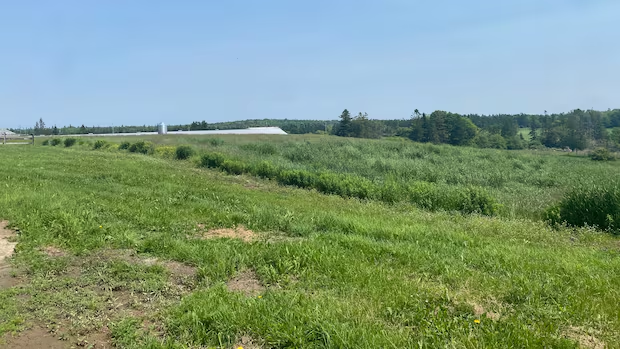
Lorne Quinn has run Quinn’s U-Pick in Millville, N.S., since 1988. While he is no stranger to changing weather, he says recent patterns have become unpredictable.
During last summer’s drought, his crop yields plummeted 40 per cent. This spring brought the exact opposite — relentless rain and overcast skies that starved his strawberries and pumpkins of sunlight.
“The berries don’t react unless the temperature is above 15 C,” Quinn said. “They are very slow-forming, so we're behind at least 10 days.”
The weather stress caused the farm to miss its traditional Canada Day opening.
“It’s either too hot, too dry, too wet or too cold," Quinn said. "There's no happy medium anymore."
Cold, wet spring delays start of Nova Scotia strawberry season
Drought causing worry for homeowners, rural firefighters in Cape Breton
Paul Eyking of Eyking Family Farms says extreme weather cycles that used to occur five to 10 years apart are now happening back-to-back.
While cold-loving crops like cabbage and rhubarb are thriving, smaller plants like beans are falling behind. Furthermore, waterlogged soil has made field maintenance highly erratic, forcing Eyking to adjust crew hours constantly.
To adapt, the farm scaled back its total crop volume and invested in high-tech solutions, including tractor satellite trackers to pinpoint field maintenance needs.
"This equipment is quite expensive, but implementing technology is where I see the future," Eyking said.
Other Cape Breton growers are moving away from traditional crop dependency altogether.
Will Kosloski and his partner, Terry, relocated from British Columbia to Judique, N.S., in 2017 to build an ecologically and economically viable operation. At Twisted Roots Farm, they have diversified into agritourism and education.
Cape Breton farms get creative to bring in business
To generate a steady income regardless of the weather, they offer goat walks across their 30-hectare property and host workshops on homesteading skills, such as making soap and body butter.
“We knew this was going to happen,” Kosloski said of the changing climate. “But the actual impact of feeling it and seeing it is certainly worrisome.”
Summer brings a slower pace for N.S. political parties, but challenges lurk
Man turns licence plates into Cape Breton attraction
Middleton man, 47, dead after motorcycle crash
'Clean up your own mess': Enfield park pulls garbage bins to deter dumpers
Smart glasses expose a gap in Canadian privacy laws
Ethan Hunt is a reporter for CBC Nova Scotia from Lunenburg, N.S. He regularly covers sports, the environment and mental health matters. You can reach him at ethan.hunt@cbc.ca.
Related Stories
 Technology
Quebec engineer testing technology to solve algae problem in lakes
1 hour ago
 Technology
Second US port to explore nuclear maritime technologies
3 hours ago
 Technology
Abu Dhabi DoE expands tech partnerships during US visit
9 hours ago
 Technology
MIT Indias IRS 2026 Brings 100+ Startups and 100+ Student Teams Together, Advancing Innovation, Entrepreneurship and Industry
11 hours ago
 Technology
Liverpool, Telangana explore strategic partnership in life sciences, tech, sports | World News
13 hours ago
 Technology
Crowdstrike, T
13 hours ago
 Technology
Could these alternative homes be the future in a hotter Britain?
15 hours ago
 Technology
Cyprus Business Now: shipping forum, fuel prices, GSI, travelling, startups, CSE
16 hours ago