
No longer taboo, Canada's defence industry steps into Europe's spotlight

No longer taboo, Canada's defence industry steps into Europe's spotlight
Fearing trade friction with U.S., Ottawa makes unprecedented arms push into Europe
The future of warfare is on sale in Poland this week, wrapped in a bright red Canadian maple leaf.
For the first time, Canada is the "lead nation" at a major European defence trade fair, known as MSPO, in Kielce, Poland. It's bringing together more than 230 companies and associations at the exhibition’s Canada Pavillion.
The nation’s oversized presence is framed by red and white banners bearing the Government of Canada logo and punctuated by the occasional sound of military bagpipers for added ambience.
Europe is rearming, mobilizing up to 800 billion euros ($1.3 billion Cdn) for defence over the next three years.
Canada was prepared to send ships to Iraq in 2003 if UN approved action, records show
Trump to Canadian plane maker Bombardier: You can't sell in U.S. unless you build in U.S.
One of the pillars of that initiative is known as SAFE, or Security Action for Europe. Canada is the only non-European nation invited to participate, allowing it to bid on European defence contracts as it pledges ongoing support for Ukraine’s defence industrial base.
Charles Barlow, the CEO of Ottawa-based Robotics Centre, says he has been staggered by the change in Canada’s positioning and its sudden eagerness to embrace industries that were shunned only a couple of years ago.
"Defence was a dirty word. [Federal] trade commissioners wouldn’t help," said Barlow during an interview at his booth at the trade fair.
Canada takes the lead at international defence expo
But a trade war with the United States and Canada's push to diversify its key industries away from its largest trading partner has dramatically altered the landscape.
"It's a very big breakthrough as we extend our reach into Europe," said Defence Minister David McGuinty, who was in Kielce on Tuesday to officially kick off the event.
"We are diversifying, we are taking our next steps, we are open to serious negotiation with the United States, but right now this is about our communities, it's about our workers and it's about giving rise to an expanded and greater energy when it comes to our defence sector," he said.
Several Canadian exhibitors told CBC News they would not have been able to make the trip to Poland without financial help provided by the Carney government.
Now that the taboo on financing, marketing and publicly advocating for defence tech has faded away, the industry is trying to quickly pivot to take advantage.
Barlow’s company, which makes small drones and quad copters, has literally taken off in the last year, thanks in part to new deals with European customers.
It's about to move from its current headquarters near Lansdowne Park in Ottawa to a new 32,000-square-foot facility in Kanata.
"A year ago, we were 15 people. Today, we're 56," he said.
One reason for the success of his quadcopters is the innovative use of unconventional materials initially demanded by Canada’s Department of Defence that is now attracting interest elsewhere.
"We've actually manufactured [the drone body] out of plywood. It flies just as well as the carbon-fibre version, which surprised all of us," Barlow said.
Other components — such as a camera, guidance system and the payload — are easily snapped onto the lightweight frame.
Government figures suggest Canada’s defence industry contributes $10 billion to the country’s economy and supports more than 81,000 jobs. The government’s new Defence Industrial Strategy aims to create more than 125,000 new jobs over the next decade.
Red and white banners and maple leaves may help with branding, but cracking the European market is fraught with significant challenges.
"It's a hard market," said Christyn Cianfarani, CEO of the Canadian Defence and Security Industries Association (CADSI). "A lot of the companies in the [Canada] pavilion are small- to medium-sized businesses. It's very hard for a small business to sell directly to a very large government."
Carney touts increasing defence spending as Trump threatens Greenland at NATO summit
She says government help is often essential. For example, if Canada buys something from a European nation and a Canadian company gets involved in the deal, it thereby becomes part of European supply chains.
"Canada recently announced it is going to make a purchase of submarines and the Germans have committed to pulling Canadian firms, Canadian companies, into their supply chains — that's a great way to do it," Cianfarani said.
But Cianfarani says the gravitational pull of the United States — far and away the world’s largest defence spender — remains strong.
"Pivoting from the United States, where it's over 50 per cent of our market share, is not an easy pivot for Canadian business. The U.S. is close, it's in the same time zone and our relationship under NORAD has given us privileges."
David Lord of Zeal Motor, based in Bromont, Que., is among those in Poland trying to navigate that huge leap this week.
His company makes enormous all-terrain vehicles, known as Fat Trucks. With giant buoyant rubber wheels and a flexible chassis, these trucks are highly equipped for Arctic conditions and conducting search and rescue operations in challenging terrain.
Lord says he’s had buyers in Canada, the United States and Great Britain, but the company now has its sights set on Europe, which is proving to be as hard a slog as some of the terrain the Fat Trucks move through.
One of the biggest challenges, he says, is simply showing the vehicle to would-be buyers.
"If you're selling software [to Europe], it's easy. But here, you've got to carry a piece of equipment that's 21,000 pounds across [the ocean]. It is a lot of investment."
"There's nothing like experiencing driving it and conquering terrain, and that's where we're trying to go right now," said Lord.
Beyond the steep shipping costs and logistical hurdles, Canadian companies are landing in a European market that has been fundamentally rewired by the war in Ukraine.
The conflict has shattered decades of peacetime complacency, forcing European militaries to realize that the old, agonizingly slow ways of buying weapons no longer work.
For Canadian firms to succeed here, they have to match a continent moving at lightning speed.
"The procurement system for everybody is changing very quickly, especially for equipment that is rapidly iterating," said Barlow, the Ottawa drone manufacturer.
"It's not like the old days when you could sit down, design a ship, start building it and take it into service eight years after you conceived of it. Now, we have to get it out within eight months. And that speed is actually accelerating."
For companies like Robotics Centre, competing against heavily subsidized European rivals on their own turf is the new, high-stakes normal.
"That's the environment that we're living in right now," Barlow said.
Chris Brown is a foreign correspondent based in the CBC’s London bureau. Previously in Moscow, Chris has a passion for great stories and has travelled all over Canada and the world to find them.
Related Stories
 Canada
Man whose 16 grandchildren found living in filthy conditions is found incompetent to stand trial
42 minutes ago
 Canada
Canadian citizenship certificate applications now facing nearly 3
43 minutes ago
 Canada
The U.S. is considering a federal tax incentive for films. How might that affect Canada?
43 minutes ago
 Canada
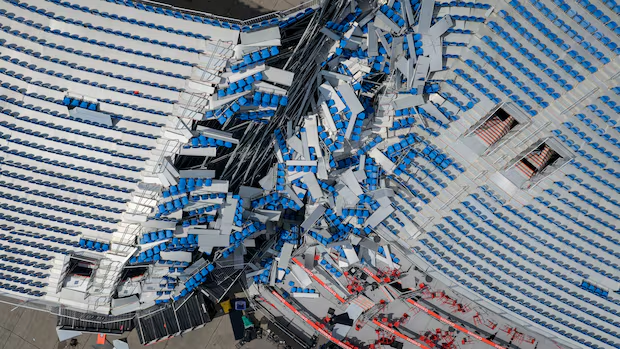
AC/DC concert at Rogers Stadium cancelled due to 'severe' storm damage: Live Nation
1 hour ago
 Canada
Dairy, liquor, motorcycles among Canadian goods facing U.S. ban
1 hour ago
 Canada
News of the day: Buffalo Bills seemingly wade into ongoing Canada
1 hour ago
 Canada
Ontario’s alcohol industry bracing for U.S. import ban after early trade war gains
1 hour ago
 Canada
Canada didn’t choose or escalate trade conflict with U.S., Champagne says
1 hour ago