
Nvidia announces AI
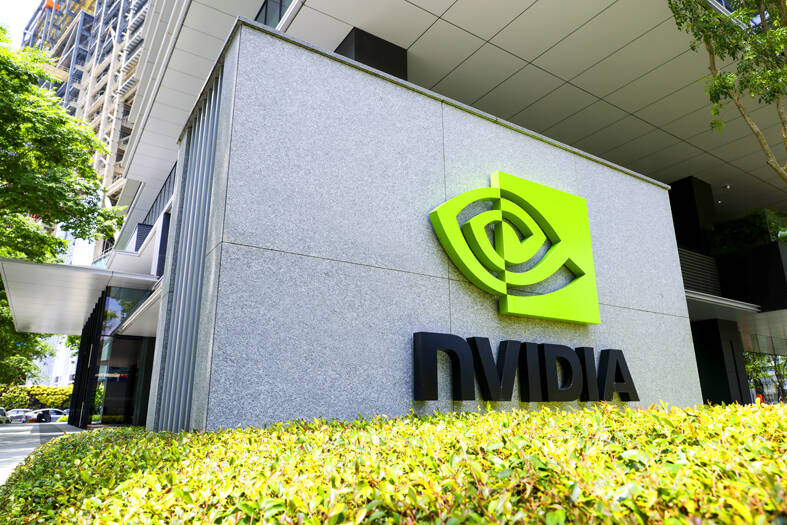
HAND-IN-HAND: Nvidia’s inability to hold the line on prices reflects how much leverage memorychip makers have amid the surge in demand for AI infrastructure
Some of Nvidia Corp’s biggest customers have been told that the prices of servers containing its artificial intelligence (AI) chips are going up more than 15 percent in many cases with memory costs soaring.
The price hikes would go into effect on systems shipped early next year and impact systems including those with the flagship Vera Rubin and Grace Blackwell chips, people familiar with the process said on condition of anonymity.
The increases would depend on the generation of Nvidia chips and the memory configurations, they said.
The logo of Nvidia outside the corporation’s headquarters in Taipei is pictured on May 20.
Companies who build the servers under contract for large data center operators such as Microsoft Corp, Alphabet Inc’s Google and Oracle Corp have notified their customers of the forthcoming increases, the people said.
The inability of the industry’s most dominant company to hold the line on prices or absorb rising costs shows how much leverage makers of memory chips — Samsung Electronics Co, SK Hynix Inc and Micron Technology Inc — have amid a surge in demand for AI infrastructure.
Major technology companies including Apple Inc and Qualcomm Inc have said they have been forced to charge more for their products because of chip shortages.
Nvidia’s accelerator processors are the heart of computers that create and run AI software. Their effectiveness depends on how much DRAM they are paired with. The two South Korean companies and Micron account for most of the world’s production of that type of chip. While they have been increasing output, they still have not caught up with surging demand.
Nvidia is one of the most profitable companies in semiconductors. It is able to charge tens of thousands of dollars per chip because supply — from contract manufacturer Taiwan Semiconductor Manufacturing Co (台積電) — still cannot meet runaway demand.
Nvidia has also raised prices for its gaming-oriented PC graphics cards, Tom’s Hardware reported earlier this month.
How Nvidia’s customers react to the move and whether it would create an opening for its competitors would likely depend on whether they are able to secure enough memory themselves.
Major customers such as Amazon, Microsoft, Google and Meta are all pursuing their own in-house chip programs, but are still dependent on purchases from Nvidia for their data center build-outs. Their ability to push forward with greater independence would also depend on their access to supply from Samsung, SK Hynix and Micron.
The price increases are also likely to add complexity to the industry’s massive AI data center build-out ambitions. Project delays, labor shortages, tightening capital markets and community resistance to developments have already complicated many plans.
Related Stories
 AI News
Startup news and updates: daily roundup (October 9, 2026)
22 minutes ago
 AI News
Lessons from Leo: University of Scranton
23 minutes ago
 AI News
New study ranks how well AI tools help shoppers hunt for deals | Action on AI
23 minutes ago
 AI News
Artificial intelligence: Risk management actuaries need to work across business units
23 minutes ago
 AI News
Monte Carlo Capital raises €13 million for Fund II to invest in early-stage DeepTech, AI and SpaceTech
1 hour ago
 AI News
Anthropic bans 'cruel' behaviour against its Claude AI
1 hour ago
 AI News
Digital detox how
1 hour ago
 AI News
OpenAI researchers say they were fired over safety warnings. The company denies it.
1 hour ago