
Nvidia bets on AI personal computers with new chip powering Windows laptops
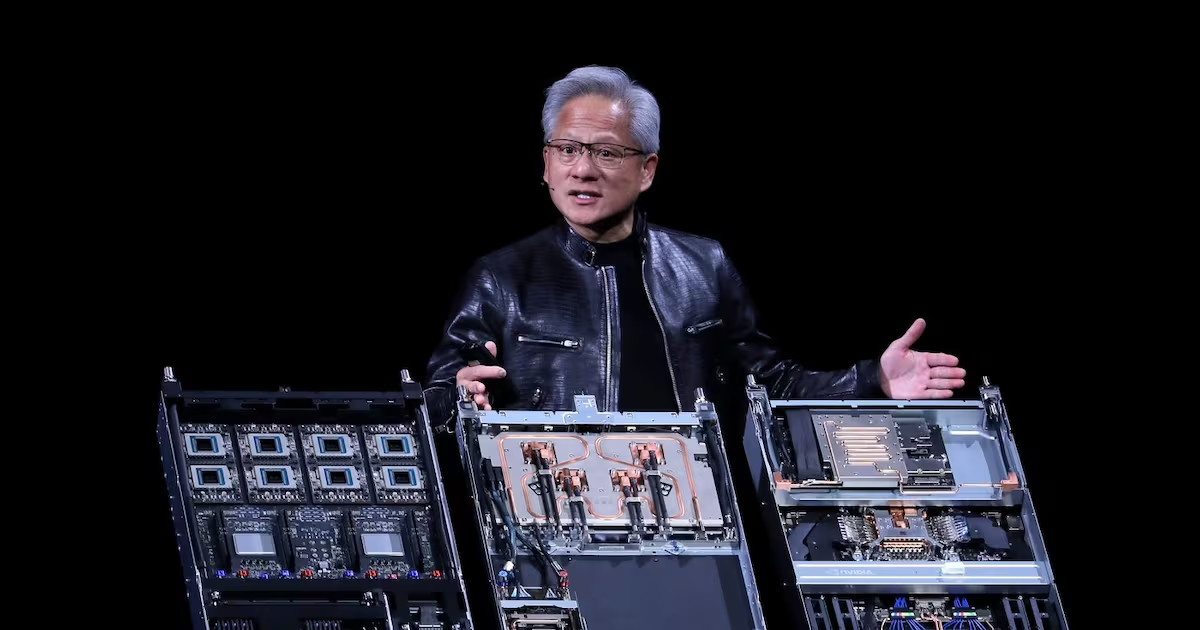
TAIPEI, Taiwan — Nvidia unveiled Monday new powerful chips that would bring advanced artificial intelligence functions into laptops and desktop computers, with the new personal computer models from brands including Microsoft and Dell set to roll out later this year.
While Santa Clara, California-based Nvidia has already been massively successful in supplying high-end chips for data centers riding the worldwide AI demand boom, it is plotting different plans to expand its presence across AI systems and products.
Jensen Huang, the Taiwanese-American founder and CEO of Nvidia, made the announcement in Taipei at the annual Nvidia GTC event. Microsoft and Nvidia “are going to reinvent the PC (personal computer),” he said in his keynote speech.
“This is going to be the new PC,” Huang said as he unveiled Nvidia’s RTX Spark superchip — which combines CPU, or central processing unit, and GPU, or graphics processing unit, capabilities — that would power new Windows laptop and desktop computer models in what the company called “AI personal computers,” expected to debut in the fall of this year.
Nvidia is already the world’s most valuable company, ahead of Apple, Google’s parent Alphabet and Microsoft.
The company said it will be “reinventing the personal computer” for creating and gaming. “When it has an autonomous (AI) agent, an agent that’s helping you, that understands you, you could talk to it. It could look at you. You could ask it to read files, go help you do some research. It could do a lot more,” Huang said.
Microsoft said in a separate statement that the personal computers running on Nvidia’s RTX superchips would be able to support “highly capable AI models” and complex workloads. With the new superchips, these personal computers can run AI agents locally, Nvidia said.
Nvidia’s move is significant at a time when demand is growing for the use of personal AI agents, said Lian Jye Su, chief analyst at the technology research and advisory group Omdia.
“For consumers, it means more choices, which is always a good thing,” Su said.
Neil Shah, analyst and co-founder of Counterpoint Research, described Nvidia’s announcement as a move that’s “revolutionizing how PCs would look like in the next 10 years.”
The new laptops and desktop computers “will drive agentic AI applications in every home,” Shah said, with an aim of having an “AI supercomputer” in each household.
Also during Monday’s speech, Nvidia’s Huang said its new Vera CPUs for data centers are in full production and are “going to be our new major growth driver” on the boom of AI agents, with early customers expected to include Anthropic, OpenAI and SpaceXAI. He also revealed a humanoid robot reference design that could act as a blueprint for future research, especially within the higher education sector.
Chan Ho-him And Taijing Wu, The Associated Press
Related Stories
 AI News
Artificial intelligence enters medicine
1 minute ago
 AI News
Ukraine war briefing: Drones strike Russia’s Tyumen oil refinery 2,000km away, says Zelenskyy
56 minutes ago
 AI News
Colombia’s runoff election expected to trigger shift in decades
56 minutes ago
 AI News
Public event held to promote ban of smartphones
56 minutes ago
 AI News
Flags to be flown ahead of Armed Forces Day
56 minutes ago
 AI News
Election candidates reflect on negative social media
56 minutes ago
 AI News
'Two Lads' stone monuments on moors to be rebuilt
56 minutes ago
 AI News
Libraries to open on Sundays again after 15 years
56 minutes ago