
Officials say mediators are still working with Iran and the US on a possible deal
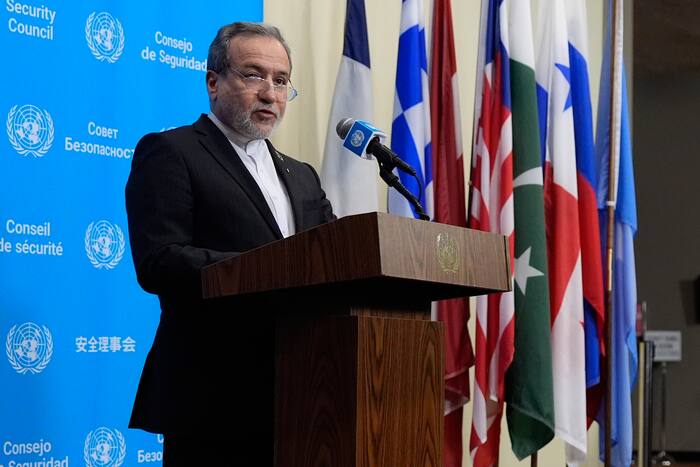
CAIRO – Three officials tell The Associated Press that mediators were still working with Iran and the United States on a deal to end the fighting and open the Strait of Hormuz, with the indirect talks expected to resume on Monday.
The details were revealed as the war enters its eighth month after causing widespread economic suffering. Multiple efforts to allow safe shipping on one of the world's most crucial waterways have failed.
There was uncertainty over the weekend after President Donald Trumptold journalists he had rejected Tehran’s latest proposal to reopen the strait in a week if the U.S. lifts its blockade of Iranian ports, releases frozen Iranian assets and waives sanctions on Iranian oil sales, among other conditions.
Iran’s foreign minister, however, remained in New York and said he awaited word from mediators. Qatar has been mediating.
The deal would first reopen the strait and lift the US blockade
Two of the officials speaking to the AP on Monday confirmed that mediators are working with both sides on a proposal that would include reopening the strait and lifting the U.S. blockade, and then removing sanctions.
According to the draft text being discussed, the strait would reopen in accordance with a separate deal that Iran has been discussing with Oman, on the other side of the strait, and it would include no tolls — something Tehran has pursued. That deal seeks to temporarily manage shipping traffic on what was seen as an international waterway before the war.
The two officials also said that despite Trump’s public comments, the U.S. has not officially rejected the current proposal, indicating that his remarks may have been a negotiating tactic.
The third official said the U.S is seeking Iranian concessions on its nuclear program, including allowing inspectors to enter the country. Under the Memorandum of Understanding the two sides signed in June that collapsed within days, Iran's nuclear program was meant to be discussed over a 60-day period.
All three officials spoke on condition of anonymity to discuss behind-the-scenes diplomatic negotiations.
One official reported positive signals coming from both sides. A second reported “slight progress” over the weekend. The third said mediators are still trying “to soften” the positions of both sides.
The White House did not immediately respond to a request for comment.
Iran's latest proposal has sought a faster timeline
While Iran’s latest proposal echoes the June deal, a key difference is speed.
Foreign Minister Abbas Araghchi told a closed-door meeting on the sidelines of the U.N. General Assembly last week that Tehran had pitched the deal as benefiting Trump in the midterm elections. Araghchi later told journalists that “the seven-day timeline will start as soon as the United States accepts this plan.”
Both the U.S. and Iran have been hurting economically — the U.S. from high oil prices as Iran attacks ships on the strait, and Tehran from the naval blockade and a growing number of U.S. sanctions that bottle up its oil sales. Brent crude, the international standard, is above $108.
For months, the two sides have been trying to outlast the other, while regional countries put up with missile and drone attacks as Tehran claims to target U.S. military assets in the region.
Reflecting Iran's impatience, a rare statement on Monday attributed to the theocracy's Supreme Leader Ayatollah Mojtaba Khamenei noted the “painful blows” that enemy forces have received near the strait. “Before long, the Arabian Sea, too, will be rid of them,” the statement added.
The latest proposed deal again seeks to end the fighting on all fronts, including in Lebanon. But a new front has emerged in recent weeks as Iran-backed rebels in Yemen are now perched on another crucial waterway, the Bab el-Mandeb Strait at the southern entrance to the Red Sea. That has further pressured global markets.
Iran argues that the Houthis have their own demands, and that their conflict with neighboring Saudi Arabia is separate from the U.S.-Iran war, but Iranian officials said they are willing to help in finding a settlement between the Houthis and the Saudis, one of the officials said.
Binkley reported from Washington. Associated Press Middle East editor Victoria Eastwood contributed.
Related Stories
 World
World
Famed Japanese dramatist Kuramoto So dies at 91
53 minutes ago
 World
World
North Korea falls to Spain on penalties in U
53 minutes ago
 World
World
Bangkok floodwaters begin to ease after torrential rains affect 700,000 people
1 hour ago
 World
World
Mexico’s journalists have long faced bullets. Now lawsuits against them are rising
1 hour ago
 World
World
Russian drones pound civilian areas as Ukraine claims battlefield breakthroughs
1 hour ago
 World
World
McNulty becomes 1st American to win elite road race world title since Lance Armstrong in 1993
4 hours ago
 World
World
Wrestler Benjamin Satterley, known as 'Pac', dies aged 40
4 hours ago
 World
World
Stock car driver, 18, inspired by dad in world bid
5 hours ago