
Ontario
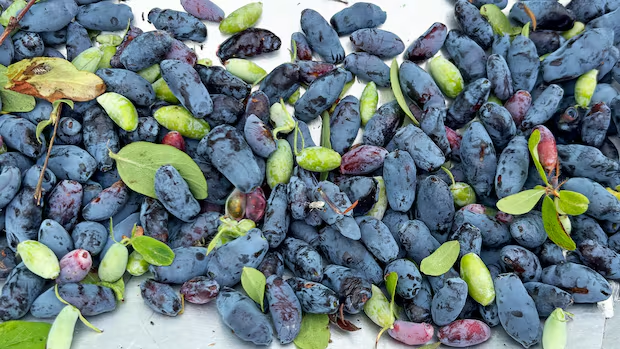
Ontario-grown haskap berry packs a flavourful punch in jams, muffins and drinks: Jasmine Mangalaseril
Despite its blueberry-like appearance, the haskap berry is in the honeysuckle family
Ontario summers are famous for locally grown strawberries, blueberries, raspberries, and even gooseberries.
But have you heard of the haskap berry?
The haskap berry, more at home in peaty soils of boreal forests across much of Canada (as well as parts of Europe and Asia), is finding fans here in southwestern Ontario.
Amy and Channing Strom, owners of Guelph’s Strom’s Farm and Bakery, are part of a handful of growers in this part of the province growing haskaps. They started growing the berry in 2014 for their bakery.
"We just thought it was an interesting taste," Amy Strom said. "It’s very high in antioxidants, what they call a super fruit."
High in vitamins, fibre, polyphenols
The indigo-coloured fruit generally looks like a three centimetre-long torpedo-shaped blueberry. Squash one and magenta juice flows. Many think it tastes like blueberry and raspberry (personally, I taste blueberry, green grape and green tea leaf).
The Haskap Canada Association based in Quebec says haskap berries are jam-packed with anthocyanins, polyphenols, vitamins, fibre and potassium. The association says each of those compounds have different types of health benefits.
While they resemble blueberries, they are part of the honeysuckle family: in some areas they are called honeyberries or blue honeysuckle.
Here in Canada, they’re called haskaps, a name derived from hasukappu meaning "little presents on the end of branches" in the Indigenous Ainu language of Japan.
Berry extracts as health supplements?
The Stroms picked six different early-season varieties and planted roughly 500 bushes on a quarter-hectare patch.
Bumblebees sourced through the University of Guelph’s Bee Research Centre pollinate the bushes in April.
Cedar waxwings appear a few weeks before harvest, signalling time to cover the patch in netting to keep the crop from winged raiders.
The Stroms harvest the berries by hand and freeze them immediately because otherwise, they turn to mush quickly.
Finding them fresh, frozen, and more
Guelph cookbook author Emily Richards said the berries’ short harvest season — a couple of weeks or so — adds to their allure.
"I kept going back to the market because I was like, 'I need this' and then they're gone … I think that's kind of the uniqueness, that mysterious part of a haskap because they don't have that long season," said Richards.
While fresh haskaps can be hard to find, producers often have products like preserves and drinks available.
When the Strom’s Market opens in September, haskaps are featured in pies, butter tarts, and marshmallows, as well as jams and vinaigrettes. Tubs of frozen berries will also be available.
Richards has been creating haskap recipes using frozen berries, jams and vinaigrettes. She’ll be demonstrating the dishes at the Stroms’ annual haskap festival in September.
"Being able to use frozen products is a great substitute [for fresh] but having the jam and the vinaigrette really helps showcase the flavour in a different way and it's also more accessible throughout the year," said Richards
She said if you are new to haskaps, start with sweet recipes and substitute them for blueberries.
"Smoothies, muffins, cakes, anything like that. Jams, jellies … I think that's a great introduction for haskaps, especially for those that have not experienced the flavour on their own," said Richards.
"The next step is playing around or getting creative, jumping into the savoury side."
Haskap, a nutritious berry, trends across Saskatchewan
Haskap berry catching on with Yukon growers
P.E.I. U-picks attract curious customers with haskap berry
Haskap 'super fruit' taking root in New Brunswick
On the savoury side, haskaps can be used in relishes and sauces for smoked meats, in oven roasted vegetable tray bakes, or even as contrast to rich, creamy cheeses.
"There's that complexity … when you incorporate a little bit of salt or heat and it really works well in the savoury element," said Richards.
Haskap liqueur adds 'summer flavour'
John Sleeman and Sons’ Spring Mill Distillery has producing haskap liqueur for about six years, using the Stroms ’ berries. The distillery creates one run of the jammy liqueur every year.
Spring Mill’s Ward Bar created several cocktails with it, including a cosmopolitan, a negroni and a gin mojito. They will also be demonstrating their cocktails at the September festival.
"It's just this berry essence. It's very bright, a little bit floral, almost. It’s quite an interesting flavour," said Christine Cipolla, Spring Mill's marketing co-ordinator.
"Really nice by itself. Really nice mixed with other things. It just adds this summer flavour to anything you put with it."
Add four ice cubes to a glass and strain the drink into the glass. Top it up with soda and garnish with bouquet of mint leaves and lime wedge.
CBC-KW food columnist Jasmine Mangalaseril is a Waterloo Region-based food writer and culinary historian. She talks about local food, restaurants, and the food industry, and how they affect what and how we eat. She’s on Bluesky, Mastodon, and Meta as @cardamomaddict.
Related Stories
 AI News
PREVIEW | Portugal vs Spain: team news, lineups, predictions (World Cup 06/07)
11 minutes ago
 AI News
Fireworks, heat, hot dogs and politics: America celebrates its 250th birthday
11 minutes ago
 AI News
World leaders and royals celebrate the US's 250th birthday
11 minutes ago
 AI News
America marks 250 years of independence, in photos
11 minutes ago
 AI News
Young girl critically injured after falling from apartment balcony
12 minutes ago
 AI News
Canadian men's historic World Cup run ends as Morocco wins Round of 16 match, 3
12 minutes ago
 AI News
Trans
12 minutes ago
 AI News
Morocco takes 2
12 minutes ago