
Ontario has unveiled mandatory changes for schools, starting this fall. Here's what you need to know
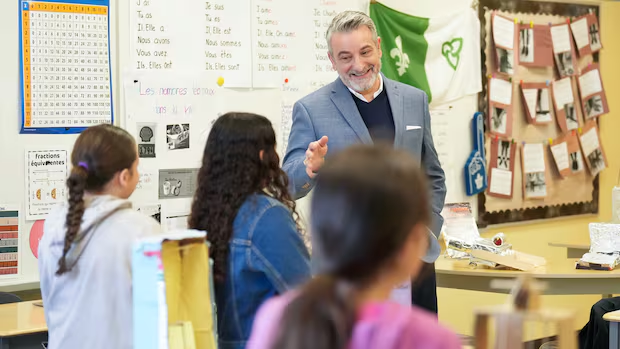
Ontario has unveiled mandatory changes for schools, starting this fall. Here's what you need to know
Province spending $60M on digital learning platform but teachers not required to use it this fall
What you need to know about Ontario's new digital learning platform coming to classrooms in the fall
Mandatory changes are coming to schools across Ontario starting in September, from attendance, participation and exams counting towards secondary school students' final grades to a digital learning platform being implemented at all school boards.
Education Minister Paul Calandra announced the changes Monday, saying the ministry has "heard constantly" from teachers that they need better control of classrooms. He says mandatory assessment standards are one way to grant teachers that control and to ensure students have grasped lessons.
To support "consistent curriculum" across the province, Ontario is also spending $60 million on a digital learning platform from Nelson Education called Edwin, Calandra said. That platform will be provided to school boards as a resource option in the new school year, but teachers will not be required to use it.
Colin Matthew, vice-president of the Ontario Secondary School Teachers' Federation, said that spending is a far cry from what teachers actually need and nowhere near enough, compared to the billions of dollars he said the Ford government has taken away from public education since 2018.
David Mastin, president of Elementary Teachers' Federation of Ontario said the announcement is just the province's way to "distract from its horrible record." He said talk of "consistency" sounds more like a corporate term and "doesn't necessarily fit" the context of education.
"It's flawed, it's dangerous and we need to resist it," he said.
Ontario education unions say teachers want change. Here's what they're asking for
New grade breakdown for high schools
According to the province's website, the breakdown for secondary school student's final marks will include the following standards:
While exams are helpful practice for students going to post-secondary schools, not all of them follow that path after graduation and may instead opt to work instead, Matthew said.
In the past, teachers could decide what final assessments looked like and how much they counted towards final grades, he said.
Ontario's colleges warn of more troubles ahead amid call for more investment
Ontario high schoolers need higher grades to get into university than ever before, data shows
"When the province tries to use a centralized standard policy in order to solve a problem that really is diverse across the province, I don't really think it gets to the heart of the matter," he said.
Matthew also said students' reasons for lack of participation and attendance are complex, often highlighting social issues that should be addressed by the province through means other than grading attendance.
Digital platform meant to save teachers time: company
Ben Higgins, vice-president of corporate strategy at Nelson Education, said Edwin was made to save teachers time, provide timely content (such as FIFA-related lessons) and create data on class progress, said
The program will allow teachers to assign students higher or lower-level grade work based on their needs, he said.
"We give the tools to the teachers so that they can meet each student where they truly are," he said.
Several teachers are already using the platform in their classrooms, said Calandra.
Calandra said data will show teachers gaps in knowledge and which students need support, as well as grant parents access to see how their child's performance compares to the class.
Why Ontario will need more than a million university grads in the next decade
But the program is an unnecessary tool for teachers who have already been doing the same work "well enough in-house" without help from a third-party, said Mastin.
He said the province should instead invest in properly staffing schools, referencing the cuts in recent months to administrative staff, vice-principals and other teaching positions.
"The province, I believe is really continuing to distract from the staffing crisis that they are in creating through their underfunding," he said.
Ontario's education unions have a united front. With tense talks ahead, will it hold?
Over 1 million university grads needed to fill labour market demands, Ontario universities report projects
While Ontario Liberal Leader John Fraser supports tools that help teachers, he said the province should instead use that funding to make schools a safe place to learn and work.
"Educators don’t have time to learn new software. To deliver the curriculum effectively, they first need smaller class sizes, greater investments in special education, and more mental health supports," he said.
Green Party Leader Mike Schreiner echoed those sentiments, adding the province should reverse cuts to education.
"The root cause of the problems in our schools is underfunding, and no digital learning platform can fix that," he said.
Arrthy Thayaparan is a Toronto-based multimedia journalist. She's interested in health, climate and community stories. She has previously worked at Reuters and CBC Vancouver. You can contact her at arrthy.thayaparan@cbc.ca.
With files from Alison Chiasson
Related Stories
 Canada
Albertans head to polls in historic referendum on whether they want to stay in Canada
17 minutes ago
 Canada
In the news today: four soldiers killed, Alberta referendum, AI privacy fears
17 minutes ago
 Canada
How a grass fire at a Canadian military base killed four soldiers
17 minutes ago
 Canada
How will household electricity rebate reduction, temporary winter pricing change impact Ontarians?
1 hour ago
 Canada
Residents told to boil tap water due to bacteria
1 hour ago
 Canada
Oil
2 hours ago
 Canada
Albertans vote on path to independence as Carney fights to keep Canada united
2 hours ago
 Canada
Two of 4 soldiers killed in fast
3 hours ago